Teleostei (teleosts) >
Eupercaria/misc (Various families in series Eupercaria) >
Labridae (Wrasses) > Hypsigenyinae
Etymology: Bodianus: Bodianus after Bodiano or Pudiano, from the Portuguese pudor, meaning modesty (Jordan & Evermann, 1896); leucosticticus: Name from the Greek leukos for “white and stiktos for spotted; referring to the row of white spots along the back of adults in life (Ref. 75973).
More on author: Bennett.
Environment: milieu / climate zone / depth range / distribution range
Ecology
Marine; reef-associated; depth range 50 - 75 m (Ref. 90102). Tropical
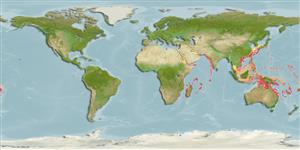
Indo-West Pacific: Somalia, Mozambique, Natal (South Africa), Mauritius, Réunion, and southern Japan. Likely at Seychelles (Ref. 1623) if Lepidaplois luteopunctatus is a synonym of Bodianus leucosticticus.
Size / Weight / Age
Maturity: Lm ? range ? - ? cm
Max length : 24.2 cm SL male/unsexed; (Ref. 13277)
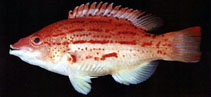
Dorsal spines (total): 12; Dorsal soft rays (total): 10; Anal spines: 3; Anal soft rays: 12. Adults reddish to purplish brown on head, body dull yellow; longitudinal row of 3 pale yellow spots along back; small black spot centered at base of caudal fin; 2 black spots on soft anal fin; large black spot on pelvic fins; blackish spot anteriorly on dorsal fin (Ref. 4392). Juveniles reddish brown with rows of white blotches and small spots; black spots on fins (Ref. 4392).
Body shape (shape guide): fusiform / normal.
Adults are usually found at moderate depths (50 m). Oviparous, distinct pairing during breeding (Ref. 205).
Life cycle and mating behavior
Maturity | Reproduction | Spawning | Eggs | Fecundity | Larvae
Oviparous, distinct pairing during breeding (Ref. 205).
Randall, J.E., 1986. Labridae. p. 683-706. In M.M. Smith and P.C. Heemstra (eds.) Smiths' sea fishes. Springer-Verlag, Berlin. (Ref. 4392)
IUCN Red List Status (Ref. 130435: Version 2025-2)
Threat to humans
Harmless
Human uses
Fisheries: minor commercial
Tools
Special reports
Download XML
Internet sources