Classification / Names
Common names | Synonyms | Catalog of Fishes(genus, species) | ITIS | CoL | WoRMS | Cloffa
Teleostei (teleosts) >
Ophidiiformes (Cusk eels) >
Ophidiidae (Cusk-eels) > Neobythitinae
Etymology: Neobythites: Greek, neos = new + Greek, bythitis, -idos = it is at the bottom, sunken (Ref. 45335); superocellatus: Name 'superocellatus' in reference to the large dorsal-fin ocellus.
Environment: milieu / climate zone / depth range / distribution range
Ecology
Marine; demersal; depth range 135 - 331 m (Ref. 137826). Tropical
Western Central Pacific: Solomon Is.
Size / Weight / Age
Maturity: Lm ? range ? - ? cm
Max length : 9.8 cm SL male/unsexed; (Ref. 137826)
Short description
Identification keys | Morphology | Morphometrics
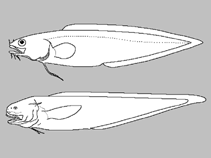
Dorsal soft rays (total): 98 - 104; Anal soft rays: 85 - 88; Vertebrae: 58 - 60. This species is distinguished from its congeners by the following set of characters: hind margin of preopercle with two blunt spines; D 98-104; A 85-88; P 26-27; precaudal vertebrae 13; total vertebrae 58-60; pseudobranchial filaments 4; long rakers on anterior gill arch 14-15; head length 21-22% Sl; pelvic-fin length 11-14% Sl, fins not reaching anus; orbit length 4.6-5.1% Sl and 22-24% hl; longest gill filament 0.8-1.4% Sl and 3.7-6.6% hl; dorsal fin with large central ocellus placed well behind vertical line through anus, spot distance 51-54% Sl and spot covers 15-17 dorsal-fin rays and extending ventrally to body covering 5 to 7 vertical-scale rows; dorsal half of ocellus in fresh specimens black, ventral half (extension to body) dark brown, connecting ventrally to brown vertical bar; dorsal fin and body anteriorly of ocellus two to three vertical bars, posteriorly more darkly pigmented; preserved specimens with dark brown, ventrally less conspicuous ocellus, anterior part of lateral line brown, vertical bars on body absent; otolith length 5.1-5.8% Sl, sulcus length 3.6-4.7% Sl, and ostium height 19-21% sulcus length and 28-30% ostium length (Ref. 137826).
Body shape (shape guide): elongated; Cross section: compressed.
Life cycle and mating behavior
Maturity | Reproduction | Spawning | Eggs | Fecundity | Larvae
Uiblein, F, and J.G. Nielsen, 2023. Five new ocellus-bearing species of the cusk-eel genus Neobythites (Ophidiidae, Ophidiiformes) from the West Pacific, with establishment of three new species groups. Zootaxa 5336(2):179-205. (Ref. 137826)
IUCN Red List Status (Ref. 130435: Version 2025-2)
Threat to humans
Harmless
Human uses
Fisheries: of no interest
Tools
Special reports
Download XML
Internet sources