Teleostei (teleosts) >
Ovalentaria/misc (Various families in series Ovalentaria) >
Pomacentridae (Damselfishes) > Pomacentrinae
Etymology: Chrysiptera: Greek, chrysos = golden + Greek, pteron = fin, wing (Ref. 45335).
Eponymy: Dr Walter Albert Starck II (d: 1939) is a marine biologist, ichthyologist and pioneer of coral reef research, who first pointed out the damselfish species to Allen while diving at Osprey Reef, Coral Sea. [...] (Ref. 128868), visit book page.
Environment: milieu / climate zone / depth range / distribution range
Ecology
Marine; reef-associated; non-migratory; depth range 20 - 60 m (Ref. 9710). Tropical; 35°N - 25°S
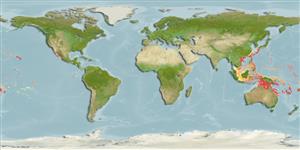
Western Pacific: anti-equatorial, from the Ryukyu Islands to Taiwan and from Queensland, Australia to New Caledonia. Recently reported from Tonga (Ref. 53797).
Size / Weight / Age
Maturity: Lm ? range ? - ? cm
Max length : 7.0 cm SL male/unsexed; (Ref. 7247)
Adults inhabit rocky outcrops and crevices that are frequently situated in sand channels on outer reef slopes. Common in deeper sections of the outer reef about 20 to 60 m in depth (Ref. 7247). Oviparous, distinct pairing during breeding (Ref. 205). Eggs are demersal and adhere to the substrate (Ref. 205). Males guard and aerate the eggs (Ref. 205). Diurnal species (Ref. 54980; 113699).
Life cycle and mating behavior
Maturity | Reproduction | Spawning | Eggs | Fecundity | Larvae
Oviparous, distinct pairing during breeding (Ref. 205). Eggs are demersal and adhere to the substrate (Ref. 205). Males guard and aerate the eggs (Ref. 205).
Allen, G.R., 1991. Damselfishes of the world. Mergus Publishers, Melle, Germany. 271 p. (Ref. 7247)
IUCN Red List Status (Ref. 130435: Version 2025-2)
Threat to humans
Harmless
Human uses
Tools
Special reports
Download XML
Internet sources