Teleostei (teleosts) >
Ophidiiformes (Cusk eels) >
Ophidiidae (Cusk-eels) > Neobythitinae
Etymology: Holcomycteronus: Greek, holkos, -e, -on = something that pulls + Greek, mykter, -eros = nose + Greek, onos = hake.
More on authors: Smith & Radcliffe.
Environment: milieu / climate zone / depth range / distribution range
Ecology
Marine; bathydemersal; depth range 1510 - 4030 m (Ref. 34024). Deep-water
Indo-West Pacific: off East Africa to the Philippines.
Size / Weight / Age
Maturity: Lm ? range ? - ? cm
Max length : 28.8 cm TL male/unsexed; (Ref. 41039)
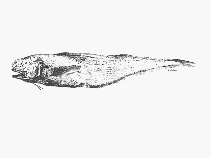
Dorsal spines (total): 0; Dorsal soft rays (total): 111 - 113; Anal spines: 0; Anal soft rays: 88 - 91. Robust body with rounded snout; eye diameter much shorter than snout; opercular spine strong; 2 median and a pair of basibranchial tooth patches; 7-11 developed rakers on anterior gill arch; pelvic fin rays flattened distally and somewhat thicker in males (Ref. 34024).
Body shape (shape guide): elongated.
Benthopelagic at bathyal and abyssal depths (Ref. 56809). Rare species (Ref. 34024). Oviparous, with oval pelagic eggs floating in a gelatinous mass (Ref. 205). Minimum depth reported taken from Ref. 4103.
Life cycle and mating behavior
Maturity | Reproduction | Spawning | Eggs | Fecundity | Larvae
Nielsen, J.G., D.M. Cohen, D.F. Markle and C.R. Robins, 1999. Ophidiiform fishes of the world (Order Ophidiiformes). An annotated and illustrated catalogue of pearlfishes, cusk-eels, brotulas and other ophidiiform fishes known to date. FAO Fish. Synop. 125(18):178p. Rome: FAO. (Ref. 34024)
IUCN Red List Status (Ref. 130435: Version 2025-2)
Threat to humans
Harmless
Human uses
Fisheries: of no interest
Tools
Special reports
Download XML
Internet sources