



Plectranthias clavatus Wada & Senou, 2024
Club perchlet
Upload your photos and videos
Google image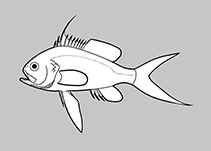 No image available for this species;
drawing shows typical species in Anthiadidae.
Google image
drawing shows typical species in Anthiadidae.
Classification / Names Common names | Synonyms | Catalog of Fishes(genus, species) | ITIS | CoL | WoRMS | Cloffa
Teleostei (teleosts) > Perciformes/Serranoidei (Groupers) > Anthiadidae (Fairy basslets or Streamer basses)
Etymology: Plectranthias: Bleeker (1873) disagrees with the generic placement of Plectropoma anthioides by Günther. He, therefore, erected Plectranthias to accommodate Pl. anthioides. The name is presumably the combination of the first part of Plectropoma (plectrum), and anthias. Plectrum = Plektron = πλῆκτρον (Greek, plektron = anyhting to strike with, spur + Greek, anthias = a fish, Ref. 45335); clavatus: Named 'clavatus', meaning 'club', referring to the stripe on the lateral surface of the body that defines the species. was collected from 100–386 m depth in Sagami Bay and the Hachijo-jima Island, Izu Islands, Japan, and Guam (Fig. 5). In addition, an individual was observed at 406 m depth on the Shoho Sea Mount, Nishi-Shichito Ridge, southern Japan (Koeda et al., 2021b). All individuals were collected from over rocky substrate.
Etymology: Plectranthias: Bleeker (1873) disagrees with the generic placement of Plectropoma anthioides by Günther. He, therefore, erected Plectranthias to accommodate Pl. anthioides. The name is presumably the combination of the first part of Plectropoma (plectrum), and anthias. Plectrum = Plektron = πλῆκτρον (Greek, plektron = anyhting to strike with, spur + Greek, anthias = a fish, Ref. 45335); clavatus: Named 'clavatus', meaning 'club', referring to the stripe on the lateral surface of the body that defines the species. was collected from 100–386 m depth in Sagami Bay and the Hachijo-jima Island, Izu Islands, Japan, and Guam (Fig. 5). In addition, an individual was observed at 406 m depth on the Shoho Sea Mount, Nishi-Shichito Ridge, southern Japan (Koeda et al., 2021b). All individuals were collected from over rocky substrate.
Environment: milieu / climate zone / depth range / distribution range Ecology
Marine; demersal; depth range 100 - 406 m (Ref. 132445). Tropical
Distribution Territories | FAO areas | Ecosystems | Occurrences | Point map | Introductions | Faunafri
West Pacific: Japan and Guam.
Size / Weight / Age
Short description Identification keys | Morphology | Morphometrics
Dorsal spines (total): 10; Dorsal soft rays (total): 17 - 18; Anal spines: 3; Anal soft rays: 7; Vertebrae: 26. This species is distinguished by the following set of characters: D X,17-18 (mode 17); pectoral-fin rays 13-14 (13), all are branched except for uppermost ray simple; principal caudal-fin rays 9 + 8; lateral line complete, pored scales 35-36 (35); scale rows above and below lateral line 5-5 and 16-17 (17), respectively; diagonal rows of large scales on cheek between eye and corner of preopercle 6-7 (6) ; circumpeduncular scales 15; rows of large predorsal scales ca. 8, single row of small scales extending to posterior two-thirds of interorbital area, tip not reaching line through posterior nostrils; body deep, depth at pelvic-fin origin 37.8-40.7 % (mean 39.1 %) of SL, greatest depth 39.6-42. 2 % (41.2 %) of SL; third dorsal-fin spine longest, its length 36.5-45.9 %
(41.9%) of body depth at pelvic-fin origin (BDP); anal-fin soft rays short, its longest ray length 47.9-59.1 % (53.5 %) of BDP; without scales on chin, branchiostegal membranes, infraorbital bones, maxilla, mandibles or snout; posterior margin of preopercle is serrated, ventral margin with 2 antrorse spines; short flaps at tips of second and third dorsal-fin spines. Colouration: three large orange-red saddles on dorsal edge of body; one orange-red stripe on posterior four-fifths of lateral body,saddles and stripe well-separated when fresh (Ref. 132445).
Cross section: compressed.
Cross section: compressed.
Collected over rocky substrate (Ref. 132445).
Life cycle and mating behavior Maturity | Reproduction | Spawning | Eggs | Fecundity | Larvae
Main reference
Upload your references | References | Coordinator | Collaborators
Wada, H. and H. Senou, 2024. Plectranthias clavatus a New Perchlet from Japan and Guam, with a Review of the Distributional Records of P. kamii (Perciformes: Serranidae: Anthiadinae). Bull. Kanagawa Pref. Mus. (Nat. Sci.), (53): 113-126. (Ref. 132445)
CITES
Not Evaluated
Threat to humans
Harmless
Human uses
Fisheries: of no interest
FAO - Publication: search | FishSource |
More information
Trophic ecology
Food items (preys)
Diet composition
Food consumption
Food rations
Predators
Food items (preys)
Diet composition
Food consumption
Food rations
Predators
Ecology
Ecology
Ecology
Population dynamics
Growth parameters
Max. ages / sizes
Length-weight rel.
Length-length rel.
Length-frequencies
Mass conversion
Recruitment
Abundance
Growth parameters
Max. ages / sizes
Length-weight rel.
Length-length rel.
Length-frequencies
Mass conversion
Recruitment
Abundance
Life cycle
Reproduction
Maturity
Maturity/Gills rel.
Fecundity
Spawning
Spawning aggregations
Eggs
Egg development
Larvae
Larval dynamics
Reproduction
Maturity
Maturity/Gills rel.
Fecundity
Spawning
Spawning aggregations
Eggs
Egg development
Larvae
Larval dynamics
Anatomy
Gill area
Brain
Otolith
Gill area
Brain
Otolith
Physiology
Body composition
Nutrients
Oxygen consumption
Swimming type
Swimming speed
Visual pigments
Fish sound
Diseases & Parasites
Toxicity (LC50s)
Body composition
Nutrients
Oxygen consumption
Swimming type
Swimming speed
Visual pigments
Fish sound
Diseases & Parasites
Toxicity (LC50s)
Genetics
Genome
Genetics
Heterozygosity
Heritability
Genetic Diversity
Genome
Genetics
Heterozygosity
Heritability
Genetic Diversity
Human related
Aquaculture systems
Aquaculture profiles
Strains
Ciguatera cases
Stamps, coins, misc.
Aquaculture systems
Aquaculture profiles
Strains
Ciguatera cases
Stamps, coins, misc.
Tools
Special reports
Download XML
Internet sources
AFORO (otoliths) | Aquatic Commons | BHL | Cloffa | Websites from users | Check FishWatcher | CISTI | Catalog of Fishes: genus, species | DiscoverLife | ECOTOX | FAO - Publication: search | Faunafri | Fishipedia | Fishtrace | GloBI | Google Books | Google Scholar | Google | IGFA World Record | OneZoom | Open Tree of Life | Otolith Atlas of Taiwan Fishes | PubMed | Reef Life Survey | Socotra Atlas | TreeBase | Tree of Life | Wikipedia: Go, Search | World Records Freshwater Fishing | Zoobank | Zoological Record
Estimates based on models
Phylogenetic diversity index (Ref. 82804): PD50 = 0.5000 [Uniqueness, from 0.5 = low to 2.0 = high].
Bayesian length-weight: a=0.02512 (0.00978 - 0.06451), b=2.98 (2.75 - 3.21), in cm total length, based on LWR estimates for this (Sub)family-body shape (Ref. 93245).
Trophic level (Ref. 69278): 4.0 ±0.7 se; based on size and trophs of closest relatives
Resilience (Ref. 120179): Medium, minimum population doubling time 1.4 - 4.4 years (Preliminary K or Fecundity.).