| Famille Caesionidae - Fusiliers | ||||
| Ordre | : | Eupercaria/misc |
|
|
| Classe | : | Teleostei | ||
| No. dans FishBase | : | Généralités : 0 | Espèce : 0 Eschmeyer's Catalog of Fishes | ||
| Environnement | : | Eau douce : No | Saumâtre : Yes | Marin : Yes | ||
| Division | : | Marine | ||
| Aquarium | : | some | ||
| Premier signalement fossile | : | |||
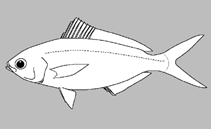
| Remarque | : | As a subfamily (Caesioninae) in Lutjanidae. Distribution: Indo-West Pacific. Morphology: Body oblong to fusiform; D X-XV,8-22 with slender weak spines; A III,9-13; pelvic fins I,5; pectoral fins 16-24; caudal fin distinctly forked with pointed lobes; scale rows on body running horizontally; dorsal and anal fins with scales except for Gymnocaesio gymnoptera and Dipterygonotus balteatus; longitudinal axis from tip of snout to middle of caudal fin passing through centre of eye; mouth small and highly protrusible; small or minute conical teeth; axil of pectoral fins black (Ref. 39189). Description: Oblong to fusiform, moderately compressed, medium-sized to small (to about 50 cm) lutjanoid fishes; eye moderately large, its diameter longer than snout length. Mouth small and highly protrusible; 1 or 2 finger-like postmaxillary processes on dorsoposterior surface of premaxilla; angle of jaw oblique, about 40° to horizontal; dentition variously reduced; premaxillae, vomer, and palatines with or without teeth; caudal fin deeply forked; margin of dorsal and anal fins more or less evenly sloping; third or fourth dorsal-fin spines longest; second or third anal-fin spines longest, remaining spines and rays gradually decreasing in length (except in Dipterygonotus with dorsal fin profile not evenly sloping, last IV-V dorsal-fin spines small and nearly separate, connected only at their bases by membrane, and dorsal-fin rays much longer than these spines); branchiostegal rays 7; scales moderate to small, weakly ctenoid; lateral-line scales 45 to 88; ascending premaxillary process a separate ossification from premaxilla; ethmo-maxillary ligament absent; a separate A1’ section of the adductor mandibulae which originates on the subocular shelf; supraneural configuration 0/0/0+2/1+1/, /0+0/0+2/1+1/, or /0+0/2/1+1/; epineurals 10-15; procurrent caudal-fin rays typically 7-10; hypurals 1-2 and 3-4 typically fused in all species (except some juveniles); openings in external wall of pars jugularis 2 to 5; colour of sides with or without longitudinal stripes, the caudal fin either without markings, with a blackish blotch on tips of lobes, or with a longitudinal blackish streak in middle of each lobe (Ref. 39189). Trophic ecology: Fusiliers are closely related to snappers (Lutjanidae) but possess several adaptations for a planktivorous mode of life, such as the elongate fusiform body, the small mouth, and the deeply forked caudal fin. During the day they occur in large zooplankton feeding schools in mid-water over the reef, along steep outer reef slopes and around deep lagoon pinnacles. Although they are active swimmers, they often pause to pick zooplankton and at cleaning stations, and shelter within the reef at night. Require unrestricted space, hence unsuitable for home aquaria. Uses: Fusiliers are important food fishes and are also used as bait in tuna fisheries. | ||
| Étymologie | : | Latin, caesius = bluish-grey ( Ref. 45335). | ||
| Guilde reproductive | : | nonguarders | ||
| Niveau d'activité typique | : | active | ||
Réf. principale |
: | Carpenter, K.E. 1988 | ||
| Coordinateur | : | |||
Classification des nageoires profondes

|
: | |||
Important recommendation:
The list below must not be used as an authority reference synonymy list like those found in scientific published revisions, which must be the source to be used and cited eventually when they exist.
Rather, it reflects the current content of FishBase, and the progress with respect to synchronization with the Catalog of Fishes. However, we think it can be useful for users to assess the quality of information in FishBase, to start new work on the family, or to cross-check with other lists.
But we appreciate to be cited in publications when this list has been of any working value. In particular, for published scientific, we suggest then to cite it in the Material and Method section as a useful tool to conduct the research, but again, not as a taxonomic or nomenclatural authority reference.
Unless it is explicitly precised, the list is not complete, please search all original names published for the family in the Catalog of Fishes (genera, species), including those with uncertain or unknown status, that are not included in FishBase when they are not attached to a valid species.
This list uses some data from Catalog of Fishes (not shown but used to sort names).
The list ordered as follows:
Please send comments and corrections if you detect errors or missing names.
