Cobitis kurui

You can sponsor this page

Cobitis kurui Erk'akan, Atalay-Ekmekçi & Nalbant, 1998

Upload your photos and videos
Google image
Image of Cobitis kurui
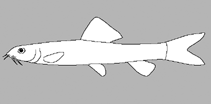
No image available for this species;
drawing shows typical species in Cobitidae.

Classification / Names Common names | Synonyms | Catalog of Fishes(genus, species) | ITIS | CoL | WoRMS | Cloffa

Teleostei (teleosts) > Cypriniformes (Carps) > Cobitidae (Spined loaches)
Etymology: Cobitis: Greek, kobitis, -idos = a kind of sardine; also related with the voice Greek, kobios, Latin gobius = gudgeon (Ref. 45335).
Eponymy: Dr Mustafa Kuru (d: 1940) is a Turkish ichthyologist whose bachelor’s degree (1964) and doctorate (1971) were awarded by the Erzurum Ataturk University and where he taught (1965–1989), eventually as Professor (1981–1989). [...] (Ref. 128868), visit book page.
More on authors: Erk'akan, Atalay-Ekmekçi & Nalbant.

Environment: milieu / climate zone / depth range / distribution range Ecology

Freshwater; benthopelagic. Subtropical

Distribution Territories | FAO areas | Ecosystems | Occurrences | Point map | Introductions | Faunafri

Asia: Büyük Menderes Nehri watershed and Yuvarlakçay in Turkey.

Size / Weight / Age

Maturity: Lm ?  range ? - ? cm
Max length : 4.5 cm SL male/unsexed; (Ref. 41095)

Short description Identification keys | Morphology | Morphometrics

Dorsal spines (total): 3; Dorsal soft rays (total): 7; Anal spines: 2 - 3; Anal soft rays: 5. Lesser size of black spot at caudal base which is brownish and a reduced in size of lateral spots (fourth Gambetta's pigmentary zone). Mouth arched with three pairs of very short barbels. Males with developed lamina circularis.
Body shape (shape guide): elongated.

Biology     Glossary (e.g. epibenthic)

Found in rivers. Oviparous, possibly with distinct pairing during breeding similar to congeners (Ref. 205).

Life cycle and mating behavior Maturity | Reproduction | Spawning | Eggs | Fecundity | Larvae

Main reference Upload your references | References | Coordinator | Collaborators

Fricke, R., M. Bilecenoglu and H.M. Sari, 2007. Annotated checklist of fish and lamprey species (Gnathostoma and Petromyzontomorphi) of Turkey, including a Red List of threatened and declining species. Stuttgarter Beitr. Naturk. Sea A (706):1-172. (Ref. 58342)

IUCN Red List Status (Ref. 130435: Version 2025-2)

  Least Concern (LC) ; Date assessed: 31 January 2006

CITES

Not Evaluated

CMS (Ref. 116361)

Not Evaluated

Threat to humans

  Harmless


Human uses

FAO - Publication: search | FishSource |

More information

Trophic ecology
Food items (preys)
Diet composition
Food consumption
Food rations
Predators
Ecology
Ecology
Population dynamics
Growth parameters
Max. ages / sizes
Length-weight rel.
Length-length rel.
Length-frequencies
Mass conversion
Recruitment
Abundance
Life cycle
Reproduction
Maturity
Maturity/Gills rel.
Fecundity
Spawning
Spawning aggregations
Eggs
Egg development
Larvae
Larval dynamics
Distribution
Territories
FAO areas
Ecosystems
Occurrences
Introductions
BRUVS - Videos
Anatomy
Gill area
Brain
Otolith
Physiology
Body composition
Nutrients
Oxygen consumption
Swimming type
Swimming speed
Visual pigments
Fish sound
Diseases & Parasites
Toxicity (LC50s)
Genetics
Genome
Genetics
Heterozygosity
Heritability
Genetic Diversity
Human related
Aquaculture systems
Aquaculture profiles
Strains
Ciguatera cases
Stamps, coins, misc.
Outreach
Collaborators
Taxonomy
Common names
Synonyms
Morphology
Morphometrics
Pictures
References
References

Tools

Special reports

Download XML

Internet sources

AFORO (otoliths) | Aquatic Commons | BHL | Cloffa | Websites from users | Check FishWatcher | CISTI | Catalog of Fishes: genus, species | DiscoverLife | ECOTOX | FAO - Publication: search | Faunafri | Fishipedia | Fishtrace | GloBI | Google Books | Google Scholar | Google | IGFA World Record | National databases | OneZoom | Open Tree of Life | Otolith Atlas of Taiwan Fishes | PubMed | Reef Life Survey | Socotra Atlas | TreeBase | Tree of Life | Wikipedia: Go, Search |