This website uses cookies to enhance your browsing experience and ensure the functionality of our site. For more detailed information about the types of cookies we use and how we protect your privacy, please visit our Privacy Information page.
×
Cookie Settings
This website uses different types of cookies to enhance your experience. Please select your preferences below:
Cephalopholis polleni, Harlequin hind : fisheries, gamefish
> Perciformes/Serranoidei (Groupers) > Epinephelidae (Groupers)
Etymology: Cephalopholis:Greek, kephale = head + Greek, pholis = scale (Ref. 45335). Eponymy: François Paul Louis Pollen (1842–1886) was a Dutch naturalist and merchant, who made major contributions to the study of Malagasy fauna. [...] (Ref. 128868), visit book page. More on author: Bleeker.
Environnement : milieu / zone climatique / profondeur / gamme de distribution Écologie
marin récifal; non migrateur; profondeur 10 - 120 m (Ref. 9710), usually 25 - 120 m (Ref. 9710). Tropical; 28°N - 24°S, 46°E - 156°W (Ref. 5222)
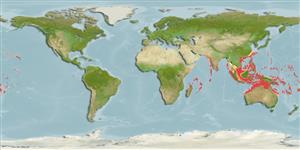
Indo-Pacific: scattered insular localities from the Comoros to the Line Islands. Unknown from the Red Sea, coast of East Africa, Sri Lanka, Australia, New Guinea, and the larger islands of Indonesia.
Longueur à la première maturité / Taille / Poids / Âge
Maturité: Lm?, range 25 - ? cm Max length : 43.0 cm TL mâle / non sexé; (Ref. 5222)
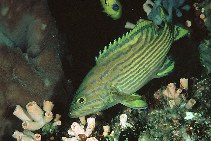
Épines dorsales (Total) : 9; Rayons mous dorsaux (Total) : 14 - 16; Épines anales: 3; Rayons mous anaux: 8 - 9. Characterized by yellow to greenish yellow color; head, body and fins with bright blue stripes; body scales ctenoid, including abdomen; pelvic fins, 1.5-1.9 in head length; greatest depth of body 2.7-3.1 in SL; truncate caudal fin to slightly emarginate (Ref. 90102); eye diameter subequal to interorbital width and about twice the depth of the preorbital; rounded preopercle, finely serrate, lower edge with 1-3 broad serrae; subopercle and interopercle finely serrate; maxilla reaches approximately to vertical at rear edge of eye; pectoral fins subequal to pelvic fins, pectoral fin length contained 1.5-1.9 times in HL (Ref. 089707) Body shape (shape guide): fusiform / normal; Cross section: oval.
Sporadic distribution (Ref. 48635). Occurs only at oceanic islands. Inhabits clear waters of steep drop-offs; rarely seen in less than 30 m. It has been taken in depths of 120 m and may occur deeper. Also found in caves and crevices. Often swims upside-down against the roofs of caves or archways (Ref. 37816). Feeds on fishes and crustaceans (Ref. 89972). Solitary (Ref 90102).
Cycle de vie et comportement reproducteur Maturité | Reproduction | Frai | Œufs | Fécondité | Larves
Heemstra, P.C. and J.E. Randall, 1993. FAO Species Catalogue. Vol. 16. Groupers of the world (family Serranidae, subfamily Epinephelinae). An annotated and illustrated catalogue of the grouper, rockcod, hind, coral grouper and lyretail species known to date. Rome: FAO. FAO Fish. Synop. 125(16):382 p. (Ref. 5222)
Statut dans la liste rouge de l'IUCN (Ref. 130435: Version 2025-2)
Cycle de vie Reproduction Maturité Maturité/épines rel. Fécondité Frai Agrégats de frai Œufs Développement de l'œuf Larves Dynamique des populations larvaires
Physiologie Composition corporelle Nutriments Consommation d'oxygène Type de natation Vitesse de nage Pigments visuels Son de poisson Maladies et parasites Toxicité (CL50)
Température préférée (Réf. 123201): 20.7 - 28.2, mean 26.5 °C (based on 670 cells).
Indice de diversité phylogénétique (Réf. 82804): PD50 = 0.5000 [Uniqueness, from 0.5 = low to 2.0 = high].
Bayesian length-weight: a=0.01259 (0.00587 - 0.02699), b=3.04 (2.87 - 3.21), in cm total length, based on LWR estimates for this Genus-body shape (Ref. 93245).
Niveau trophique (Réf. 69278): 4.2 ±0.7 se; based on size and trophs of closest relatives
Résilience (Réf. 120179): Milieu, temps minimum de doublement de population : 1,4 à 4,4 années (Preliminary K or Fecundity.).
Vulnérabilité de la pêche (Ref. 59153): Low to moderate vulnerability (33 of 100). 🛈