-

- About this page
- Languages
- User feedbacks
- Citation
- Uploads
- Related species
-



Xenurolebias tupinikin Gomes, Sarmento-Soares, Martins-Pinheiro & Leite, 2025
Upload your photos and videos
Google image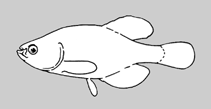 No image available for this species;
drawing shows typical species in Rivulidae.
Google image
drawing shows typical species in Rivulidae.
Classification / Names Common names | Synonyms | Catalog of Fishes(genus, species) | ITIS | CoL | WoRMS | Cloffa
Teleostei (teleosts) > Cyprinodontiformes (Rivulines, killifishes and live bearers) > Rivulidae (Rivulines) > Cynolebiinae
Etymology: tupinikin: Name 'tupinikin' in reference to the Tupiniquim Indigenous people, inhabitants of lowlands in the central north of Espírito Santo.
Etymology: tupinikin: Name 'tupinikin' in reference to the Tupiniquim Indigenous people, inhabitants of lowlands in the central north of Espírito Santo.
Environment: milieu / climate zone / depth range / distribution range Ecology
Freshwater; benthopelagic. Tropical
Distribution Territories | FAO areas | Ecosystems | Occurrences | Point map | Introductions | Faunafri
South America: Brazil.
Size / Weight / Age
Short description Identification keys | Morphology | Morphometrics
Dorsal soft rays (total): 12 - 17; Anal soft rays: 21 - 23. This species is distinguished from its congeners by the following set of characters: adult males presenting in life a dark blotch overlapping the median portion of the last stripe on the caudal peduncle; dorsal and anal fin borders with a black outline; body depth of 25.9-27.9 in SL; caudal fin in males with 5-6 bars; male head depth 64.5-76.9% of HL; and absence of yellow spots on the distal half of the dorsal fin in males (Ref 138058).
Body shape (shape guide): fusiform / normal; Cross section: compressed.
Body shape (shape guide): fusiform / normal; Cross section: compressed.
This species inhabits an isolated pool, spanning roughly 2 km² and densely covered with emergent vegetation dominated by grasses and ferns. Its substrate is composed of a mixture of emergent plants, decomposing plant debris, and sand (Ref. 138058).
Life cycle and mating behavior Maturity | Reproduction | Spawning | Eggs | Fecundity | Larvae
Main reference
Upload your references | References | Coordinator : Costa, Wilson J.E.M. | Collaborators
Gomes, B.P., L.M. Sarmento-Soares, R.F. Martins-Pinheiro and G.R. Leite, 2025. Habitat and Conservation Assessment of Annual Killifishes of the Genus Xenurolebias (Rivulidae: Cynolebiinae) from Coastal Floodplains, Including the First Record South of the Rio Doce, Southeastern Brazil. Diversity 17:644. (Ref. 138058)
CITES
Not Evaluated
Threat to humans
Harmless
Human uses
Fisheries: of no interest
FAO - Publication: search | FishSource |
More information
Trophic ecology
Food items (preys)
Diet composition
Food consumption
Food rations
Predators
Food items (preys)
Diet composition
Food consumption
Food rations
Predators
Population dynamics
Growth parameters
Max. ages / sizes
Length-weight rel.
Length-length rel.
Length-frequencies
Mass conversion
Recruitment
Abundance
Growth parameters
Max. ages / sizes
Length-weight rel.
Length-length rel.
Length-frequencies
Mass conversion
Recruitment
Abundance
Life cycle
Reproduction
Maturity
Maturity/Gills rel.
Fecundity
Spawning
Spawning aggregations
Eggs
Egg development
Larvae
Larval dynamics
Reproduction
Maturity
Maturity/Gills rel.
Fecundity
Spawning
Spawning aggregations
Eggs
Egg development
Larvae
Larval dynamics
Anatomy
Gill area
Brain
Otolith
Gill area
Brain
Otolith
Physiology
Body composition
Nutrients
Oxygen consumption
Swimming type
Swimming speed
Visual pigments
Fish sound
Diseases & Parasites
Toxicity (LC50s)
Body composition
Nutrients
Oxygen consumption
Swimming type
Swimming speed
Visual pigments
Fish sound
Diseases & Parasites
Toxicity (LC50s)
Genetics
Genome
Genetics
Heterozygosity
Heritability
Genetic Diversity
Genome
Genetics
Heterozygosity
Heritability
Genetic Diversity
Human related
Aquaculture systems
Aquaculture profiles
Strains
Ciguatera cases
Stamps, coins, misc.
Aquaculture systems
Aquaculture profiles
Strains
Ciguatera cases
Stamps, coins, misc.
Tools
Special reports
Download XML
Internet sources
AFORO (otoliths) | Aquatic Commons | BHL | Cloffa | Websites from users | Check FishWatcher | CISTI | Catalog of Fishes: genus, species | DiscoverLife | ECOTOX | FAO - Publication: search | Faunafri | Fishipedia | Fishtrace | GloBI | Google Books | Google Scholar | Google | IGFA World Record | OneZoom | Open Tree of Life | Otolith Atlas of Taiwan Fishes | PubMed | Reef Life Survey | Socotra Atlas | TreeBase | Tree of Life | Wikipedia: Go, Search | World Records Freshwater Fishing | Zoobank | Zoological Record
Estimates based on models
Phylogenetic diversity index (Ref. 82804): PD50 = 0.5312 [Uniqueness, from 0.5 = low to 2.0 = high].