-

- About this page
- Languages
- User feedbacks
- Citation
- Uploads
-
Related species
- Species in
Labeo - Species in
Cyprinidae - - Classification -
- Labeoninae
- Cyprinidae
- Cypriniformes
- Teleostei
- Chordata
- Animalia
- Species in
-



Upload your photos and videos
Google image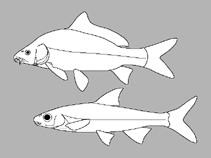 No image available for this species;
drawing shows typical species in Cyprinidae.
Google image
drawing shows typical species in Cyprinidae.
Classification / Names Common names | Synonyms | Catalog of Fishes(genus, species) | ITIS | CoL | WoRMS | Cloffa
Teleostei (teleosts) > Cypriniformes (Carps) > Cyprinidae (Minnows or carps) > Labeoninae
Etymology: Labeo: Latin, labeo = one who has large lips (Ref. 45335); uru: Name 'uru' from a type of wooden dhow, handmade for centuries by master craftsmen in the shipyards of Beypore, near Calicut, in reference to the elongate median fins of this species reminiscent of a dhow under full sail. A noun in apposition.
Etymology: Labeo: Latin, labeo = one who has large lips (Ref. 45335); uru: Name 'uru' from a type of wooden dhow, handmade for centuries by master craftsmen in the shipyards of Beypore, near Calicut, in reference to the elongate median fins of this species reminiscent of a dhow under full sail. A noun in apposition.
Environment: milieu / climate zone / depth range / distribution range Ecology
Freshwater; benthopelagic. Tropical
Distribution Territories | FAO areas | Ecosystems | Occurrences | Point map | Introductions | Faunafri
Asia: India.
Size / Weight / Age
Short description Identification keys | Morphology | Morphometrics
Dorsal soft rays (total): 19; Anal soft rays: 8; Vertebrae: 37. This species is distinguished from its congeners by the following set of characters: anterior most rays of the dorsal, pelvic and anal fins being greatly elongated; adpressed dorsal fin reaching the base of the caudal fin and adpressed anal fin reaching the fork of the caudal fin; pre-dorsal length 46.9-51.8% SL; caudal peduncle 14.8-16.5% SL; snout 38.2-46.7% HL, 5½ scales between lateral line and pelvic fin origin (Ref. 137933).
Body shape (shape guide): elongated; Cross section: oval.
Body shape (shape guide): elongated; Cross section: oval.
Life cycle and mating behavior Maturity | Reproduction | Spawning | Eggs | Fecundity | Larvae
Main reference
Upload your references | References | Coordinator | Collaborators
Kumar, R.G., C. Ravi and V.S. Basheer, 2025. Identity of Labeo nigrescens Day, 1870 with descriptions of two new Labeo species from the Southern Western Ghats. Indian J. Fish., 72(1):29-35. (Ref. 137993)
CITES
Not Evaluated
Threat to humans
Harmless
Human uses
Fisheries: of no interest
FAO - Publication: search | FishSource |
More information
Trophic ecology
Food items (preys)
Diet composition
Food consumption
Food rations
Predators
Food items (preys)
Diet composition
Food consumption
Food rations
Predators
Ecology
Ecology
Ecology
Population dynamics
Growth parameters
Max. ages / sizes
Length-weight rel.
Length-length rel.
Length-frequencies
Mass conversion
Recruitment
Abundance
Growth parameters
Max. ages / sizes
Length-weight rel.
Length-length rel.
Length-frequencies
Mass conversion
Recruitment
Abundance
Life cycle
Reproduction
Maturity
Maturity/Gills rel.
Fecundity
Spawning
Spawning aggregations
Eggs
Egg development
Larvae
Larval dynamics
Reproduction
Maturity
Maturity/Gills rel.
Fecundity
Spawning
Spawning aggregations
Eggs
Egg development
Larvae
Larval dynamics
Anatomy
Gill area
Brain
Otolith
Gill area
Brain
Otolith
Physiology
Body composition
Nutrients
Oxygen consumption
Swimming type
Swimming speed
Visual pigments
Fish sound
Diseases & Parasites
Toxicity (LC50s)
Body composition
Nutrients
Oxygen consumption
Swimming type
Swimming speed
Visual pigments
Fish sound
Diseases & Parasites
Toxicity (LC50s)
Genetics
Genome
Genetics
Heterozygosity
Heritability
Genetic Diversity
Genome
Genetics
Heterozygosity
Heritability
Genetic Diversity
Human related
Aquaculture systems
Aquaculture profiles
Strains
Ciguatera cases
Stamps, coins, misc.
Aquaculture systems
Aquaculture profiles
Strains
Ciguatera cases
Stamps, coins, misc.
Tools
Special reports
Download XML
Internet sources
AFORO (otoliths) | Aquatic Commons | BHL | Cloffa | Websites from users | Check FishWatcher | CISTI | Catalog of Fishes: genus, species | DiscoverLife | ECOTOX | FAO - Publication: search | Faunafri | Fishipedia | Fishtrace | GloBI | Google Books | Google Scholar | Google | IGFA World Record | OneZoom | Open Tree of Life | Otolith Atlas of Taiwan Fishes | PubMed | Reef Life Survey | Socotra Atlas | TreeBase | Tree of Life | Wikipedia: Go, Search |