-

- About this page
- Languages
- User feedbacks
- Citation
- Uploads
- Related species
-



Hypsolebias bonita Abrantes, Ramos, Bento & Lima, 2023
Upload your photos and videos
Google image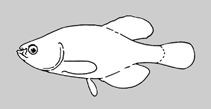 No image available for this species;
drawing shows typical species in Rivulidae.
Google image
drawing shows typical species in Rivulidae.
Classification / Names Common names | Synonyms | Catalog of Fishes(genus, species) | ITIS | CoL | WoRMS | Cloffa
Teleostei (teleosts) > Cyprinodontiformes (Rivulines, killifishes and live bearers) > Rivulidae (Rivulines) > Cynolebiinae
Etymology: bonita: Name 'bonita' in honor of Maria Gomes de Oliveira, known as 'Maria Bonita' the most prominent woman leader within the ‘cangaço’ social movement in the early XX century and in allusion to the antonymy to the adjective ‘feia’ (ugly), present in the name of the Furna Feia National Park, the type locality of the species.
Etymology: bonita: Name 'bonita' in honor of Maria Gomes de Oliveira, known as 'Maria Bonita' the most prominent woman leader within the ‘cangaço’ social movement in the early XX century and in allusion to the antonymy to the adjective ‘feia’ (ugly), present in the name of the Furna Feia National Park, the type locality of the species.
Environment: milieu / climate zone / depth range / distribution range Ecology
Freshwater; benthopelagic. Tropical
Distribution Territories | FAO areas | Ecosystems | Occurrences | Point map | Introductions | Faunafri
South America: Brazil.
Size / Weight / Age
Short description Identification keys | Morphology | Morphometrics
Dorsal soft rays (total): 15 - 25; Anal soft rays: 19 - 24; Vertebrae: 30. This species is distinguished from its congeners by the following set of characters: scale rows around caudal peduncle 12-14; yellowish brown dorsal fin; pelvic-fin rays 6; neuromasts on infraorbital series 15-19; parietal neuromasts 4; contact organs absent; dorsal-fin rays 21-25; caudal-fin rays 22-25; dorsal-fin origin at vertical through base of 2nd-3nd anal fin ray, in males; filaments at tip of dorsal and anal fins in adult males 3; number of longitudinal series scales 28-30; scales transverse series counts 12; oblique position of dark grey bar in eye; iridescent blue dots in the body and caudal fin present; number of vertebrae 30; and narrow head width in males 51.3-64.1% HL (Ref. 137857).
Body shape (shape guide): fusiform / normal; Cross section: compressed.
Body shape (shape guide): fusiform / normal; Cross section: compressed.
Life cycle and mating behavior Maturity | Reproduction | Spawning | Eggs | Fecundity | Larvae
Main reference
Upload your references | References | Coordinator : Costa, Wilson J.E.M. | Collaborators
Abrantes, Y.G., T.P.A. Ramos, D.D.M. Bento and S.M.Q. Lima, 2023. Molecular delimitation of the seasonal killifishes of the Hypsolebias antenori species group (Cyprinodontiformes, Rivulidae), with description of two new species from the Caatinga coastal basins, northeastern Brazil. Zootaxa 5389(5):545-562. (Ref. 137857)
CITES
Not Evaluated
Threat to humans
Harmless
Human uses
Fisheries: of no interest
FAO - Publication: search | FishSource |
More information
Trophic ecology
Food items (preys)
Diet composition
Food consumption
Food rations
Predators
Food items (preys)
Diet composition
Food consumption
Food rations
Predators
Ecology
Ecology
Ecology
Population dynamics
Growth parameters
Max. ages / sizes
Length-weight rel.
Length-length rel.
Length-frequencies
Mass conversion
Recruitment
Abundance
Growth parameters
Max. ages / sizes
Length-weight rel.
Length-length rel.
Length-frequencies
Mass conversion
Recruitment
Abundance
Life cycle
Reproduction
Maturity
Maturity/Gills rel.
Fecundity
Spawning
Spawning aggregations
Eggs
Egg development
Larvae
Larval dynamics
Reproduction
Maturity
Maturity/Gills rel.
Fecundity
Spawning
Spawning aggregations
Eggs
Egg development
Larvae
Larval dynamics
Anatomy
Gill area
Brain
Otolith
Gill area
Brain
Otolith
Physiology
Body composition
Nutrients
Oxygen consumption
Swimming type
Swimming speed
Visual pigments
Fish sound
Diseases & Parasites
Toxicity (LC50s)
Body composition
Nutrients
Oxygen consumption
Swimming type
Swimming speed
Visual pigments
Fish sound
Diseases & Parasites
Toxicity (LC50s)
Genetics
Genome
Genetics
Heterozygosity
Heritability
Genetic Diversity
Genome
Genetics
Heterozygosity
Heritability
Genetic Diversity
Human related
Aquaculture systems
Aquaculture profiles
Strains
Ciguatera cases
Stamps, coins, misc.
Aquaculture systems
Aquaculture profiles
Strains
Ciguatera cases
Stamps, coins, misc.
Tools
Special reports
Download XML
Internet sources
AFORO (otoliths) | Aquatic Commons | BHL | Cloffa | Websites from users | Check FishWatcher | CISTI | Catalog of Fishes: genus, species | DiscoverLife | ECOTOX | FAO - Publication: search | Faunafri | Fishipedia | Fishtrace | GloBI | Google Books | Google Scholar | Google | IGFA World Record | OneZoom | Open Tree of Life | Otolith Atlas of Taiwan Fishes | PubMed | Reef Life Survey | Socotra Atlas | TreeBase | Tree of Life | Wikipedia: Go, Search | World Records Freshwater Fishing | Zoobank | Zoological Record
Estimates based on models
Phylogenetic diversity index (Ref. 82804): PD50 = 0.5000 [Uniqueness, from 0.5 = low to 2.0 = high].