-

- About this page
- Languages
- User feedbacks
- Citation
- Uploads
- Related species
-



Enteromius walshae Mamonekene, Ibala Zamba & Stiassny, 2018
Upload your photos and videos
Google image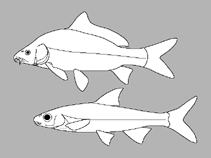 No image available for this species;
drawing shows typical species in Cyprinidae.
Google image
drawing shows typical species in Cyprinidae.
Classification / Names Common names | Synonyms | Catalog of Fishes(genus, species) | ITIS | CoL | WoRMS | Cloffa
Teleostei (teleosts) > Cypriniformes (Carps) > Cyprinidae (Minnows or carps) > Smiliogastrinae
Etymology: Enteromius: Greek, enteron = intestine + Greek, myo, mys = muscle (Ref. 45335); walshae: This species is named for Gina Walsh of the University of Witwatersrand, South Africa, whose ongoing research continues to enhance conservation efforts throughout the region (Ref. 119360).
Eponymy: Gina Walsh is (2015>) an Independent Research Associate Freshwater Ecologist at the University of Witwatersrand, South Africa, and an independent consultant at Flora, Fauna & Man Ecological Services. [...] (Ref. 128868), visit book page.
Etymology: Enteromius: Greek, enteron = intestine + Greek, myo, mys = muscle (Ref. 45335); walshae: This species is named for Gina Walsh of the University of Witwatersrand, South Africa, whose ongoing research continues to enhance conservation efforts throughout the region (Ref. 119360).
Eponymy: Gina Walsh is (2015>) an Independent Research Associate Freshwater Ecologist at the University of Witwatersrand, South Africa, and an independent consultant at Flora, Fauna & Man Ecological Services. [...] (Ref. 128868), visit book page.
Environment: milieu / climate zone / depth range / distribution range Ecology
Freshwater; benthopelagic. Tropical
Distribution Territories | FAO areas | Ecosystems | Occurrences | Point map | Introductions | Faunafri
Africa: Louesse River of upper Niari basin and Djoulou River of upper Ogowe basin in the Republic of Congo (Ref. 119360).
Size / Weight / Age
Short description Identification keys | Morphology | Morphometrics
Dorsal spines (total): 0; Dorsal soft rays (total): 11; Anal spines: 0; Anal soft rays: 8 - 9; Vertebrae: 30 - 31. Diagnosis: This species is readily distinguished from all congeners by the presence of a flexible, weakly ossified, and smooth-bordered last unbranched dorsal-fin ray, well-developed barbels, and a straight and complete lateral line in combination with a characteristic pigmentation patterning consisting of a distinctive, rounded black spot at the base of and extending over the first rays of the anal fin and a prominent, darkly pigmented blotch over the base of the anterior dorsal-fin rays (Ref. 119360).
Body shape (shape guide): fusiform / normal; Cross section: compressed.
Body shape (shape guide): fusiform / normal; Cross section: compressed.
Found in small, forested streams where water levels remain low throughout most of the rainy season (Ref. 119360). It feeds principally on detritus and organic debris; guts contain detritus, sand grains, some chironomid larval head cases and other fragmented, unidentifiable insect remains (Ref. 119360).
Life cycle and mating behavior Maturity | Reproduction | Spawning | Eggs | Fecundity | Larvae
Main reference
Upload your references | References | Coordinator | Collaborators
Mamonekene, V., A. Ibala Zamba and M.L.J. Stiassny, 2018. A new small barb (Cyprininae: Smiliogastrini) from the Louesse, Lekoumou (upper Niari basin), and Djoulou (upper Ogowe basin) rivers in the Republic of Congo, west-central Africa. Am. Mus. Novit. 3917:16 p. (Ref. 119360)
CITES
Not Evaluated
Threat to humans
Harmless
Human uses
Fisheries: of no interest
FAO - Publication: search | FishSource |
More information
Trophic ecology
Food items (preys)
Diet composition
Food consumption
Food rations
Predators
Food items (preys)
Diet composition
Food consumption
Food rations
Predators
Population dynamics
Growth parameters
Max. ages / sizes
Length-weight rel.
Length-length rel.
Length-frequencies
Mass conversion
Recruitment
Abundance
Growth parameters
Max. ages / sizes
Length-weight rel.
Length-length rel.
Length-frequencies
Mass conversion
Recruitment
Abundance
Life cycle
Reproduction
Maturity
Maturity/Gills rel.
Fecundity
Spawning
Spawning aggregations
Eggs
Egg development
Larvae
Larval dynamics
Reproduction
Maturity
Maturity/Gills rel.
Fecundity
Spawning
Spawning aggregations
Eggs
Egg development
Larvae
Larval dynamics
Anatomy
Gill area
Brain
Otolith
Gill area
Brain
Otolith
Physiology
Body composition
Nutrients
Oxygen consumption
Swimming type
Swimming speed
Visual pigments
Fish sound
Diseases & Parasites
Toxicity (LC50s)
Body composition
Nutrients
Oxygen consumption
Swimming type
Swimming speed
Visual pigments
Fish sound
Diseases & Parasites
Toxicity (LC50s)
Genetics
Genome
Genetics
Heterozygosity
Heritability
Genetic Diversity
Genome
Genetics
Heterozygosity
Heritability
Genetic Diversity
Human related
Aquaculture systems
Aquaculture profiles
Strains
Ciguatera cases
Stamps, coins, misc.
Aquaculture systems
Aquaculture profiles
Strains
Ciguatera cases
Stamps, coins, misc.
Tools
Special reports
Download XML
Internet sources
AFORO (otoliths) | Aquatic Commons | BHL | Cloffa | Websites from users | Check FishWatcher | CISTI | Catalog of Fishes: genus, species | DiscoverLife | ECOTOX | FAO - Publication: search | Faunafri | Fishipedia | Fishtrace | GloBI | Google Books | Google Scholar | Google | IGFA World Record | OneZoom | Open Tree of Life | Otolith Atlas of Taiwan Fishes | PubMed | Reef Life Survey | Socotra Atlas | TreeBase | Tree of Life | Wikipedia: Go, Search |