-

- About this page
- Languages
- User feedbacks
- Citation
- Uploads
- Related species
-



Nomorhamphus lanceolatus Huylebrouck, Hadiaty & Herder, 2014
Upload your photos and videos
Google image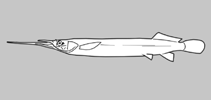 No image available for this species;
drawing shows typical species in Zenarchopteridae.
Google image
drawing shows typical species in Zenarchopteridae.
Classification / Names Common names | Synonyms | Catalog of Fishes(genus, species) | ITIS | CoL | WoRMS | Cloffa
Teleostei (teleosts) > Beloniformes (Needle fishes) > Zenarchopteridae (Internally fertilized halfbeaks)
Etymology: Nomorhamphus: Greek, nema = filament + Greek, rhamphos = bill, peak (Ref. 45335); lanceolatus: From the late Latin adjective lanceolatus, meaning lanceolate, in reference to the shape of the spiculus of the new species.
Etymology: Nomorhamphus: Greek, nema = filament + Greek, rhamphos = bill, peak (Ref. 45335); lanceolatus: From the late Latin adjective lanceolatus, meaning lanceolate, in reference to the shape of the spiculus of the new species.
Environment: milieu / climate zone / depth range / distribution range Ecology
Freshwater; pelagic; depth range 0 - ? m. Tropical
Distribution Territories | FAO areas | Ecosystems | Occurrences | Point map | Introductions | Faunafri
Asia: Sungai Wawolambo in Sulawesi Tenggara, Indonesia.
Size / Weight / Age
Short description Identification keys | Morphology | Morphometrics
Dorsal soft rays (total): 11 - 13; Anal soft rays: 15 - 16; Vertebrae: 36 - 38. Nomorhamphus lanceolatus can be distinguished from all congeners by the combination of the following characters: lower jaw short; no fleshy lower jaw appendage in males; presence of black pigmentation in anal and dorsal fin; life coloration with yellow and orange colored anal, dorsal, and caudal fin, ventral surface of lower jaw orange and yellow belly; a lanceolate, dorsally slightly curved spiculus in the male andropodium, with the middle segments of the spiculus in contact with the distal tip of the third anal-fin ray; nine to ten segments proximal to spinae (mode nine segments); segments three or four to six or seven (mode four to seven) of second anal-fin ray in males with a dorsal and a ventral row of 'subsegments' forming small squares and rectangles of different sizes, so that these segments seem to be subdivided; third anal-fin ray slightly constricted longitudinally, giving the appearance of two distinct rays, distal part of this ray is slightly curved ventrally to contact spiculus (Ref. 97329).
Occurs in a stream of about 7-9 m wide and 50 cm deep, partially shaded by forest canopy, with a bed of sand and gravel (Ref. 97329).
Life cycle and mating behavior Maturity | Reproduction | Spawning | Eggs | Fecundity | Larvae
Main reference
Upload your references | References | Coordinator | Collaborators
Huylebrouck, J., R.K. Hadiaty and F. Herder, 2014. Two new species of viviparous halfbreaks (Atherinomorpha: Beloniformes: Zenarchopteridae) endemic to Sulawesi Tenggara, Indonesia. Raffles Bulleting of Zoology 62:200-209. (Ref. 97329)
IUCN Red List Status (Ref. 130435: Version 2025-2)
Endangered (EN) (B1ab(iii)); Date assessed: 17 January 2020
CITES
Not Evaluated
Threat to humans
Harmless
Human uses
FAO - Publication: search | FishSource |
More information
Trophic ecology
Food items (preys)
Diet composition
Food consumption
Food rations
Predators
Food items (preys)
Diet composition
Food consumption
Food rations
Predators
Population dynamics
Growth parameters
Max. ages / sizes
Length-weight rel.
Length-length rel.
Length-frequencies
Mass conversion
Recruitment
Abundance
Growth parameters
Max. ages / sizes
Length-weight rel.
Length-length rel.
Length-frequencies
Mass conversion
Recruitment
Abundance
Life cycle
Reproduction
Maturity
Maturity/Gills rel.
Fecundity
Spawning
Spawning aggregations
Eggs
Egg development
Larvae
Larval dynamics
Reproduction
Maturity
Maturity/Gills rel.
Fecundity
Spawning
Spawning aggregations
Eggs
Egg development
Larvae
Larval dynamics
Anatomy
Gill area
Brain
Otolith
Gill area
Brain
Otolith
Physiology
Body composition
Nutrients
Oxygen consumption
Swimming type
Swimming speed
Visual pigments
Fish sound
Diseases & Parasites
Toxicity (LC50s)
Body composition
Nutrients
Oxygen consumption
Swimming type
Swimming speed
Visual pigments
Fish sound
Diseases & Parasites
Toxicity (LC50s)
Genetics
Genome
Genetics
Heterozygosity
Heritability
Genetic Diversity
Genome
Genetics
Heterozygosity
Heritability
Genetic Diversity
Human related
Aquaculture systems
Aquaculture profiles
Strains
Ciguatera cases
Stamps, coins, misc.
Aquaculture systems
Aquaculture profiles
Strains
Ciguatera cases
Stamps, coins, misc.
Tools
Special reports
Download XML
Internet sources
AFORO (otoliths) | Aquatic Commons | BHL | Cloffa | Websites from users | Check FishWatcher | CISTI | Catalog of Fishes: genus, species | DiscoverLife | ECOTOX | FAO - Publication: search | Faunafri | Fishipedia | Fishtrace | GloBI | Google Books | Google Scholar | Google | IGFA World Record | OneZoom | Open Tree of Life | Otolith Atlas of Taiwan Fishes | PubMed | Reef Life Survey | Socotra Atlas | TreeBase | Tree of Life | Wikipedia: Go, Search |