-

- About this page
- Languages
- User feedbacks
- Citation
- Uploads
- Related species
-



Patagolycus melastomus Matallanas & Corbella, 2012
Upload your photos and videos
Google image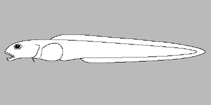 No image available for this species;
drawing shows typical species in Zoarcidae.
Google image
drawing shows typical species in Zoarcidae.
Classification / Names Common names | Synonyms | Catalog of Fishes(genus, species) | ITIS | CoL | WoRMS | Cloffa
Teleostei (teleosts) > Perciformes/Zoarcoidei (Eelpouts and pricklebacks) > Zoarcidae (Eelpouts) > Lycodinae
Etymology: Patagolycus: Named for Patagonia ('Patago', the type species found mainly in Patagonian waters) and the Greek 'lykos' (= wolf), a commonly used suffix for southern hemisphere zoarcid genera; melastomus: Name from the Greek 'melas' for black or dark and 'stoma' for mouth; referring to the colour of its orobranchial cavity.
Etymology: Patagolycus: Named for Patagonia ('Patago', the type species found mainly in Patagonian waters) and the Greek 'lykos' (= wolf), a commonly used suffix for southern hemisphere zoarcid genera; melastomus: Name from the Greek 'melas' for black or dark and 'stoma' for mouth; referring to the colour of its orobranchial cavity.
Environment: milieu / climate zone / depth range / distribution range Ecology
Marine; demersal; depth range 164 - 489 m (Ref. 90127). Temperate; 45°S - 52°S, 60°W - 69°W (Ref. 90127)
Distribution Territories | FAO areas | Ecosystems | Occurrences | Point map | Introductions | Faunafri
Southwest Atlantic: Argentina.
Size / Weight / Age
Maturity: Lm ? range ? - ? cm
Max length : 43.7 cm TL male/unsexed; (Ref. 90127); 38.5 cm TL (female)
Max length : 43.7 cm TL male/unsexed; (Ref. 90127); 38.5 cm TL (female)
Short description Identification keys | Morphology | Morphometrics
Dorsal soft rays (total): 83 - 89; Anal soft rays: 67 - 73; Vertebrae: 86 - 93. This species is distinguished by the following characters: presence of submental crest; elongated and narrowed neurocranium; frontals fused anteriorly with no trace of a suture; frontal corner squared; long frontal ramus; frontal and parasphenoid well separated by pterosphenoid; sphenotic and parietal in contact; parietals separated from mid-line; parasphenoid wing reaches the mid-height of the trigeminofacialis foramen; supraoccipital?exoccipìtal articulation excluded by epioccipital; no supratemporal commissure and occipital pores; intercalar well developed; 8 suborbital bones, canal with 7 pores; postorbital pores 1 and 4; ceratohyal?epihyal juncture interdigitating dorsally; branchiostegal rays 5; posterior hyomandibular ramus elongate; well developed palatal arch and posttemporal ventral ramus; scapular foramen enclosed by bone; scapular strut present; cartilaginous basal plate of pectoral girdle with 4 foramina; asymmetrical vertebrae; well developed oral valve; gill slit extending ventrally below lower end of pectoral-fin base; scalloped gill rakers; pelvic-fin rays ensheated; squamation extensive; with lateral line, pyloric caeca, palatine and vomerine teeth; oral cavity and peritoneum black (Ref. 90127).
Body shape (shape guide): elongated; Cross section: oval.
Body shape (shape guide): elongated; Cross section: oval.
Life cycle and mating behavior Maturity | Reproduction | Spawning | Eggs | Fecundity | Larvae
Main reference
Upload your references | References | Coordinator | Collaborators
Matallanas, J. and C. Corbella, 2012. Redescription of Iluocoetes Jenyns, 1842; proposal of a new genus, Argentinolycus, for Iluocoetes elongatus (Smitt, 1898), and description of Patagolycus melastomus gen. et sp. nov. (Teleostei, Zoarcidae). Zootaxa 3296:1-18. (Ref. 90127)
CITES
Not Evaluated
Threat to humans
Harmless
Human uses
FAO - Publication: search | FishSource |
More information
Trophic ecology
Food items (preys)
Diet composition
Food consumption
Food rations
Predators
Food items (preys)
Diet composition
Food consumption
Food rations
Predators
Ecology
Ecology
Ecology
Population dynamics
Growth parameters
Max. ages / sizes
Length-weight rel.
Length-length rel.
Length-frequencies
Mass conversion
Recruitment
Abundance
Growth parameters
Max. ages / sizes
Length-weight rel.
Length-length rel.
Length-frequencies
Mass conversion
Recruitment
Abundance
Life cycle
Reproduction
Maturity
Maturity/Gills rel.
Fecundity
Spawning
Spawning aggregations
Eggs
Egg development
Larvae
Larval dynamics
Reproduction
Maturity
Maturity/Gills rel.
Fecundity
Spawning
Spawning aggregations
Eggs
Egg development
Larvae
Larval dynamics
Anatomy
Gill area
Brain
Otolith
Gill area
Brain
Otolith
Physiology
Body composition
Nutrients
Oxygen consumption
Swimming type
Swimming speed
Visual pigments
Fish sound
Diseases & Parasites
Toxicity (LC50s)
Body composition
Nutrients
Oxygen consumption
Swimming type
Swimming speed
Visual pigments
Fish sound
Diseases & Parasites
Toxicity (LC50s)
Genetics
Genome
Genetics
Heterozygosity
Heritability
Genetic Diversity
Genome
Genetics
Heterozygosity
Heritability
Genetic Diversity
Human related
Aquaculture systems
Aquaculture profiles
Strains
Ciguatera cases
Stamps, coins, misc.
Aquaculture systems
Aquaculture profiles
Strains
Ciguatera cases
Stamps, coins, misc.
Tools
Special reports
Download XML
Internet sources
AFORO (otoliths) | Aquatic Commons | BHL | Cloffa | Websites from users | Check FishWatcher | CISTI | Catalog of Fishes: genus, species | DiscoverLife | ECOTOX | FAO - Publication: search | Faunafri | Fishipedia | Fishtrace | GloBI | Google Books | Google Scholar | Google | IGFA World Record | OneZoom | Open Tree of Life | Otolith Atlas of Taiwan Fishes | PubMed | Reef Life Survey | Socotra Atlas | TreeBase | Tree of Life | Wikipedia: Go, Search |