-

- About this page
- Languages
- User feedbacks
- Citation
- Uploads
- Related species
-



Paradiancistrus christmasensis Schwarzhans & Møller, 2011
Christmas viviparous brotula
Upload your photos and videos
Pictures | Google image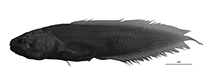 Paradiancistrus christmasensis
Female Picture by W. Schwarzhans & P. R. Møller
Pictures | Google image
Female Picture by W. Schwarzhans & P. R. Møller
Classification / Names Common names | Synonyms | Catalog of Fishes(genus, species) | ITIS | CoL | WoRMS | Cloffa
Teleostei (teleosts) > Ophidiiformes (Cusk eels) > Dinematichthyidae (Viviparous brotula)
Etymology: Paradiancistrus: Named for its most similar genus, Diancistrus; christmasensis: Named for its type locality; adjectival.
More on authors: Schwarzhans & Møller.
Etymology: Paradiancistrus: Named for its most similar genus, Diancistrus; christmasensis: Named for its type locality; adjectival.
More on authors: Schwarzhans & Møller.
Environment: milieu / climate zone / depth range / distribution range Ecology
Marine; benthopelagic; depth range 15 - 22 m (Ref. 88966). Tropical
Distribution Territories | FAO areas | Ecosystems | Occurrences | Point map | Introductions | Faunafri
Southeastern Indian Ocean, Christmas Island.
Size / Weight / Age
Maturity: Lm ? range ? - ? cm
Max length : 6.8 cm SL (female)
Max length : 6.8 cm SL (female)
Short description Identification keys | Morphology | Morphometrics
Dorsal soft rays (total): 78; Anal soft rays: 67; Vertebrae: 43. This species is distinguished by the following characters: vertebrae 11+32=43; dorsal fin rays 78; anal fin rays 67; head with narrow scale patch on cheeks with 3 rows on upper cheek and 2 rows on lower cheek; operculum scaleless; stubby snout profile; lower preopercular pore 1; otolith with undifferentiated, short sulcus, dorsal rim anteriorly expanded, posteriorly depressed, otolith length to otolith height 2.15, otolith length to sulcus length 2.3 (Ref. 88966).
Body shape (shape guide): elongated.
Body shape (shape guide): elongated.
Cryptic and solitary, inhabits reef crevices (Ref. 90102).
Life cycle and mating behavior Maturity | Reproduction | Spawning | Eggs | Fecundity | Larvae
Main reference
Upload your references | References | Coordinator | Collaborators
Schwarzhans, W. and P.R. Møller, 2011. New Dinematichthyini (Teleostei: Bythitidae) from the Indo-west Pacific, with the description of a new genus and five new species. The Beagle, Records of the Museums and Art Galleries of the Northern Territory 27:161-177. (Ref. 88966)
IUCN Red List Status (Ref. 130435: Version 2025-2)
Data deficient (DD) ; Date assessed: 16 August 2019
CITES
Not Evaluated
Threat to humans
Harmless
Human uses
Fisheries: of no interest
FAO - Publication: search | FishSource |
More information
Trophic ecology
Food items (preys)
Diet composition
Food consumption
Food rations
Predators
Food items (preys)
Diet composition
Food consumption
Food rations
Predators
Ecology
Ecology
Ecology
Population dynamics
Growth parameters
Max. ages / sizes
Length-weight rel.
Length-length rel.
Length-frequencies
Mass conversion
Recruitment
Abundance
Growth parameters
Max. ages / sizes
Length-weight rel.
Length-length rel.
Length-frequencies
Mass conversion
Recruitment
Abundance
Life cycle
Reproduction
Maturity
Maturity/Gills rel.
Fecundity
Spawning
Spawning aggregations
Eggs
Egg development
Larvae
Larval dynamics
Reproduction
Maturity
Maturity/Gills rel.
Fecundity
Spawning
Spawning aggregations
Eggs
Egg development
Larvae
Larval dynamics
Anatomy
Gill area
Brain
Otolith
Gill area
Brain
Otolith
Physiology
Body composition
Nutrients
Oxygen consumption
Swimming type
Swimming speed
Visual pigments
Fish sound
Diseases & Parasites
Toxicity (LC50s)
Body composition
Nutrients
Oxygen consumption
Swimming type
Swimming speed
Visual pigments
Fish sound
Diseases & Parasites
Toxicity (LC50s)
Genetics
Genome
Genetics
Heterozygosity
Heritability
Genetic Diversity
Genome
Genetics
Heterozygosity
Heritability
Genetic Diversity
Human related
Aquaculture systems
Aquaculture profiles
Strains
Ciguatera cases
Stamps, coins, misc.
Aquaculture systems
Aquaculture profiles
Strains
Ciguatera cases
Stamps, coins, misc.
Tools
Special reports
Download XML
Internet sources
AFORO (otoliths) | Aquatic Commons | BHL | Cloffa | Websites from users | Check FishWatcher | CISTI | Catalog of Fishes: genus, species | DiscoverLife | ECOTOX | FAO - Publication: search | Faunafri | Fishipedia | Fishtrace | GloBI | Google Books | Google Scholar | Google | IGFA World Record | OneZoom | Open Tree of Life | Otolith Atlas of Taiwan Fishes | PubMed | Reef Life Survey | Socotra Atlas | TreeBase | Tree of Life | Wikipedia: Go, Search |