-

- About this page
- Languages
- User feedbacks
- Citation
- Uploads
-
Related species
- Species in
Leporinus - Species in
Anostomidae - - Classification -
- Anostomidae
- Characiformes
- Teleostei
- Chordata
- Animalia
- Species in
-



Upload your photos and videos
Google image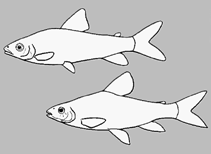 No image available for this species;
drawing shows typical species in Anostomidae.
Google image
drawing shows typical species in Anostomidae.
Classification / Names Common names | Synonyms | Catalog of Fishes(genus, species) | ITIS | CoL | WoRMS | Cloffa
Teleostei (teleosts) > Characiformes (Characins) > Anostomidae (Headstanders)
Etymology: Leporinus: Latin, lepus, leporis = rabbit (Ref. 45335); geminis: The specific name geminis is in allusion to the similarity showed by the young of this species with its congeneric Leporinus unitaeniatus.
Etymology: Leporinus: Latin, lepus, leporis = rabbit (Ref. 45335); geminis: The specific name geminis is in allusion to the similarity showed by the young of this species with its congeneric Leporinus unitaeniatus.
Environment: milieu / climate zone / depth range / distribution range Ecology
Freshwater; benthopelagic. Tropical
Distribution Territories | FAO areas | Ecosystems | Occurrences | Point map | Introductions | Faunafri
South America: Rio Tocantins, Brazil.
Size / Weight / Age
Short description Identification keys | Morphology | Morphometrics
Dorsal soft rays (total): 11 - 12; Anal soft rays: 9. Differs from its congeners by the following characters: one longitudinal and discontinuous
narrow dark brown stripe running inconspicuously from a vertical through middle of dorsal fin to base of caudal peduncle along lateral line; two or three large dark brown vertically elongated blotches along middle trunk: first at the vertical through dorsal-fin, second anterior to adipose fin and third on the caudal peduncle; mainly in young specimens, 12-13 short transversal dark brown bars meeting small dark brown blotches laterally; snout length 39 to 47.6% in head length; orbital diameter 21.4 to 27.8% of head length; body depth 21.6 to 26.0% of SL; sub-inferior mouth (inferior margin of superior lip horizontally aligned with the inferior margin of infraorbital bones); 4 teeth on each premaxillary and dentary; teeth gross incisive-like, forming
an arched cutting edge, decreasing in size from the symphysal largest pair; 40 to 42 scales in the lateral line, 5,5 or 6 scales series above and 5 under lateral line and 16 circumpeduncular series of scales (Ref. 80692).
Body shape (shape guide): elongated.
Body shape (shape guide): elongated.
Distinct pairs breed on densely grown weedy places (Ref. 205).
Life cycle and mating behavior Maturity | Reproduction | Spawning | Eggs | Fecundity | Larvae
Distinct pairs breed on densely grown weedy places (Ref. 205).
Main reference
Upload your references | References | Coordinator : Garavello, Júlio | Collaborators
Garavello, J.C. and G.M. Santos, 2009. Two new species of Leporinus Agassiz, 1829 from Araguaia-Tocantins system, Amazon basin, Brazil (Ostoriophysi, Anostomidae). Brazilian J. Biol. 69 (1):109-116. (Ref. 80692)
CITES
Not Evaluated
Threat to humans
Harmless
Human uses
FAO - Publication: search | FishSource |
More information
Trophic ecology
Food items (preys)
Diet composition
Food consumption
Food rations
Predators
Food items (preys)
Diet composition
Food consumption
Food rations
Predators
Ecology
Ecology
Ecology
Population dynamics
Growth parameters
Max. ages / sizes
Length-weight rel.
Length-length rel.
Length-frequencies
Mass conversion
Recruitment
Abundance
Growth parameters
Max. ages / sizes
Length-weight rel.
Length-length rel.
Length-frequencies
Mass conversion
Recruitment
Abundance
Life cycle
Reproduction
Maturity
Maturity/Gills rel.
Fecundity
Spawning
Spawning aggregations
Eggs
Egg development
Larvae
Larval dynamics
Reproduction
Maturity
Maturity/Gills rel.
Fecundity
Spawning
Spawning aggregations
Eggs
Egg development
Larvae
Larval dynamics
Anatomy
Gill area
Brain
Otolith
Gill area
Brain
Otolith
Physiology
Body composition
Nutrients
Oxygen consumption
Swimming type
Swimming speed
Visual pigments
Fish sound
Diseases & Parasites
Toxicity (LC50s)
Body composition
Nutrients
Oxygen consumption
Swimming type
Swimming speed
Visual pigments
Fish sound
Diseases & Parasites
Toxicity (LC50s)
Genetics
Genome
Genetics
Heterozygosity
Heritability
Genetic Diversity
Genome
Genetics
Heterozygosity
Heritability
Genetic Diversity
Human related
Aquaculture systems
Aquaculture profiles
Strains
Ciguatera cases
Stamps, coins, misc.
Aquaculture systems
Aquaculture profiles
Strains
Ciguatera cases
Stamps, coins, misc.
Tools
Special reports
Download XML
Internet sources
AFORO (otoliths) | Aquatic Commons | BHL | Cloffa | Websites from users | Check FishWatcher | CISTI | Catalog of Fishes: genus, species | DiscoverLife | ECOTOX | FAO - Publication: search | Faunafri | Fishipedia | Fishtrace | GloBI | Google Books | Google Scholar | Google | IGFA World Record | OneZoom | Open Tree of Life | Otolith Atlas of Taiwan Fishes | PubMed | Reef Life Survey | Socotra Atlas | TreeBase | Tree of Life | Wikipedia: Go, Search |