Holocephali (chimaeras) >
Chimaeriformes (Chimaeras) >
Chimaeridae (Shortnose chimaeras or ratfishes)
Etymology: Hydrolagus: hydro-, combining form of hydor (Gr.), water; lagos (Gr.), hare, i.e., “water rabbit,” probably referring to three pairs of tooth plates, which tend to protrude from the mouth like a rabbit’s incisors (See ETYFish); homonycteris: homo-, from hominis (L.), man; nykteris (Gr.), bat, referring to Thomas A. Griffiths, bat systematist known as “bat man,” who introduced Didier to chimaeroid fishes (See ETYFish).
Environment: milieu / climate zone / depth range / distribution range
Ecology
Marine; bathydemersal; depth range 866 - 1447 m (Ref. 76967). Deep-water
Southern Ocean: Australia and New Zealand.
Length at first maturity / Size / Weight / Age
Maturity: Lm ?, range 85 - ? cm
Max length : 109 cm TL male/unsexed; (Ref. 76967)
Short description
Identification keys | Morphology | Morphometrics
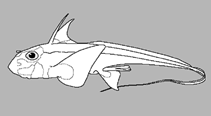
This chimaeroid fish has a ventral caudal fin that that is not indented at its origin to form a separate anal fin, it is distinguished from its congeners by the following characters: color of the body an even dark black or blackish-brown; its dorsal fin spine is longer than height of first dorsal fin; pelvic fins is distinctly round in shape; males with pelvic claspers that are dark at the base with pale tips, divided for the distal 1/3 of their length (Ref. 76967).
Body shape (shape guide): elongated.
Life cycle and mating behavior
Maturity | Reproduction | Spawning | Eggs | Fecundity | Larvae
Didier, D.A., 2008. Two new species of the genus Hydrolagus Gill (Holocephali: Chimaeridae) from Australia. In Last, P.R., White, W.T. & Pogonoski, J.J. (eds.): Descriptions of New Australian Chondrichthyans. CSIRO Marine and Atmospheric Research Paper no. 22. (Ref. 76967)
IUCN Red List Status (Ref. 130435: Version 2025-2)
Threat to humans
Harmless
Human uses
Tools
Special reports
Download XML
Internet sources