This website uses cookies to enhance your browsing experience and ensure the functionality of our site. For more detailed information about the types of cookies we use and how we protect your privacy, please visit our Privacy Information page.
×
Cookie Settings
This website uses different types of cookies to enhance your experience. Please select your preferences below:
Classification / Names Common names | Synonyms | Catalog of Fishes(genus, species) | ITIS | CoL | WoRMS | Cloffa
Teleostei (teleosts) > Cyprinodontiformes (Rivulines, killifishes and live bearers) > Rivulidae (Rivulines) > Cynolebiinae
Etymology: Matilebias:Named for Dr. Matias Pandolfi; combination of his nickname 'Mati' and Greek 'lebias'; paucisquama:Name from the Latin pauci, meaning few, and squama, meaning scales, in reference to the reduced number of scales around caudal peduncle. More on authors: Ferrer, dos & SantosMalabarbaCosta.
Environment: milieu / climate zone / depth range / distribution range Ecology
South America: known only from the type locality, a temporary pool in the rio Vacacaí drainage, rio Jacuí tributary, laguna dos Patos drainage in Brazil.
Size / Weight / Age
Maturity: Lm? range ? - ? cm Max length : 3.4 cm SL male/unsexed; (Ref. 76851); 3.5 cm SL (female)
Short description Identification keys | Morphology | Morphometrics
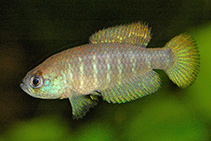
Vertebrae: 28 - 30. Distinguished from its congeners except from those of the Austrolebias alexandri species-group by the dark gray pectoral fins combined with the bright blue iridescence in males. Differs from other species of the Austrolebias alexandri species-group by fewer scales around caudal peduncle (12 vs. 16 or more) and the fewer dorsal-fin rays in males (17-21 vs. 20 or more ). Can be differentiated from all other species of the genus by the absence of contact organs on the inner surface of the pectoral fin in males and the color pattern of females - ground color light brownish, sides of body with a variable number of relatively large dark black spots distributed mostly on posterior portion of body (Ref. 76851).
Body shape (shape guide): elongated.
Inhabits temporary pool, almost completely covered with emergent vegetation (Ref. 76851).
Life cycle and mating behavior Maturity | Reproduction | Spawning | Eggs | Fecundity | Larvae
Ferrer, J., L.R. Malabarba and W.J.E.M. Costa, 2008. Austrolebias paucisquama (Cyprinodontiformes: Rivulidae), a new species of annual killifish from Southern Brazil. Neotrop. Ichthyol. 6(2):175-180. (Ref. 76851)
IUCN Red List Status (Ref. 130435: Version 2025-2)