Teleostei (teleosts) >
Pleuronectiformes (Flatfishes) >
Cynoglossidae (Tonguefishes) > Symphurinae
Etymology: Symphurus: Greek, syn, symphysis = grown together + Greek, oura = tail (Ref. 45335); ocellaris: Name from Latin meaning eyes, refers to the distinct ocellated spot on the caudal fin.
Environment: milieu / climate zone / depth range / distribution range
Ecology
Marine; demersal; depth range 7 - 20 m (Ref. 75618). Tropical
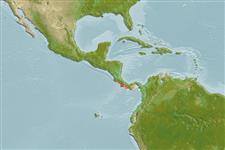
Eastern Central Pacific: Panama.
Size / Weight / Age
Maturity: Lm ? range ? - ? cm
Max length : 7.3 cm SL male/unsexed; (Ref. 75618)
Short description
Identification keys | Morphology | Morphometrics
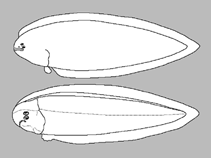
Dorsal soft rays (total): 96 - 97; Anal soft rays: 80 - 81; Vertebrae: 51. This species is distinguished from its congeners by these characters: a 1-3-4 pattern of interdigitation of dorsal-fin pterygiophores and neural spines; caudal-fin rays 12; presence of an ocellated spot on the caudal fin in both sexes; total vertebrae 51, dorsal-fin rays 96-97, anal-fin rays 80-81; longitudinal scale rows 85-86; a pupillary operculum; non-pigmented peritoneum, uniformly pigmented blind side, and ocular-side background coloration without prominent dark spots or conspicuous crossbands (Ref. 75618).
Body shape (shape guide): short and / or deep.
Life cycle and mating behavior
Maturity | Reproduction | Spawning | Eggs | Fecundity | Larvae
Munroe, T.A. and D.R. Robertson, 2005. Symphurus ocellaris, a new shallow-water symphurine tonguefish collected off Pacific Panama (Pleuronectiformes: Cynoglossidae). Proc. Biol. Soc. Wash. 118(8):576-581. (Ref. 75618)
IUCN Red List Status (Ref. 130435: Version 2025-2)
Threat to humans
Harmless
Human uses
Tools
Special reports
Download XML
Internet sources