-

- About this page
- Languages
- User feedbacks
- Citation
- Uploads
-
Related species
- Species in
Squatina - Species in
Squatinidae - - Classification -
- Squatinidae
- Squatiniformes
- Elasmobranchii
- Chordata
- Animalia
- Species in
-



Squatina pseudocellata Last & White, 2008
Western angelshark
Add your observation in Fish Watcher
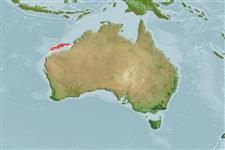
| Native range | All suitable habitat | Point map | Year 2050 |
|
| This map was computer-generated and has not yet been reviewed. |
| Squatina pseudocellata AquaMaps Data sources: GBIF OBIS |
Upload your photos and videos
Pictures | Google image Squatina pseudocellata
Male Picture by Last P.R. & W.T. White
Pictures | Google image
Male Picture by Last P.R. & W.T. White
Classification / Names Common names | Synonyms | Catalog of Fishes(genus, species) | ITIS | CoL | WoRMS | Cloffa
Elasmobranchii (sharks and rays) > Squatiniformes (Angel sharks) > Squatinidae (Angel sharks)
Etymology: Squatina: Latin for skate, which angel sharks superficially resemble, presumably tautonymous with Squalus squatina Linnaeus 1758 (no species mentioned) (See ETYFish); pseudocellata: pseudo-, from pseudes (Gr.), false; ocellata (L.), having little eyes (ocelli), referring to indistinct ocellate markings on pectoral fins (See ETYFish).
More on authors: Last & White.
Etymology: Squatina: Latin for skate, which angel sharks superficially resemble, presumably tautonymous with Squalus squatina Linnaeus 1758 (no species mentioned) (See ETYFish); pseudocellata: pseudo-, from pseudes (Gr.), false; ocellata (L.), having little eyes (ocelli), referring to indistinct ocellate markings on pectoral fins (See ETYFish).
More on authors: Last & White.
Environment: milieu / climate zone / depth range / distribution range Ecology
Marine; benthopelagic; depth range 150 - 312 m (Ref. 74939). Tropical; 18°S - 25°S
Distribution Territories | FAO areas | Ecosystems | Occurrences | Point map | Introductions | Faunafri
Eastern Indian Ocean: northwestern Australia.
Size / Weight / Age
Maturity: Lm ? range ? - ? cm
Max length : 75.1 cm TL male/unsexed; (Ref. 74939); 64.0 cm TL (female)
Max length : 75.1 cm TL male/unsexed; (Ref. 74939); 64.0 cm TL (female)
Short description Identification keys | Morphology | Morphometrics
Body strongly depressed anteriorly, firm. Trunk strongly depressed, almost ray-like, deepest over abdomen; not tapering abruptly at pelvic-fin insertion, tail strongly depressed, even at origin of caudal fin. Abdomen moderately elongate. Head broad, extended laterally, strongly depressed. Dermal denticles covering entire dorsal surface of body; less dense, absent on posterior borders of fins (Ref. 74939).
Cross section: flattened.
Cross section: flattened.
Life cycle and mating behavior Maturity | Reproduction | Spawning | Eggs | Fecundity | Larvae
Main reference
Upload your references | References | Coordinator : Compagno, Leonard J.V. | Collaborators
Last, P.R. and W.T. White, 2008. Three new angel sharks (Chondrichthyes:Squatinidae) from the Indo-Australian region. Zootaxa 1734:1-26. (Ref. 74939)
CITES
Not Evaluated
Threat to humans
Harmless
Human uses
FAO - Publication: search | FishSource |
More information
Trophic ecology
Food items (preys)
Diet composition
Food consumption
Food rations
Predators
Food items (preys)
Diet composition
Food consumption
Food rations
Predators
Ecology
Ecology
Ecology
Population dynamics
Growth parameters
Max. ages / sizes
Length-weight rel.
Length-length rel.
Length-frequencies
Mass conversion
Recruitment
Abundance
Growth parameters
Max. ages / sizes
Length-weight rel.
Length-length rel.
Length-frequencies
Mass conversion
Recruitment
Abundance
Life cycle
Reproduction
Maturity
Maturity/Gills rel.
Fecundity
Spawning
Spawning aggregations
Eggs
Egg development
Larvae
Larval dynamics
Reproduction
Maturity
Maturity/Gills rel.
Fecundity
Spawning
Spawning aggregations
Eggs
Egg development
Larvae
Larval dynamics
Anatomy
Gill area
Brain
Otolith
Gill area
Brain
Otolith
Physiology
Body composition
Nutrients
Oxygen consumption
Swimming type
Swimming speed
Visual pigments
Fish sound
Diseases & Parasites
Toxicity (LC50s)
Body composition
Nutrients
Oxygen consumption
Swimming type
Swimming speed
Visual pigments
Fish sound
Diseases & Parasites
Toxicity (LC50s)
Genetics
Genome
Genetics
Heterozygosity
Heritability
Genetic Diversity
Genome
Genetics
Heterozygosity
Heritability
Genetic Diversity
Human related
Aquaculture systems
Aquaculture profiles
Strains
Ciguatera cases
Stamps, coins, misc.
Aquaculture systems
Aquaculture profiles
Strains
Ciguatera cases
Stamps, coins, misc.
Tools
Special reports
Download XML
Internet sources
AFORO (otoliths) | Aquatic Commons | BHL | Cloffa | Websites from users | Check FishWatcher | CISTI | Catalog of Fishes: genus, species | DiscoverLife | ECOTOX | FAO - Publication: search | Faunafri | Fishipedia | Fishtrace | GloBI | Google Books | Google Scholar | Google | IGFA World Record | OneZoom | Open Tree of Life | Otolith Atlas of Taiwan Fishes | PubMed | Reef Life Survey | Socotra Atlas | TreeBase | Tree of Life | Wikipedia: Go, Search | World Records Freshwater Fishing | Zoobank | Zoological Record
Estimates based on models
Preferred temperature (Ref. 123201): 14.1 - 20.4, mean 18.9 °C (based on 8 cells).
Phylogenetic diversity index (Ref. 82804): PD50 = 0.5000 [Uniqueness, from 0.5 = low to 2.0 = high].
Bayesian length-weight: a=0.00676 (0.00295 - 0.01551), b=3.07 (2.88 - 3.26), in cm total length, based on LWR estimates for this Genus-body shape (Ref. 93245).
Trophic level (Ref. 69278): 3.9 ±0.6 se; based on size and trophs of closest relatives
Resilience (Ref. 120179): Low, minimum population doubling time 4.5 - 14 years (Preliminary low fecundity).