Teleostei (teleosts) >
Cypriniformes (Carps) >
Nemacheilidae (Brook loaches)
Etymology: Triplophysa: Greek, triplos = thrice + Greek, physa = tube (Ref. 45335).
Eponymy: Alexander Nikolaevich Kaznakov (1872–1933) was a Russian zoologist and naturalist who became Director, Caucasus Museum. [...] (Ref. 128868), visit book page.
Environment: milieu / climate zone / depth range / distribution range
Ecology
Freshwater; benthopelagic. Temperate
Asia: China, Tuguryuk River Valley (= Nom-Gol River).
Size / Weight / Age
Maturity: Lm ? range ? - ? cm
Max length : 12.7 cm SL male/unsexed; (Ref. 57754)
Short description
Identification keys | Morphology | Morphometrics
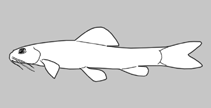
Dorsal spines (total): 3; Dorsal soft rays (total): 7; Anal spines: 3; Anal soft rays: 5; Vertebrae: 42 - 46. Distinguished from its congeners by the following characters: distance between anterior and posterior nares exceeds diameter of posterior ones, upper lip with deep median incision, sometimes completely dividing it into two parts; lower lip has extensive lateral expansions; weakly developed processus dentiformis always present; lateral line complete; manubrium well-developed; free air-bladder portion reduced or absent; vertebrae 42-46; anterior fontanelle or neurocranium present; parietal and pteroticum in contact; basibranchial-4 and infrapharyngobranchials-3 absent (Ref. 57754).
Body shape (shape guide): elongated.
Life cycle and mating behavior
Maturity | Reproduction | Spawning | Eggs | Fecundity | Larvae
Prokofiev, A.M., 2004. Revision of the species-complex of Triplophysa labiata with description of a new species, T. kaznakowi sp. n. (Osteichthyes,Balitoridae, Nemacheilinae). Senckenb. Biol. 83(2):181-208. (Ref. 57754)
IUCN Red List Status (Ref. 130435: Version 2025-2)
Threat to humans
Harmless
Human uses
Tools
Special reports
Download XML
Internet sources