Teleostei (teleosts) >
Pleuronectiformes (Flatfishes) >
Cynoglossidae (Tonguefishes) > Symphurinae
Etymology: Symphurus: Greek, syn, symphysis = grown together + Greek, oura = tail (Ref. 45335).
Environment: milieu / climate zone / depth range / distribution range
Ecology
Marine; bathydemersal. Deep-water
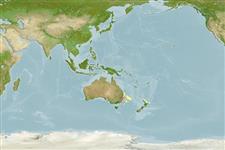
Indo-West Pacific: Australia.
Size / Weight / Age
Maturity: Lm ? range ? - ? cm
Short description
Identification keys | Morphology | Morphometrics
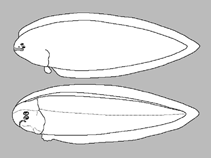
Dorsal soft rays (total): 111 - 119; Anal soft rays: 98 - 104; Vertebrae: 59 - 65. With a 1-2-2 pattern of interdigitation of proximal dorsal pterygiophores and interneural spines (ID); 9 abdominal vertebrae; 110-125 scales in a longitudinal series; whitish or yellowish blind side which is distinctly lighter than the ocular surface (Ref. 35979).
Body shape (shape guide): short and / or deep.
Life cycle and mating behavior
Maturity | Reproduction | Spawning | Eggs | Fecundity | Larvae
Munroe, T.A. and K. Amaoka, 1998. Symphurus hondoensis Hubbs, 1915, a valid species of Western Pacific tonguefish (Pleuronectiformes: Cynoglossidae). Ichthyol. Res. 45(4):385-391. (Ref. 35979)
IUCN Red List Status (Ref. 130435: Version 2025-2)
Threat to humans
Harmless
Human uses
Tools
Special reports
Download XML
Internet sources