Teleostei (teleosts) >
Pleuronectiformes (Flatfishes) >
Cynoglossidae (Tonguefishes) > Symphurinae
Etymology: Symphurus: Greek, syn, symphysis = grown together + Greek, oura = tail (Ref. 45335).
More on author: Hubbs.
Environment: milieu / climate zone / depth range / distribution range
Ecology
Marine; bathydemersal; depth range 390 - 815 m (Ref. 35979). Deep-water
Distribution
Territories | FAO areas | Ecosystems | Occurrences | Point map | Introductions | Faunafri
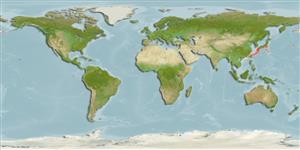
Northwest Pacific: probably endemic to deep waters off the southern Japanese Archipelago.
Size / Weight / Age
Maturity: Lm ? range ? - ? cm
Max length : 12.2 cm SL male/unsexed; (Ref. 35979)
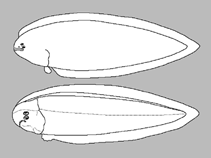
Dorsal spines (total): 0; Dorsal soft rays (total): 111 - 113; Anal spines: 0; Anal soft rays: 95; Vertebrae: 59. Distinguished from congeners by having 1-2-3 interdigitation pattern (ID) of proximal dorsal pterygiophores and interneural spines; 10 abdominal vertebrae; 14 caudal-fin rays; 105-106 scales in longitudinal series; a pigmented blind side nearly as dark as the ocular surface; and black peritoneum (Ref. 35979).
Body shape (shape guide): short and / or deep.
Collected from sand or sand-mud bottom (Ref. 35979). Unpublished maximum depth given at 1040 m (in Ref. 127475).
Life cycle and mating behavior
Maturity | Reproduction | Spawning | Eggs | Fecundity | Larvae
Munroe, T.A. and K. Amaoka, 1998. Symphurus hondoensis Hubbs, 1915, a valid species of Western Pacific tonguefish (Pleuronectiformes: Cynoglossidae). Ichthyol. Res. 45(4):385-391. (Ref. 35979)
IUCN Red List Status (Ref. 130435: Version 2025-2)
Threat to humans
Harmless
Human uses
Tools
Special reports
Download XML
Internet sources