Teleostei (teleosts) >
Ovalentaria/misc (Various families in series Ovalentaria) >
Pomacentridae (Damselfishes) > Microspathodontinae
Etymology: Stegastes: Greek, stegastos, -e, -on = covered (Ref. 45335).
More on author: Forster.
Environment: milieu / climate zone / depth range / distribution range
Ecology
Marine; reef-associated; depth range 0 - 5 m (Ref. 39287). Tropical
Eastern Central Pacific: Endemic to Marquesas Is. (French Polynesia).
Size / Weight / Age
Maturity: Lm ? range ? - ? cm
Max length : 13.8 cm SL male/unsexed; (Ref. 137577)
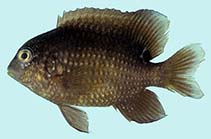
Dorsal spines (total): 12; Dorsal soft rays (total): 15; Anal spines: 2; Anal soft rays: 12 - 14; Vertebrae: 26. Body dark reddish brown with edges of scales narrowly darker brown; black spot in axil and upper half of pectoral fin base. Body depth, 2-2.3 in SL. Preorbital width above end of maxilla 1/2 or more orbit diameter; margin of suborbital and posterior margin of preopercle strongly serrated. Suborbital scaled; scales on snout extending slightly anterior to nostrils. Tubed lateral line scales 19-20 (Ref. 39287).
Body shape (shape guide): short and / or deep; Cross section: compressed.
A shallow water species; on hard substratum (Ref. 39287). Adults are collected usually from bays and many from tide pools (Ref. 54980). Oviparous, distinct pairing during breeding (Ref. 205). Eggs are demersal and adhere to the substrate (Ref. 205). Males guard and aerate the eggs (Ref. 205).
Life cycle and mating behavior
Maturity | Reproduction | Spawning | Eggs | Fecundity | Larvae
Oviparous, distinct pairing during breeding (Ref. 205). Eggs are demersal and adhere to the substrate (Ref. 205). Males guard and aerate the eggs (Ref. 205).
Randall, J.E., 2001. Four new damselfishes (Perciformes: Pomacentridae) from the Marquesas Islands. Copeia 2001(1):92-107. (Ref. 39287)
IUCN Red List Status (Ref. 130435: Version 2025-2)
Threat to humans
Harmless
Human uses
Tools
Special reports
Download XML
Internet sources