Teleostei (teleosts) >
Stomiiformes (Lightfishes and dragonfishes) >
Stomiidae (Barbeled dragonfishes) > Astronesthinae
Etymology: Astronesthes: Greek, astra = ray + Greek, esthes, -es = suit, something used to wrap (Ref. 45335); lucibucca: The name is derived from the Latin 'lux' (light) and 'bucca' (cheek), referring to the unique specific characteristic (the presence of luminous patches in the cheek region) (Ref. 27676).
Environment: milieu / climate zone / depth range / distribution range
Ecology
Marine; pelagic-oceanic; depth range 150 - 210 m (Ref. 27676). Subtropical
Southeast Pacific: Type specimens were taken from the transition zone between the subtropical and subantarctic gyres. Possibly, it is more widely distributed in the transitional zone of the southern hemisphere, i.e., in the southern Subtropical Convergence Region. High Seas only.
Size / Weight / Age
Maturity: Lm ? range ? - ? cm
Max length : 10.0 cm SL male/unsexed; (Ref. 27676)
Short description
Identification keys | Morphology | Morphometrics
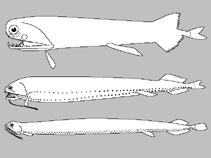
Dorsal soft rays (total): 15 - 16; Anal soft rays: 14 - 16; Vertebrae: 45 - 46. Last photophore of VAL series in advance both of origin of anal and last photophore of VAV series. Luminous patches on head, when fully developed in fish > 9.5 cm SL, appearing on upper, middle and lower parts of gill cover and behind eye, on cheek; no luminous patches on body. In immature fish < 6 cm SL, chin barbel fully developed, longer than head, its swollen tip forming a narrow lobe with weak oblique ribs; distal part of barbel twisted at a right angle (Ref. 27676).
Body shape (shape guide): elongated.
Life cycle and mating behavior
Maturity | Reproduction | Spawning | Eggs | Fecundity | Larvae
Parin, N.V. and O.D. Borodulina, 1996. Revision of the Astronesthes indicus species group (Astronesthidae), with descriptions of five new species. J. Ichthyol. 36(8):551-565. (Ref. 27676)
IUCN Red List Status (Ref. 130435: Version 2025-2)
Threat to humans
Harmless
Human uses
Tools
Special reports
Download XML
Internet sources