Teleostei (teleosts) >
Eupercaria/misc (Various families in series Eupercaria) >
Labridae (Wrasses) > Scarinae
Etymology: Calotomus: Greek, kalos, kallos = beautiful + Greek, tomos = section, cut (Ref. 45335).
Environment: milieu / climate zone / depth range / distribution range
Ecology
Marine; reef-associated; depth range 12 - 170 m (Ref. 525). Tropical
Pacific Ocean: Midway and Hawaiian islands.
Size / Weight / Age
Maturity: Lm ? range ? - ? cm
Max length : 33.0 cm TL male/unsexed; (Ref. 9710)
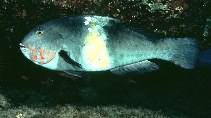
Dorsal spines (total): 9; Dorsal soft rays (total): 10; Anal spines: 3; Anal soft rays: 9; Vertebrae: 25. When fresh, reddish brown to brown dorsally, reddish to almost white ventrally; irregular fine whitish marks on scales. Head with white speckling; a reddish transverse band on chin, followed by a diffuse white band; reddish iris. Whitish pectoral fins, base reddish brown; 3 narrow irregular brownish red stripes on whitish pelvic fins. Pungent dorsal spines; rounded caudal fin at all sizes. Skin dark around anus, almost black. Lateral line interrupted.
Body shape (shape guide): short and / or deep; Cross section: compressed.
Occurs in areas of coral rock with coral or rubble, from the lower surge zone to at least 10 m (Ref. 9710). Benthopelagic (Ref. 58302). Protogynous (Ref. 55080).
Life cycle and mating behavior
Maturity | Reproduction | Spawning | Eggs | Fecundity | Larvae
Pair spawnings involved an initial- and a terminal-phase fish; group spawnings involve several of both. Investigations strongly suggest that the species is gonochoristic.
Bruce, R.W. and J.E. Randall, 1985. A revision of the Indo-West Pacific parrotfish genera Calotomus and Leptoscarus (Scaridae: Sparisomatinae). Indo-Pac. Fish. (5):32 p. (Ref. 525)
IUCN Red List Status (Ref. 130435: Version 2025-2)
Threat to humans
Harmless
Human uses
Fisheries: commercial; aquarium: commercial
Tools
Special reports
Download XML
Internet sources