Teleostei (teleosts) >
Blenniiformes (Blennies) >
Blenniidae (Combtooth blennies) > Salariinae
Etymology: Entomacrodus: Greek, ento = inside + Greek, makros = big + Greek, odous = teeth (Ref. 45335).
More on author: Gill.
Environment: milieu / climate zone / depth range / distribution range
Ecology
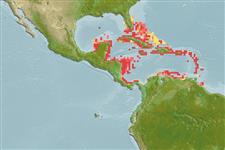
Marine; reef-associated; depth range 0 - 6 m (Ref. 9710), usually 0 - 3 m (Ref. 13628). Tropical; 32°N - 7°N, 92°W - 59°W
Western Atlantic: Bermuda, southern Florida (USA), and Bahamas to northern South America.
Size / Weight / Age
Maturity: Lm ? range ? - ? cm
Max length : 10.0 cm TL male/unsexed; (Ref. 7251)
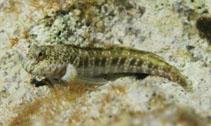
Facultative air-breathing (Ref. 126274); Adults occur in intertidal areas (Ref. 31184), like tide pools, rocky slopes, and places where there are boulders on the bottom (Ref. 5521). Actively shuttle back and forth between rock-pools and air (Ref. 31184). They breathe air (Ref. 31184) and can remain out of water for up to 2 hours if kept moist (Ref. 51276). Feed mainly on algae (Ref. 13442). Oviparous. Eggs are demersal and adhesive (Ref. 205), and are attached to the substrate via a filamentous, adhesive pad or pedestal (Ref. 94114). Larvae are planktonic, often found in shallow, coastal waters (Ref. 94114).
Life cycle and mating behavior
Maturity | Reproduction | Spawning | Eggs | Fecundity | Larvae
Oviparous, distinct pairing (Ref. 205).
Robins, C.R. and G.C. Ray, 1986. A field guide to Atlantic coast fishes of North America. Houghton Mifflin Company, Boston, U.S.A. 354 p. (Ref. 7251)
IUCN Red List Status (Ref. 130435: Version 2025-2)
Threat to humans
Harmless
Human uses
Fisheries: of no interest; aquarium: commercial
Tools
Special reports
Download XML
Internet sources