Teleostei (teleosts) >
Lophiiformes (Anglerfishes) >
Gigantactinidae (Whipnose anglers)
Etymology: Gigantactis: Greek, 'gigas' or 'gigantos' = gigantic + Greek, 'aktis' = ray (referring to the unusually long first dorsal-fin spine that functions as a lure in this genus) (Ref. 86949).
More on author: Regan.
Environment: milieu / climate zone / depth range / distribution range
Ecology
Marine; bathypelagic; depth range 2000 - 2500 m (Ref. 86949). Deep-water
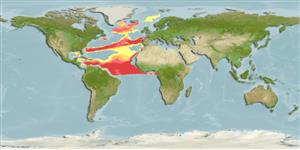
Atlantic Ocean: in tropical waters.
Size / Weight / Age
Maturity: Lm ? range ? - ? cm
Max length : 10.7 cm TL male/unsexed; (Ref. 44404)
Short description
Identification keys | Morphology | Morphometrics
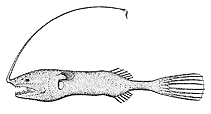
Dorsal soft rays (total): 5 - 6; Anal soft rays: 5 - 6. Metamorphosed females distinguished by the following characteristics: length of illicium less than 120% SL (104-107%SL); escal bulb with an elongate darkly pigmented spinulose distal prolongation; presence of short distal and slender proximal escal filaments; absence of distally flattened escal papillae; illicium without posterior pair of papillae; dentary teeth in posterior part of jaw in three longitudinal series; rays of caudal fin less than 30% SL (Ref. 86949).
Life cycle and mating behavior
Maturity | Reproduction | Spawning | Eggs | Fecundity | Larvae
Bertelsen, E., 1990. Gigantactinidae. p. 513-515. In J. C. Quero, J. C. Hureau, C. Karrer, A. Post and L. Saldanha (eds.) Check-list of the fishes of the eastern tropical Atlantic (CLOFETA). JNICT, Lisbon; SEI, Paris; and UNESCO, Paris. Vol. 1. (Ref. 10761)
IUCN Red List Status (Ref. 130435: Version 2025-2)
Threat to humans
Harmless
Human uses
Fisheries: of no interest
Tools
Special reports
Download XML
Internet sources