



Anguilla bicolor McClelland, 1844
Indonesian shortfin eel
Add your observation in Fish Watcher
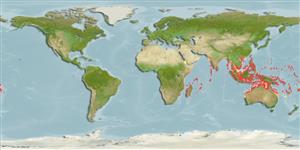
| Native range | All suitable habitat | Point map | Year 2050 |
|
| This map was computer-generated and has not yet been reviewed. |
| Anguilla bicolor AquaMaps Data sources: GBIF OBIS |
Upload your photos and videos
Pictures | Google image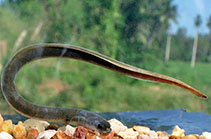 Anguilla bicolor
Picture by Ramani Shirantha
Pictures | Google image
Picture by Ramani Shirantha
Classification / Names Common names | Synonyms | Catalog of Fishes(genus, species) | ITIS | CoL | WoRMS | Cloffa
Teleostei (teleosts) > Anguilliformes (Eels and morays) > Anguillidae (Freshwater eels)
Etymology: Anguilla: Latin, anguilla, .-ae = eel (Ref. 45335).
More on author: McClelland.
Etymology: Anguilla: Latin, anguilla, .-ae = eel (Ref. 45335).
More on author: McClelland.
Environment: milieu / climate zone / depth range / distribution range Ecology
Marine; freshwater; brackish; demersal; catadromous (Ref. 138274). Tropical; 22°N - 27°S
Distribution Territories | FAO areas | Ecosystems | Occurrences | Point map | Introductions | Faunafri
Indo-Pacific: widespread in the tropical Indian Ocean and western Pacific. Known in Australia only from streams in the Kimberley regions of northern western Australia. Africa: widespread but relatively uncommon along east and southeast African coast and Madagascar (Ref. 7248, 52193). Mozambique; Lower Zambezi River (Ref. 39494). Most easily confused with Anguilla obscura and the surest way to distinguish them is by the count of vertebrae (Ref. 9828).
Size / Weight / Age
Maturity: Lm ? range ? - ? cm
Max length : 123 cm TL male/unsexed; (Ref. 6371); common length : 65.0 cm TL male/unsexed; (Ref. 2871); max. reported age: 20 years (Ref. 48660)
Max length : 123 cm TL male/unsexed; (Ref. 6371); common length : 65.0 cm TL male/unsexed; (Ref. 2871); max. reported age: 20 years (Ref. 48660)
Short description Identification keys | Morphology | Morphometrics
Dorsal spines (total): 0; Dorsal soft rays (total): 240 - 245; Anal spines: 0; Anal soft rays: 200 - 220; Vertebrae: 105 - 115.
Body shape (shape guide): eel-like; Cross section: circular.
Body shape (shape guide): eel-like; Cross section: circular.
Adults inhabit freshwater streams and pools, preferring marshy habitats (Ref. 41236), in rivers and creeks, commonly over rock bottoms and in deeper pools and move as young to estuaries and seas (Ref. 12693). Seldom found in large rivers (Ref. 6028). Restricted to lowland (coastal) reaches of river systems (Ref. 7248). Adults descend to the sea to spawn (Refs. 52331, 79840). They feed on small fishes, crustaceans and mollusks. Reported to breed east of Madagascar; the south equatorial current probably carries the eel larvae and elvers towards the east coast of Africa where local coastal currents guide the elvers to suitable rivers which they invade and they stay there until sexually mature, when they return to their breeding grounds (Ref. 13337). Caught with various types of nets. Sometimes used in the aquarium trade (Ref. 6028).
Life cycle and mating behavior Maturity | Reproduction | Spawning | Eggs | Fecundity | Larvae
Main reference
Upload your references | References | Coordinator | Collaborators
Kottelat, M., 2013. The fishes of the inland waters of Southeast Asia: a catalogue and core bibliography of the fishes known to occur in freshwaters, mangroves and estuaries. The Raffles Bulletin of Zoology 2013 (Suppl. 27):1-663. (Ref. 94476)
IUCN Red List Status (Ref. 130435: Version 2025-2 (Global))
Near Threatened (NT) (A2bcde); Date assessed: 11 August 2019
CITES
Not Evaluated
Threat to humans
Harmless
Human uses
Fisheries: minor commercial
FAO - Publication: search | FishSource | Sea Around Us
More information
Population dynamics
Growth parameters
Max. ages / sizes
Length-weight rel.
Length-length rel.
Length-frequencies
Mass conversion
Recruitment
Abundance
Growth parameters
Max. ages / sizes
Length-weight rel.
Length-length rel.
Length-frequencies
Mass conversion
Recruitment
Abundance
Life cycle
Reproduction
Maturity
Maturity/Gills rel.
Fecundity
Spawning
Spawning aggregations
Eggs
Egg development
Larvae
Larval dynamics
Reproduction
Maturity
Maturity/Gills rel.
Fecundity
Spawning
Spawning aggregations
Eggs
Egg development
Larvae
Larval dynamics
Anatomy
Gill area
Brain
Otolith
Gill area
Brain
Otolith
Physiology
Body composition
Nutrients
Oxygen consumption
Swimming type
Swimming speed
Visual pigments
Fish sound
Diseases & Parasites
Toxicity (LC50s)
Body composition
Nutrients
Oxygen consumption
Swimming type
Swimming speed
Visual pigments
Fish sound
Diseases & Parasites
Toxicity (LC50s)
Genetics
Genome
Genetics
Heterozygosity
Heritability
Genetic Diversity
Genome
Genetics
Heterozygosity
Heritability
Genetic Diversity
Human related
Aquaculture systems
Aquaculture profiles
Strains
Ciguatera cases
Stamps, coins, misc.
Aquaculture systems
Aquaculture profiles
Strains
Ciguatera cases
Stamps, coins, misc.
Tools
E-book | Field guide | Identification keys | Length-frequency wizard | Life-history tool | Point map |
Catch-MSY |
Special reports
Download XML
Internet sources
AFORO (otoliths) | Alien/Invasive Species database | Aquatic Commons | BHL | Cloffa | Websites from users | Check FishWatcher | CISTI | Catalog of Fishes: genus, species | DiscoverLife | ECOTOX | FAO - Publication: search | Faunafri | Fishipedia | Fishtrace | GloBI | Google Books | Google Scholar | Google | IGFA World Record | National databases | OneZoom | Open Tree of Life | Otolith Atlas of Taiwan Fishes | PubMed | Reef Life Survey | Socotra Atlas | TreeBase | Tree of Life | Wikipedia: Go, Search | World Records Freshwater Fishing | Zoobank | Zoological Record
Estimates based on models
Preferred temperature (Ref. 123201): 26.5 - 29.1, mean 28.3 °C (based on 1098 cells).
Phylogenetic diversity index (Ref. 82804): PD50 = 0.5000 [Uniqueness, from 0.5 = low to 2.0 = high].
Bayesian length-weight: a=0.00076 (0.00037 - 0.00155), b=3.17 (3.00 - 3.34), in cm total length, based on LWR estimates for this Genus-body shape (Ref. 93245).
Trophic level (Ref. 69278): 3.6 ±0.50 se; based on food items.
Resilience (Ref. 120179): Low, minimum population doubling time 4.5 - 14 years (tmax=20).
Nutrients (Ref. 124155): Calcium = 58.7 [34.4, 111.3] mg/100g; Iron = 0.801 [0.472, 1.318] mg/100g; Protein = 18.8 [17.0, 20.8] %; Omega3 = 0.29 [0.14, 0.60] g/100g; Selenium = 150 [74, 289] μg/100g; VitaminA = 13.3 [3.1, 51.7] μg/100g; Zinc = 0.925 [0.650, 1.373] mg/100g (wet weight); based on nutrient studies.