-

- About this page
- Languages
- User feedbacks
- Citation
- Uploads
-
Related species
- Species in
Synchiropus - Species in
Callionymidae - - Classification -
- Callionymidae
- Callionymiformes
- Teleostei
- Chordata
- Animalia
- Species in
-



Synchiropus morrisoni Schultz, 1960
Morrison's dragonet
Add your observation in Fish Watcher
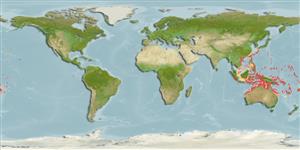
| Native range | All suitable habitat | Point map | Year 2050 |
|
| This map was computer-generated and has not yet been reviewed. |
| Synchiropus morrisoni AquaMaps Data sources: GBIF OBIS |
Upload your photos and videos
Pictures | Videos | Google image Synchiropus morrisoni
Female Picture by Petrinos, C.
Pictures | Videos | Google image
Female Picture by Petrinos, C.
Classification / Names Common names | Synonyms | Catalog of Fishes(genus, species) | ITIS | CoL | WoRMS | Cloffa
Teleostei (teleosts) > Callionymiformes (Dragonets) > Callionymidae (Dragonets)
Etymology: Synchiropus: Greek, syn, symphysis = grown together + Greek, cheir = hand + Greek, pous = foot (Ref. 45335).
Eponymy: Dr Joseph Paul Eldred Morrison (1906–1983) was an American malacologist and collector. [...] (Ref. 128868), visit book page.
More on author: Schultz.
Etymology: Synchiropus: Greek, syn, symphysis = grown together + Greek, cheir = hand + Greek, pous = foot (Ref. 45335).
Eponymy: Dr Joseph Paul Eldred Morrison (1906–1983) was an American malacologist and collector. [...] (Ref. 128868), visit book page.
More on author: Schultz.
Environment: milieu / climate zone / depth range / distribution range Ecology
Marine; reef-associated; depth range 10 - 40 m (Ref. 75992), usually 25 - 33 m (Ref. 27115). Tropical; 33°N - 26°S, 100°E - 168°W
Distribution Territories | FAO areas | Ecosystems | Occurrences | Point map | Introductions | Faunafri
Western Pacific: Japan to Australia and eastward to Samoa.
Size / Weight / Age
Short description Identification keys | Morphology | Morphometrics
Dorsal spines (total): 4; Dorsal soft rays (total): 8; Anal spines: 0; Anal soft rays: 7. Body with numerous round spots. Males identified by striped dorsal fin (Ref. 48636).
Body shape (shape guide): fusiform / normal.
Body shape (shape guide): fusiform / normal.
Occurs in algal covered rocks of seaward reefs; rarely in less than 25 m in most coral reef areas (Ref. 1602, 48636). Minimum depth from Ref. 90102, common minimum depth from Refs. 1602, 48636, 34765.
Life cycle and mating behavior Maturity | Reproduction | Spawning | Eggs | Fecundity | Larvae
Main reference
Upload your references | References | Coordinator : Fricke, Ronald | Collaborators
Fricke, R., 2016. Synchiropus novaehiberniensis, a new species of dragonet from New Ireland, Papua New Guinea, western Pacific Ocean, with a review of subgenus Synchiropus (Neosynchiropus) and description of a new subgenus (Teleostei: Callionymidae). J. Nat. Hist. (Ref. 111072)
IUCN Red List Status (Ref. 130435: Version 2025-2)
Least Concern (LC) ; Date assessed: 24 March 2022
CITES
Not Evaluated
Threat to humans
Harmless
Human uses
Fisheries: commercial; aquarium: commercial; bait: occasionally
FAO - Publication: search | FishSource |
More information
Trophic ecology
Food items (preys)
Diet composition
Food consumption
Food rations
Predators
Food items (preys)
Diet composition
Food consumption
Food rations
Predators
Population dynamics
Growth parameters
Max. ages / sizes
Length-weight rel.
Length-length rel.
Length-frequencies
Mass conversion
Recruitment
Abundance
Growth parameters
Max. ages / sizes
Length-weight rel.
Length-length rel.
Length-frequencies
Mass conversion
Recruitment
Abundance
Life cycle
Reproduction
Maturity
Maturity/Gills rel.
Fecundity
Spawning
Spawning aggregations
Eggs
Egg development
Larvae
Larval dynamics
Reproduction
Maturity
Maturity/Gills rel.
Fecundity
Spawning
Spawning aggregations
Eggs
Egg development
Larvae
Larval dynamics
Anatomy
Gill area
Brain
Otolith
Gill area
Brain
Otolith
Physiology
Body composition
Nutrients
Oxygen consumption
Swimming type
Swimming speed
Visual pigments
Fish sound
Diseases & Parasites
Toxicity (LC50s)
Body composition
Nutrients
Oxygen consumption
Swimming type
Swimming speed
Visual pigments
Fish sound
Diseases & Parasites
Toxicity (LC50s)
Genetics
Genome
Genetics
Heterozygosity
Heritability
Genetic Diversity
Genome
Genetics
Heterozygosity
Heritability
Genetic Diversity
Human related
Aquaculture systems
Aquaculture profiles
Strains
Ciguatera cases
Stamps, coins, misc.
Aquaculture systems
Aquaculture profiles
Strains
Ciguatera cases
Stamps, coins, misc.
Tools
Special reports
Download XML
Internet sources
AFORO (otoliths) | Aquatic Commons | BHL | Cloffa | Websites from users | Check FishWatcher | CISTI | Catalog of Fishes: genus, species | DiscoverLife | ECOTOX | FAO - Publication: search | Faunafri | Fishipedia | Fishtrace | GloBI | Google Books | Google Scholar | Google | IGFA World Record | National databases | OneZoom | Open Tree of Life | Otolith Atlas of Taiwan Fishes | PubMed | Reef Life Survey | Socotra Atlas | TreeBase | Tree of Life | Wikipedia: Go, Search |