-

- About this page
- Languages
- User feedbacks
- Citation
- Uploads
-
Related species
- Species in
Sparisoma - Species in
Labridae - - Classification -
- Scarinae
- Labridae
- Eupercaria/misc
- Teleostei
- Chordata
- Animalia
- Species in
-



Sparisoma aurofrenatum (Valenciennes, 1840)
Redband parrotfish
Add your observation in Fish Watcher
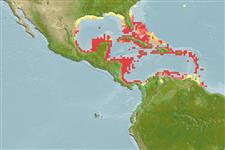
| Native range | All suitable habitat | Point map | Year 2050 |
|
| This map was computer-generated and has not yet been reviewed. |
| Sparisoma aurofrenatum AquaMaps Data sources: GBIF OBIS |
Upload your photos and videos
Pictures | Videos | Google image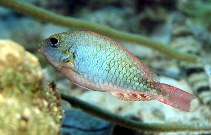 Sparisoma aurofrenatum
Picture by Patzner, R.
Pictures | Videos | Google image
Picture by Patzner, R.
Classification / Names Common names | Synonyms | Catalog of Fishes(genus, species) | ITIS | CoL | WoRMS | Cloffa
Teleostei (teleosts) > Eupercaria/misc (Various families in series Eupercaria) > Labridae (Wrasses) > Scarinae
Etymology: Sparisoma: Latin, sparus = a fish with a golden head + Greek, soma = body (Ref. 45335).
More on author: Valenciennes.
Etymology: Sparisoma: Latin, sparus = a fish with a golden head + Greek, soma = body (Ref. 45335).
More on author: Valenciennes.
Environment: milieu / climate zone / depth range / distribution range Ecology
Marine; reef-associated; depth range 2 - 20 m (Ref. 9710). Subtropical; 33°N - 8°N, 98°W - 51°W
Distribution Territories | FAO areas | Ecosystems | Occurrences | Point map | Introductions | Faunafri
Western Atlantic: throughout the Caribbean Sea.
Length at first maturity / Size / Weight / Age
Maturity: Lm ?, range 15 - ? cm
Max length : 28.0 cm TL male/unsexed; (Ref. 7251); common length : 20.0 cm TL male/unsexed; (Ref. 3802)
Max length : 28.0 cm TL male/unsexed; (Ref. 7251); common length : 20.0 cm TL male/unsexed; (Ref. 3802)
Short description Identification keys | Morphology | Morphometrics
Dorsal spines (total): 9; Dorsal soft rays (total): 10; Anal spines: 3; Anal soft rays: 9. Adults of both sexes have distinct white spot behind base of dorsal fin; super males with red line from corner of mouth to below back of eye; and 2 or more jet-black spots on side above pectoral fin (Ref. 26938). The smaller color phase is brown or greenish brown with a dark blue cast on the back and sides, becoming red ventrally (Ref. 13442).
Body shape (shape guide): fusiform / normal.
Body shape (shape guide): fusiform / normal.
Inhabits coral reefs, young usually in adjacent seagrass beds. Often rests on the bottom (Ref. 9710). Feeds on plants. Solitary or in small groups. A protogynous hermaphrodite (Ref. 55367).
Life cycle and mating behavior Maturity | Reproduction | Spawning | Eggs | Fecundity | Larvae
A monandric species (Ref. 55367). Length at sex change = 17.5 cm TL (Ref. 55367). Forms harem groups composed of a single male and several smaller females (Ref. 55367). Also Ref. 103751.
Main reference
Upload your references | References | Coordinator : Westneat, Mark | Collaborators
Robins, C.R. and G.C. Ray, 1986. A field guide to Atlantic coast fishes of North America. Houghton Mifflin Company, Boston, U.S.A. 354 p. (Ref. 7251)
IUCN Red List Status (Ref. 130435: Version 2025-2)
Least Concern (LC) ; Date assessed: 15 September 2009
CITES
Not Evaluated
Threat to humans
Reports of ciguatera poisoning (Ref. 30303)
Human uses
Fisheries: minor commercial; aquarium: commercial
FAO - Publication: search | FishSource | Sea Around Us
More information
Population dynamics
Growth parameters
Max. ages / sizes
Length-weight rel.
Length-length rel.
Length-frequencies
Mass conversion
Recruitment
Abundance
Growth parameters
Max. ages / sizes
Length-weight rel.
Length-length rel.
Length-frequencies
Mass conversion
Recruitment
Abundance
Life cycle
Reproduction
Maturity
Maturity/Gills rel.
Fecundity
Spawning
Spawning aggregations
Eggs
Egg development
Larvae
Larval dynamics
Reproduction
Maturity
Maturity/Gills rel.
Fecundity
Spawning
Spawning aggregations
Eggs
Egg development
Larvae
Larval dynamics
Physiology
Body composition
Nutrients
Oxygen consumption
Swimming type
Swimming speed
Visual pigments
Fish sound
Diseases & Parasites
Toxicity (LC50s)
Body composition
Nutrients
Oxygen consumption
Swimming type
Swimming speed
Visual pigments
Fish sound
Diseases & Parasites
Toxicity (LC50s)
Genetics
Genome
Genetics
Heterozygosity
Heritability
Genetic Diversity
Genome
Genetics
Heterozygosity
Heritability
Genetic Diversity
Tools
Bio-Quiz | E-book | Field guide | Identification keys | Length-frequency wizard | Life-history tool | Point map |
Catch-MSY |
Special reports
Download XML
Internet sources
AFORO (otoliths) | Aquatic Commons | BHL | Cloffa | Websites from users | Check FishWatcher | CISTI | Catalog of Fishes: genus, species | DiscoverLife | ECOTOX | FAO - Publication: search | Faunafri | Fishipedia | Fishtrace | GloBI | GoMexSI (interaction data) | Google Books | Google Scholar | Google | IGFA World Record | National databases | OneZoom | Open Tree of Life | Otolith Atlas of Taiwan Fishes | PubMed | Reef Life Survey | Socotra Atlas | TreeBase | Tree of Life | Wikipedia: Go, Search | World Records Freshwater Fishing | Zoological Record
Estimates based on models
Preferred temperature (Ref. 123201): 26.3 - 28.2, mean 27.5 °C (based on 491 cells).
Phylogenetic diversity index (Ref. 82804): PD50 = 0.5000 [Uniqueness, from 0.5 = low to 2.0 = high].
Bayesian length-weight: a=0.01072 (0.00655 - 0.01752), b=3.13 (2.99 - 3.27), in cm total length, based on LWR estimates for this species & Genus-body shape (Ref. 93245).
Trophic level (Ref. 69278): 2.0 ±0.1 se; based on diet studies.
Generation time: 5.5 ( na - na) years. Estimated as median ln(3)/K based on 2 growth studies.
Resilience (Ref. 120179): Medium, minimum population doubling time 1.4 - 4.4 years (K=0.20).
Nutrients (Ref. 124155): Calcium = 40.6 [20.6, 87.8] mg/100g; Iron = 0.787 [0.395, 1.416] mg/100g; Protein = 19 [17, 21] %; Omega3 = 0.158 [0.082, 0.289] g/100g; Selenium = 13.4 [6.2, 28.9] μg/100g; VitaminA = 34.2 [9.1, 126.0] μg/100g; Zinc = 1.27 [0.82, 2.21] mg/100g (wet weight);