-

- About this page
- Languages
- User feedbacks
- Citation
- Uploads
-
Related species
- Species in
Scarus - Species in
Labridae - - Classification -
- Scarinae
- Labridae
- Eupercaria/misc
- Teleostei
- Chordata
- Animalia
- Species in
-



Add your observation in Fish Watcher
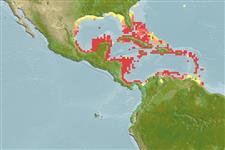
| Native range | All suitable habitat | Point map | Year 2050 |
|
| This map was computer-generated and has not yet been reviewed. |
| Scarus vetula AquaMaps Data sources: GBIF OBIS |
Upload your photos and videos
Pictures | Videos | Stamps, coins, misc. | Google image Scarus vetula
Picture by Patzner, R.
Pictures | Videos | Stamps, coins, misc. | Google image
Picture by Patzner, R.
Classification / Names Common names | Synonyms | Catalog of Fishes(genus, species) | ITIS | CoL | WoRMS | Cloffa
Teleostei (teleosts) > Eupercaria/misc (Various families in series Eupercaria) > Labridae (Wrasses) > Scarinae
Etymology: Scarus: Greek, skaros = a fish described by anciente writers as a parrot fish; 1601 (Ref. 45335).
More on authors: Bloch & Schneider.
Etymology: Scarus: Greek, skaros = a fish described by anciente writers as a parrot fish; 1601 (Ref. 45335).
More on authors: Bloch & Schneider.
Environment: milieu / climate zone / depth range / distribution range Ecology
Marine; reef-associated; depth range 3 - 25 m (Ref. 9710). Tropical; 33°N - 8°N, 98°W - 59°W
Distribution Territories | FAO areas | Ecosystems | Occurrences | Point map | Introductions | Faunafri
Western Central Atlantic: Bermuda, Florida (USA), and Bahamas to northern South America; throughout the Caribbean Sea.
Size / Weight / Age
Maturity: Lm ? range ? - ? cm
Max length : 61.0 cm TL male/unsexed; (Ref. 7251); common length : 32.0 cm TL male/unsexed; (Ref. 3802)
Max length : 61.0 cm TL male/unsexed; (Ref. 7251); common length : 32.0 cm TL male/unsexed; (Ref. 3802)
Short description Identification keys | Morphology | Morphometrics
Dorsal spines (total): 9; Dorsal soft rays (total): 10; Anal spines: 3; Anal soft rays: 9. Young adults of both sexes dark gray overall, with broad white stripe slightly below mid-side. Super males have upper pectoral fin margin and upper and lower margins of tail dusky with submarginal band of brownish orange (Ref. 26938).
Body shape (shape guide): fusiform / normal.
Body shape (shape guide): fusiform / normal.
Inhabits coral reefs and adjacent habitats. Feeds on algae scraped from rocks or dead coral. Sleeps in a mucus cocoon (Ref. 9710). Often seen in groups of one super male with several young adults, most of which are probably females (Ref. 26938). A protogynous hermaphrodite (Ref. 55367).
Life cycle and mating behavior Maturity | Reproduction | Spawning | Eggs | Fecundity | Larvae
Forms permanent harem groups composed of a single male and several smaller females (Ref. 55367). A monandric species (Ref. 55367). Length at sex change = 25.2 cm TL (Ref. 55367).
Main reference
Upload your references | References | Coordinator : Westneat, Mark | Collaborators
Robins, C.R. and G.C. Ray, 1986. A field guide to Atlantic coast fishes of North America. Houghton Mifflin Company, Boston, U.S.A. 354 p. (Ref. 7251)
IUCN Red List Status (Ref. 130435: Version 2025-2)
Least Concern (LC) ; Date assessed: 15 September 2009
CITES
Not Evaluated
Threat to humans
Reports of ciguatera poisoning (Ref. 30911)
Human uses
Fisheries: minor commercial; aquarium: commercial
FAO - Publication: search | FishSource |
More information
Population dynamics
Growth parameters
Max. ages / sizes
Length-weight rel.
Length-length rel.
Length-frequencies
Mass conversion
Recruitment
Abundance
Growth parameters
Max. ages / sizes
Length-weight rel.
Length-length rel.
Length-frequencies
Mass conversion
Recruitment
Abundance
Life cycle
Reproduction
Maturity
Maturity/Gills rel.
Fecundity
Spawning
Spawning aggregations
Eggs
Egg development
Larvae
Larval dynamics
Reproduction
Maturity
Maturity/Gills rel.
Fecundity
Spawning
Spawning aggregations
Eggs
Egg development
Larvae
Larval dynamics
Anatomy
Gill area
Brain
Otolith
Gill area
Brain
Otolith
Physiology
Body composition
Nutrients
Oxygen consumption
Swimming type
Swimming speed
Visual pigments
Fish sound
Diseases & Parasites
Toxicity (LC50s)
Body composition
Nutrients
Oxygen consumption
Swimming type
Swimming speed
Visual pigments
Fish sound
Diseases & Parasites
Toxicity (LC50s)
Tools
Bio-Quiz | E-book | Field guide | Identification keys | Length-frequency wizard | Life-history tool | Point map |
Catch-MSY |
Special reports
Download XML
Internet sources
AFORO (otoliths) | Aquatic Commons | BHL | Cloffa | Websites from users | Check FishWatcher | CISTI | Catalog of Fishes: genus, species | DiscoverLife | ECOTOX | FAO - Publication: search | Faunafri | Fishipedia | Fishtrace | GloBI | Google Books | Google Scholar | Google | IGFA World Record | National databases | OneZoom | Open Tree of Life | Otolith Atlas of Taiwan Fishes | Public aquariums | PubMed | Reef Life Survey | Socotra Atlas | TreeBase | Tree of Life | Wikipedia: Go, Search |