Common names from other countries
>
Clupeiformes (Herrings) >
Engraulidae (Anchovies) > Engraulinae
Etymology: Cetengraulis: Greek, ketos = a marine monster, whale + Greek, eggraulis, -eos = anchovy (Ref. 45335).
More on author: Cuvier.
Environnement : milieu / zone climatique / profondeur / gamme de distribution
Écologie
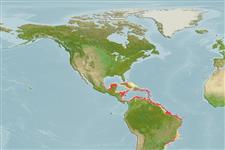
marin; saumâtre pelagic-neritic; profondeur 10 - ? m. Tropical; 23°N - 28°S, 98°W - 32°W (Ref. 189)
Western Atlantic: in the Antilles, from Cuba southward; Costa Rica south and east to Colombia and Venezuela, Trinidad south to Itapema, Santa Catarina, Brazil.
Longueur à la première maturité / Taille / Poids / Âge
Maturité: Lm 13.7 range ? - ? cm
Max length : 20.5 cm TL mâle / non sexé; (Ref. 125970); common length : 15.0 cm TL mâle / non sexé; (Ref. 5217); poids max. publié: 140.58 g (Ref. 125970)
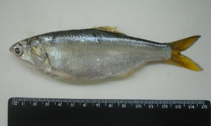
Épines dorsales (Total) : 0; Épines anales: 0; Rayons mous anaux: 18 - 24. Head large and deep. Snout short and pointed, about 2/3 eye diameter; maxilla moderate, tip blunt, just failing to reach lower jaw articulation; fine and numerous lower gill rakers, increasing in large fishes; no gill rakers on posterior face of third epibranchial. Branchiostegal rays 8, long and slender; branchiostegal membrane broad. Silver stripe disappearing at about 10 cm SL (Ref. 189). Dusky dots on upper surface of head and snout, series of large black dots along base of anal (Ref. 37032).
Body shape (shape guide): fusiform / normal; Cross section: compressed.
Occurs inshore and forms quite large schools. Enters brackish waters of lagoons and estuaries and can tolerate salinities of 10.32-31 ppt (Santa Cruz Canal, Pernambuco, Brazil). A filter-feeder presumably on both phytoplankton and zooplankton. Spawns off the Araya Peninsula, Venezuela from October to January, with a distinct peak in mid-November. Eggs are oval, spawned at 0230-0500 hours along shoreline out to about 1.5 km and hatching at about 20-24 hours later.
Whitehead, P.J.P., G.J. Nelson and T. Wongratana, 1988. FAO Species Catalogue. Vol. 7. Clupeoid fishes of the world (Suborder Clupeoidei). An annotated and illustrated catalogue of the herrings, sardines, pilchards, sprats, shads, anchovies and wolf-herrings. FAO Fish. Synop. 125(7/2):305-579. Rome: FAO. (Ref. 189)
Statut dans la liste rouge de l'IUCN (Ref. 130435: Version 2025-2)
Menace pour l'homme
Harmless
Utilisations par l'homme
Pêcheries: intérêt commercial mineur; appât: usually
Outils
Articles particuliers
Télécharger en XML
Sources Internet
Estimations basées sur des modèles
Température préférée (Réf.
123201): 24.4 - 28, mean 27.4 °C (based on 76 cells).
Indice de diversité phylogénétique (Réf.
82804): PD
50 = 0.7500 [Uniqueness, from 0.5 = low to 2.0 = high].
Bayesian length-weight: a=0.00490 (0.00386 - 0.00621), b=3.24 (3.17 - 3.31), in cm total length, based on LWR estimates for this species (Ref.
93245).
Niveau trophique (Réf.
69278): 2.1 ±0.07 se; based on food items.
Résilience (Réf.
120179): Milieu, temps minimum de doublement de population : 1,4 à 4,4 années (K=0.13-0.22; Fec=8,189 (batch fecundity)).
Prior r = 0.55, 95% CL = 0.37 - 0.83, Based on 3 data-limited stock assessments.
Vulnérabilité de la pêche (Ref.
59153): Moderate vulnerability (44 of 100).
🛈
Vulnérabilité climatique (Ref.
125649): Moderate to high vulnerability (50 of 100).
🛈
Nutriments (Ref.
124155): Calcium = 189 [109, 487] mg/100g; Iron = 1.52 [0.77, 2.95] mg/100g; Protein = 18.3 [16.7, 19.9] %; Omega3 = 0.389 [0.196, 0.833] g/100g; Selenium = 31.4 [14.3, 73.9] μg/100g; VitaminA = 24.9 [5.4, 82.9] μg/100g; Zinc = 2.65 [1.77, 4.20] mg/100g (wet weight);