Genypterus blacodes, Pink cusk-eel : fisheries

You can sponsor this page

Genypterus blacodes (Forster, 1801)

Pink cusk-eel
Ajouter votre observation dans Fish Watcher
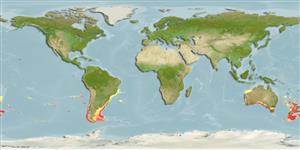
Native range | All suitable habitat | Point map | Year 2050
This map was computer-generated and has not yet been reviewed.
Genypterus blacodes   AquaMaps   Data sources: GBIF OBIS
Envoyez vos Photos et vidéos
Images | Images Google
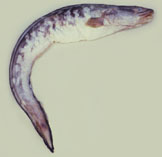
Image of Genypterus blacodes (Pink cusk-eel)
Genypterus blacodes
Photo de Carvalho Filho, A.


Uruguay territory information

Common names: Abadejo, Bacalao del sur, Pink cusk-eel
Occurrence: native
Salinity: marine
Abundance: | Ref:
Importance: minor commercial | Ref: FAO, 1994
Aquaculture: | Ref:
Regulations: | Ref:
Uses: no uses
Comments:
National Checklist:
Territory Information: https://www.cia.gov/library/publications/resources/the-world-factbook/geos/uy.html
National Fisheries Authority:
Occurrences: Occurrences Point map
Main Ref: Hureau, J.-C., 1991
National Database: Dinara

Common names from other countries

Classification / Noms Noms communs | Synonymes | Catalog of Fishes(Genre, Espèce) | ITIS | CoL | WoRMS | Cloffa

> Ophidiiformes (Cusk eels) > Ophidiidae (Cusk-eels) > Ophidiinae
Etymology: Genypterus: Greek, geny, -yos = face, jaw + Greek, pteron, = wing, fin (Ref. 45335).
More on author: Forster.

Environnement : milieu / zone climatique / profondeur / gamme de distribution Écologie

marin bathydémersal; océanodrome (Ref. 51243); profondeur 22 - 1000 m (Ref. 58489), usually 300 - 550 m (Ref. 6390). Deep-water; 17°S - 57°S, 114°E - 30°W (Ref. 34024)

Distribution Territoires | Zones FAO | Écosystèmes | Occurrences | Carte par point | Introductions | Faunafri

Southwest Pacific: southern Australia and around New Zealand. Southeast Pacific: Chile (Ref. 9068). Southwest Atlantic: Brazil (Ref. 4517).

Longueur à la première maturité / Taille / Poids / Âge

Maturité: Lm 72.0  range ? - ? cm
Max length : 200 cm SL mâle / non sexé; (Ref. 34024); common length : 100.0 cm TL mâle / non sexé; (Ref. 9258); poids max. publié: 25.0 kg (Ref. 34024); âge max. reporté: 46 années (Ref. 128769)

Description synthétique Clés d'identification | Morphologie | Morphométrie

Épines dorsales (Total) : 0; Rayons mous dorsaux (Total) : 141 - 164; Épines anales: 0; Rayons mous anaux: 101 - 126; Vertèbres: 68 - 70. Body pinkish yellow, marbled with irregular reddish brown blotches dorsally (Ref. 27363).
Body shape (shape guide): elongated; Cross section: compressed.

Biologie     Glossaire (ex. epibenthic)

Common species (Ref. 34024). Found between depths of 22 m (Ref. 58489) and 1000 m (Ref. 33848). Feed mainly on crustaceans such as Munida and scampi and also on fish. Also caught above the bottom when feeding on hoki (Macruronus novaezelandiae) during the hoki spawning season. Available all year round. Juveniles are found in shallower shelf waters (Ref. 6390). Oviparous, with oval pelagic eggs floating in a gelatinous mass (Ref. 205). Utilized fresh, frozen or smoked; can be fried and baked (Ref. 9988, 34024).

Cycle de vie et comportement reproducteur Maturité | Reproduction | Frai | Œufs | Fécondité | Larves

Référence principale Téléchargez vos références | Références | Coordinateur | Collaborateurs

Nielsen, J.G., D.M. Cohen, D.F. Markle and C.R. Robins, 1999. Ophidiiform fishes of the world (Order Ophidiiformes). An annotated and illustrated catalogue of pearlfishes, cusk-eels, brotulas and other ophidiiform fishes known to date. FAO Fish. Synop. 125(18):178p. Rome: FAO. (Ref. 34024)

Statut dans la liste rouge de l'IUCN (Ref. 130435: Version 2025-2)

  Vulnérable (VU) (A2bd); Date assessed: 04 March 2024

CITES

Not Evaluated

CMS (Ref. 116361)

Not Evaluated

Menace pour l'homme

  Harmless


Utilisations par l'homme

Pêcheries: hautement commercial
FAO - pêcheries: débarquements, Résumé espèce; Publication: search | FIRMS - Stock assessments | FishSource | Sea Around Us

Plus d'informations

Cycle de vie
Reproduction
Maturité
Maturité/épines rel.
Fécondité
Frai
Agrégats de frai
Œufs
Développement de l'œuf
Larves
Dynamique des populations larvaires
Distribution
Territoires
Zones FAO
Écosystèmes
Occurrences
Introductions
BRUVS - Vidéos
Anatomie
Surface branchiale
Cerveau
Otolithe
Physiologie
Composition corporelle
Nutriments
Consommation d'oxygène
Type de natation
Vitesse de nage
Pigments visuels
Son de poisson
Maladies et parasites
Toxicité (CL50)
Génétique
génôme
Génétique
Hétérozygotie
Héritabilité
Liées à l'homme
Systèmes d'aquaculture
Profils d'aquaculture
Souches
Cas de ciguatera
Timbres, pièces de monnaie, divers
Sensibilisation
Collaborateurs
Références
Références

Outils

Articles particuliers

Télécharger en XML

Sources Internet

AFORO (otoliths) | Aquatic Commons | BHL | Cloffa | Websites from users | FishWatcher | CISTI | Catalog of Fishes: Genre, Espèce | DiscoverLife | ECOTOX | FAO - pêcheries: débarquements, Résumé espèce; Publication: search | Faunafri | Fishipedia | Fishtrace | GloBI | Google Books | Google Scholar | Google | IGFA World Record | Bases de données nationales | OneZoom | Open Tree of Life | Otolith Atlas of Taiwan Fishes | PubMed | Reef Life Survey | Socotra Atlas | TreeBase | Arbre de Vie | Wikipedia: aller à, chercher | World Records Freshwater Fishing | Zoological Record

Estimations basées sur des modèles

Température préférée (Réf. 123201): 3.3 - 12.7, mean 7.2 °C (based on 279 cells).
Indice de diversité phylogénétique (Réf. 82804):  PD50 = 0.5156   [Uniqueness, from 0.5 = low to 2.0 = high].
Bayesian length-weight: a=0.00219 (0.00131 - 0.00364), b=3.17 (3.02 - 3.32), in cm total length, based on LWR estimates for this species & (Sub)family-body (Ref. 93245).
Niveau trophique (Réf. 69278):  4.2   ±0.76 se; based on food items.
Generation time: 11.0 (8.6 - 12.6) years. Estimated as median ln(3)/K based on 10 growth studies.
Résilience (Réf. 120179):  Faible, temps minimum de doublement de population : 4,5 à 14 années (K=0.1-0.23; tmax=30; tm=5-7).
Prior r = 0.25, 95% CL = 0.16 - 0.37, Based on 4 full stock assessments.
Vulnérabilité de la pêche (Ref. 59153):  Very high vulnerability (84 of 100). 🛈
Vulnérabilité climatique (Ref. 125649):  Moderate vulnerability (44 of 100). 🛈
Catégorie de prix (Ref. 80766):   Medium.
Nutriments (Ref. 124155):  Calcium = 11.8 [7.2, 25.7] mg/100g; Iron = 0.365 [0.190, 0.713] mg/100g; Protein = 15.6 [13.6, 17.7] %; Omega3 = 0.255 [0.136, 0.502] g/100g; Selenium = 31.6 [14.3, 70.0] μg/100g; VitaminA = 6.94 [1.54, 32.25] μg/100g; Zinc = 0.234 [0.157, 0.351] mg/100g (wet weight); based on nutrient studies.