Thunnus albacares, Yellowfin tuna : fisheries, aquaculture, gamefish

You can sponsor this page

Thunnus albacares (Bonnaterre, 1788)

Yellowfin tuna
Добавить Ваши наблюдения в Fish Watcher
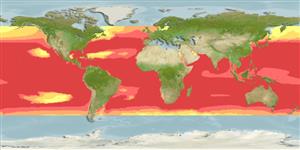
Native range | All suitable habitat | Point map | Year 2050
This map was computer-generated and has not yet been reviewed.
Thunnus albacares   AquaMaps   Data sources: GBIF OBIS
Загрузить свой Фото и Видео
изображения | Видео | Марки, монеты и прочее. | Изображение на Google
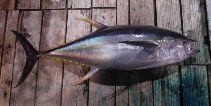
Image of Thunnus albacares (Yellowfin tuna)
Thunnus albacares
Изображение сделано Archambault, C.


Uruguay territory information

Common names: Aleta amarilla, Yellowfin tuna
Occurrence: native
Salinity: brackish
Abundance: | Ref:
Importance: | Ref:
Aquaculture: | Ref:
Regulations: | Ref:
Uses: live export: yes;
Comments:
National Checklist:
Territory Information: https://www.cia.gov/library/publications/resources/the-world-factbook/geos/uy.html
National Fisheries Authority:
Occurrences: Occurrences Point map
Main Ref: Nión, H., C. Ríos and P. Meneses, 2002
National Database: Dinara

Common names from other countries

Классификация / Имена народные названия | синонимы | Catalog of Fishes(род, виды) | ITIS | CoL | WoRMS | Cloffa

> Scombriformes (Mackerels) > Scombridae (Mackerels, tunas, bonitos) > Scombrinae
Etymology: Thunnus: Greek, thynnos = tunna (Ref. 45335).
More on author: Bonnaterre.

Окружающая среда: среда / климатическая зона / пределы глубины / диапазон распространения экология

морской; солоноватоводный pelagic-oceanic; мигрирует в океане (Ref. 71039); пределы глубины 1 - 1602 m, usually 1 - 250 m (Ref. 6390). Tropical; 15°C - 31°C (Ref. 168); 50°N - 50°S, 180°W - 180°E

распространение Территории | регионы FAO | Экосистемы | места находок | карта точек | интродукции | Faunafri

Worldwide in tropical and subtropical seas, but absent from the Mediterranean Sea. Highly migratory species.

Длина при первой зрелости / Размер / Вес / Возраст

половая зрелость: Lm 103.3, range 78 - 158 cm
Max length : 239 cm FL самец/пол неопределен; (Ref. 40637); common length : 150 cm FL самец/пол неопределен; (Ref. 168); наибольший вес (опубликованные данные): 200.0 kg (Ref. 26550); наибольший возраст (опубликованны данные): 18 годы (Ref. 137697)

Краткое описание определительные ключи | морфология | морфометрия

колючие лучи спинного плавника (общее число) : 11 - 14; членистые (мягкие) лучи спинного плавника (общее число) : 12 - 16; колючие лучи анального плавника: 0; членистые (мягкие) лучи анального плавника: 11 - 16; позвонки: 39. This large species is distinguished by the following characters: elongate, fusiform body, slightly compressed laterally; total gill rakers on first gill arch 26-34; dorsal fins 2 and separated only by a narrow interspace, the second followed by 8-10 finlets; anal fin followed by 7 to 10 finlets; large specimens may have very long second dorsal and anal fins, becoming well over 20% of fork length; pectoral fins moderately long, usually reaching beyond second dorsal-fin origin but not beyond end of its base, usually 22-31% of FL; 2 flaps (interpelvic process) between pelvic fins; body with very small scales; corselet of larger scales developed but not very distinct; caudal peduncle very slender, bearing on each side a strong lateral keel between 2 smaller keels; no striations on ventral surface of liver; swimbladder present. Colour of back metallic dark blue changing through yellow to silver on belly; belly frequently crossed by about 20 broken, nearly vertical lines; dorsal and anal fins, and dorsal and anal finlets bright yellow, the finlets with a narrow black border (Ref. 9684).
Body shape (shape guide): fusiform / normal; Cross section: oval.

биология     глоссарий (например epibenthic)

An oceanic species occurring above and below the thermoclines. Pelagic in open water , but rarely seen near reefs (Ref. 48637). They school primarily by size, either in monospecific or multi-species groups. Larger fish frequently school with porpoises, also associated with floating debris and other objects. Feed on fishes, crustaceans and squids. It is sensitive to low concentrations of oxygen and therefore is not usually caught below 250 m in the tropics (Ref. 28952, 30329). Peak spawning occurs during the summer, in batches (Ref. 9684, 51846). Eggs and larvae are pelagic (Ref. 6769). Encircling nets are employed to catch schools near the surface (Ref. 9340). Caught mainly with longlines and purse seines. Marketed mainly fresh, frozen, canned (Ref. 9684), but also smoked (Ref. 9987). Highly valued for sashimi (Ref. 26938).

Жизненный цикл и брачное поведение половая зрелость | размножение | нерест | икра | Плодовитость | личинки

Spawn throughout the tropical and equatorial waters of the major oceans (Ref. 6390). At higher latitudes, spawning is seasonal, with peaks in summer; may continue throughout the year at lower latitudes (Ref. 6390). Yellowfin tuna are multiple spawners, ie they spawn every few days over the spawning period (Ref. 6390). Eggs and sperm are released into the water for fertilisation (Ref. 6390).

Основная ссылка Загрузите свои рекомендации | ссылки | координатор : Collette, Bruce B. | соавторы

Collette, B.B. and C.E. Nauen, 1983. FAO Species Catalogue. Vol. 2. Scombrids of the world. An annotated and illustrated catalogue of tunas, mackerels, bonitos and related species known to date. Rome: FAO. FAO Fish. Synop. 125(2):137 p. (Ref. 168)

Статус Красного Списка МСОП (Ref. 130435: Version 2025-2)

  Не вызывающий беспокойства (LC) ; Date assessed: 15 January 2021

CITES

Not Evaluated

CMS (Ref. 116361)

Not Evaluated

Угроза для людей

  Harmless


Использование человеком

рыболовство: важный объект промысла; аквакультура (рыбоводство): экспериментальный; объект спортивного рыболовства: да
FAO - Системы аквакультуры: Производство; рыболовство: посадки, Видовой профиль; Publication: search | FIRMS - Stock assessments | FishSource | Море вокруг нас

дополнительная информация

генетика
Геном
генетика
Гетерозиготность
наследуемость
Связанные с человеком
Системы аквакультуры
особенности рыбоводства
степень растяжения
Случаи заболевания сигуатерой
Марки, монеты и прочее.
Информационно-просветительская работа
соавторы
ссылки
ссылки

инструменты

Специальные отчеты

Скачать в формате XML

ресурсы в Интернет

Оценки, основанные на моделях

Предпочтительная температура (ссылка 123201): 16.5 - 28.9, mean 26.7 °C (based on 6382 cells).
Индекс филогенетического разнообразия (ссылка 82804):  PD50 = 0.5039   [Uniqueness, from 0.5 = low to 2.0 = high].
Bayesian length-weight: a=0.01445 (0.01183 - 0.01766), b=3.03 (2.99 - 3.07), in cm total length, based on LWR estimates for this species (Ref. 93245).
Трофический уровень (ссылка 69278):  4.4   ±0.4 se; based on diet studies.
Generation time: 2.8 (2.3 - 3.5) years. Estimated as median ln(3)/K based on 46 growth studies.
устойчивость к внешним воздействиям (ссылка 120179):  средний (среднего размера), минимальное время удвоения популяции 1.4-4.4 года (K=0.13-0.42; tm=2-5; tmax=8; Fec=200,000).
Prior r = 0.36, 95% CL = 0.24 - 0.54, Based on 9 full stock assessments.
Уязвимость рыбной ловли (Ref. 59153):  Moderate to high vulnerability (46 of 100). 🛈
Климатическая уязвимость (Ref. 125649):  Moderate vulnerability (42 of 100). 🛈
Категория цены (Ref. 80766):   High.
Питательные вещества (Ref. 124155):  Calcium = 41 [22, 86] mg/100g; Iron = 2.84 [1.17, 6.68] mg/100g; Protein = 23.7 [22.2, 25.1] %; Omega3 = 0.274 [0.166, 0.457] g/100g; Selenium = 82.4 [21.0, 256.4] μg/100g; VitaminA = 29.6 [3.7, 227.6] μg/100g; Zinc = 0.524 [0.292, 0.972] mg/100g (wet weight); based on nutrient studies.