Common names from other countries
Окружающая среда: среда / климатическая зона / пределы глубины / диапазон распространения
экология
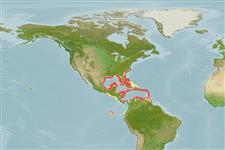
морской батидемерсальный; пределы глубины 30 - 400 m (Ref. 5222). Deep-water; 35°N - 3°S, 98°W - 58°W (Ref. 5222)
Western Atlantic: Bermuda, North Carolina (USA), Florida (USA), Gulf of Mexico, Bahamas, Cuba, Yucatan (Mexico), Jamaica, Puerto Rico, the Virgin Islands, and the Leeward islands to Trinidad. Eastern Pacific: Galapagos Islands.
Размер / Вес / Возраст
половая зрелость: Lm ? range ? - ? cm
Max length : 160 cm TL самец/пол неопределен; (Ref. 3244); 100.0 cm TL (female); наибольший вес (опубликованные данные): 107.0 kg (Ref. 3244)
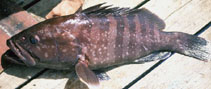
колючие лучи спинного плавника (общее число) : 11; членистые (мягкие) лучи спинного плавника (общее число) : 14 - 15; колючие лучи анального плавника: 3; членистые (мягкие) лучи анального плавника: 8 - 9. With 8 or 9 regular vertical darker brown bars on side. The only grouper in the Caribbean with a pattern of regular dark bars (Ref. 26938). Further distinguished by the following characteristics: head and body buff; blackish brown pelvic fins; prominent blackish brown maxillary streak on the cheek along upper edge of the maxilla; depth of body contained 2.4-2.9 times in SL; head length 2.3-2.5 times in SL; convex interorbital area; rounded preopercle angle, with enlarged serrae, 1-2 small serrae at lower edge, just in front of the angle; serrate interopercle and subopercle; posterior nostrils greatly enlarged, diameter is 4 or more times larger than anterior nostrils (Ref. 89707).
Body shape (shape guide): fusiform / normal; Cross section: compressed.
A solitary (Ref. 26340), deep-water species reported from 100-400 m; juveniles sometimes in water as shallow as 30 m. Feeds on fishes, crustaceans, and squids (Ref. 89707). Virtually nothing is known of the age, growth, and reproduction of this species. Marketed fresh.
Жизненный цикл и брачное поведение
половая зрелость | размножение | нерест | икра | Плодовитость | личинки
Craig, M.T. and P.A. Hastings, 2007. A molecular phylogeny of the groupers of the subfamily Epinephelinae (Serranidae) with revised classification of the epinephelini. Ichthyol. Res. 54:1-17. (Ref. 83414)
Статус Красного Списка МСОП (Ref. 130435: Version 2025-2)
Угроза для людей
Harmless
Использование человеком
рыболовство: коммерческий; объект спортивного рыболовства: да
дополнительная информация
инструменты
Специальные отчеты
Скачать в формате XML
ресурсы в Интернет
Оценки, основанные на моделях
Предпочтительная температура (ссылка
123201): 16.8 - 26.1, mean 21.7 °C (based on 68 cells).
Индекс филогенетического разнообразия (ссылка
82804): PD
50 = 0.5000 [Uniqueness, from 0.5 = low to 2.0 = high].
Bayesian length-weight: a=0.01349 (0.00621 - 0.02932), b=3.03 (2.86 - 3.20), in cm total length, based on LWR estimates for this Genus-body shape (Ref.
93245).
Трофический уровень (ссылка
69278): 4.6 ±0.0 se; based on diet studies.
устойчивость к внешним воздействиям (ссылка
120179): очень низкий, минимальное время удвоения популяции более 14 лет (Preliminary K or Fecundity.).
Уязвимость рыбной ловли (Ref.
59153): Very high vulnerability (90 of 100).
🛈
Питательные вещества (Ref.
124155): Calcium = 10.5 [5.1, 24.3] mg/100g; Iron = 0.287 [0.135, 0.621] mg/100g; Protein = 17.8 [15.9, 19.6] %; Omega3 = 0.342 [0.178, 0.655] g/100g; Selenium = 21 [9, 49] μg/100g; VitaminA = 8.34 [1.56, 44.48] μg/100g; Zinc = 0.266 [0.183, 0.408] mg/100g (wet weight);