Common names from other countries
Environnement : milieu / zone climatique / profondeur / gamme de distribution
Écologie
; eau douce benthopélagique; potamodrome (Ref. 138296); profondeur 15 - ? m (Ref. 12693). Tropical; 22°C - 28°C; 24°N - 8°S
Asia: Mekong and Chao Phraya basins, Malay Peninsula, Sumatra and Java (Ref. 27732). Occurs throughout the whole stretch on the Mekong, from the delta around the saline intrusion zone to Chiang Khong in Thailand (Ref. 37770).
Longueur à la première maturité / Taille / Poids / Âge
Maturité: Lm ?, range 16 - ? cm
Max length : 43.0 cm TL mâle / non sexé; (Ref. 118477)
Description synthétique
Clés d'identification | Morphologie | Morphométrie
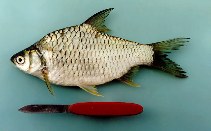
Épines dorsales (Total) : 4; Rayons mous dorsaux (Total) : 8; Épines anales: 3; Rayons mous anaux: 6 - 7. Body is strongly compressed. The back is elevated, its dorsal profile arched, often concave above the occiput. The head is small; the snout pointed; the mouth terminal. The barbels are very minute or rudimentary, especially the upper ones, which sometimes disappear entirely. Color when fresh is silvery white, sometimes with a golden tint. The dorsal and caudal fins are gray to gray-yellow; the anal and pelvic fins light orange, their tips reddish; the pectoral fins pale to light yellow (Ref. 4792). Very few tubercles on the snout which are not visible without magnification; snout length much less than the width of the eye socket (Ref. 37768). Anal-fin with 6-7 branches rays (Ref. 12693).
Body shape (shape guide): fusiform / normal; Cross section: oval.
Occurs at midwater to bottom depths in rivers, streams, floodplains, and occasionally in reservoirs. Seems to prefer standing water habitats instead of flowing waters. Inhabits the flooded forest during high water period (Ref. 12693). Feeds on plant matter (e.g. leaves, weeds, Ipomea reptans and Hydrilla) and invertebrates (Ref. 4835). A migratory species but not considered to be a long-distance migrant. Regarded as local migrant which moves from the Mekong up into small streams and canals and onto flooded areas during the rainy season and back again during receding water (Ref. 37770). Some reports indicated that upstream migration of this fish is triggered by the first rains and rising water levels. When it finds a tributary, canal or stream it moves upstream and eventually onto flooded areas. When water recedes, it migrates back into canals and streams and into the Mekong again (Ref. 37770). Often used as a pituitary donor for artificial propagation in aquaculture. Escapees from culture installations have become established in rivers and form the basis for capture fisheries on several Southeast Asian islands (Ref. 1739). Useful in cropping excessive vegetation in reservoirs (Ref. 2686). Used for lap pa (in the preparation of which the numerous small bones are ground fine) or grilled or used to make som pa. Usually marketed fresh and occasionally seen in the aquarium trade (Ref. 12693). A specimen measuring 45 cm TL (2,100 g) was reportedly caught from Dan Tchang Reservoir, Thailand on 8 July 2003 (Jean-Francois Helias, pers. comm., FISHING ADVENTURES THAILAND [mailto:fishasia@ksc.th.com] ).
Cycle de vie et comportement reproducteur
Maturité | Reproduction | Frai | Œufs | Fécondité | Larves
Assuming same reproductive mode as B. schwanenfeldii (RF).
Kottelat, M., A.J. Whitten, S.N. Kartikasari and S. Wirjoatmodjo, 1993. Freshwater fishes of Western Indonesia and Sulawesi. Periplus Editions, Hong Kong. 221 p. (Ref. 7050)
Statut dans la liste rouge de l'IUCN (Ref. 130435: Version 2025-2 (Global))
Menace pour l'homme
Harmless
Utilisations par l'homme
Pêcheries: commercial; Aquaculture: commercial; pêche sportive: oui; Aquarium: Commercial
Outils
Articles particuliers
Télécharger en XML
Sources Internet
Estimations basées sur des modèles
Indice de diversité phylogénétique (Réf.
82804): PD
50 = 0.5156 [Uniqueness, from 0.5 = low to 2.0 = high].
Bayesian length-weight: a=0.01122 (0.00927 - 0.01358), b=2.99 (2.94 - 3.04), in cm total length, based on LWR estimates for this species (Ref.
93245).
Niveau trophique (Réf.
69278): 2.4 ±0.13 se; based on food items.
Résilience (Réf.
120179): Milieu, temps minimum de doublement de population : 1,4 à 4,4 années (Assuming tm=2).
Vulnérabilité de la pêche (Ref.
59153): Low to moderate vulnerability (33 of 100).
🛈
Nutriments (Ref.
124155): Calcium = 244 [122, 623] mg/100g; Iron = 0.899 [0.517, 1.679] mg/100g; Protein = 16.5 [15.2, 17.8] %; Omega3 = 0.457 [0.202, 1.037] g/100g; Selenium = 71.7 [32.2, 148.3] μg/100g; VitaminA = 32.2 [11.4, 103.8] μg/100g; Zinc = 1.44 [0.84, 2.23] mg/100g (wet weight); based on
nutrient studies.