Squatina squatina, Angelshark : fisheries, gamefish

You can sponsor this page

Squatina squatina (Linnaeus, 1758)

Angelshark
Ajouter votre observation dans Fish Watcher
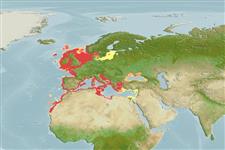
Native range | All suitable habitat | Point map | Year 2050
This map was computer-generated and has not yet been reviewed.
Squatina squatina   AquaMaps   Data sources: GBIF OBIS
Envoyez vos Photos et vidéos
Images | Images Google
Image of Squatina squatina (Angelshark)
Squatina squatina
Photo de Hernández-González, C.L.

Common names from other countries

Classification / Noms Noms communs | Synonymes | Catalog of Fishes(Genre, Espèce) | ITIS | CoL | WoRMS | Cloffa

Élasmobranches (requins et raies) (sharks and rays) > Squatiniformes (Angel sharks) > Squatinidae (Angel sharks)
Etymology: Squatina: Latin for skate, which angel sharks superficially resemble, presumably tautonymous with Squalus squatina Linnaeus 1758 (no species mentioned) (See ETYFish)squatina: Latin for skate, which angel sharks superficially resemble (See ETYFish).
More on author: Linnaeus.

Environnement : milieu / zone climatique / profondeur / gamme de distribution Écologie

marin; saumâtre démersal; océanodrome (Ref. 51243); profondeur 5 - 150 m (Ref. 247). Temperate; 63°N - 21°N, 19°W - 42°E

Distribution Territoires | Zones FAO | Écosystèmes | Occurrences | Carte par point | Introductions | Faunafri

East Atlantic. Its range and abundance is declining severely throughout its range. There is a proposed legal protection in Britain (Ref. 58085). The European Council Regulations 43/2009, 23/2010, 57/2011, 44/2012, 40/2013, 43/2014, 2015/104 and 2016/72 prohibit to fish for, to retain on board, to tranship and to land this species in all waters from the European Community (F. Osaer, pers.comm. 04/2016).

Longueur à la première maturité / Taille / Poids / Âge

Maturité: Lm 147.5, range 102 - 169 cm
Max length : 183 cm TL mâle / non sexé; (Ref. 247); 244.0 cm TL (female); common length : 150 cm TL mâle / non sexé; (Ref. ); poids max. publié: 80.0 kg (Ref. 35388)

Description synthétique Clés d'identification | Morphologie | Morphométrie

Épines dorsales (Total) : 0. Broad flattened body, with enlarged pectoral and pelvic fins, no anal fin. Eyes and large spiracles dorsally. Gill openings at the sides of the head. The mouth is terminal. Coloration variable, from grey to reddish or greenish-brown with scattered small white spots and blackish dots dorsally (Ref. 78469). No ocelli on body (Ref. 247).
Body shape (shape guide): other.

Biologie     Glossaire (ex. epibenthic)

A benthic species that occurs inshore, on coasts and along the continental shelf; may enter estuaries (Ref. 247, 58085). Found mainly on sand or mud bottoms; sluggish by day, lying buried with eyes protruding. Also utilizes areas with macroalgae, kelp or rocks (Ref. 88920). Nocturnal species, swims off bottom at night. Feeds mainly on flatfishes and other benthic fishes, but also on skates, crustaceans and molluscs, with one record of swallowed cormorant (Ref. 247, 28070). Moves to deeper waters during winter, returning to the shallower depths in the spring (Ref. 88187), moving northwards in summer. Ovoviviparous (Ref. 50449, 107715). Females generally grow larger than males (Ref. 58137, 107710, 107713, 107715). Detects weak electric fields generated by other organisms (e.g. potential prey) (Ref. 10311). The marine leech Stibarobdella macrothela is a common parasite (Ref. 107712) and the isopod Aegapheles deshaysiana a common micropredator (Ref. 107714) for this shark species in the Canary Islands. Utilized fresh and dried salted for human consumption, and possibly for oil and fishmeal (Ref. 247). Reaches 250 cm (Ref. 35388).

Cycle de vie et comportement reproducteur Maturité | Reproduction | Frai | Œufs | Fécondité | Larves

Ovoviviparous, produce 7-25 pups/litter (Ref. 58085), 13.0 +/- 1.9 pups in the Canary Is (Ref. 107713) with litter number increasing with female size. Gestation period lasts for 8-10 months (born Dec-Feb in Mediterranean, July in England) (Ref. 58085), and +/- 6 months in the Canary Is (Ref. 107713). Size at birth ranges from 24-30 cm TL (Ref. 58085). Embryos feed solely on yolk (Ref. 50449). Full term embryos weighed 189-200 g; no egg capsules found around ova or embryos (Ref. 107715). A biannual reproductive cycle is likely the case for this species (Ref. 32746), triannual cycle in the Canary Is (Ref. 107713).

Référence principale Téléchargez vos références | Références | Coordinateur : Compagno, Leonard J.V. | Collaborateurs

Compagno, L.J.V., 1984. FAO Species Catalogue. Vol. 4. Sharks of the world. An annotated and illustrated catalogue of shark species known to date. Part 1 - Hexanchiformes to Lamniformes. FAO Fish. Synop. 125(4/1):1-249. Rome, FAO. (Ref. 247)

Statut dans la liste rouge de l'IUCN (Ref. 130435: Version 2025-2)

  Niveau de menace critique (CR) (A2bcd); Date assessed: 12 July 2017

CITES

Not Evaluated

Menace pour l'homme

  Traumatogenic


Utilisations par l'homme

Pêcheries: intérêt commercial mineur; pêche sportive: oui
FAO - pêcheries: débarquements, Résumé espèce; Publication: search | FishSource | Sea Around Us

Plus d'informations

Écologie trophique
Aliments (proies)
Composition du régime alimentaire
Consommation alimentaire
Rations alimentaires
Prédateurs
Écologie
Écologie
Home ranges
Dynamique des populations
Paramètres de croissance
Âges / tailles maximales
Longueur-poids rel.
Rel. longueur-longueur.
Fréquences de longueurs
Conversion de masse
Recrutement
Abondance
Cycle de vie
Reproduction
Maturité
Maturité/épines rel.
Fécondité
Frai
Agrégats de frai
Œufs
Développement de l'œuf
Larves
Dynamique des populations larvaires
Distribution
Territoires
Zones FAO
Écosystèmes
Occurrences
Introductions
BRUVS - Vidéos
Anatomie
Surface branchiale
Cerveau
Otolithe
Physiologie
Composition corporelle
Nutriments
Consommation d'oxygène
Type de natation
Vitesse de nage
Pigments visuels
Son de poisson
Maladies et parasites
Toxicité (CL50)
Génétique
génôme
Génétique
Hétérozygotie
Héritabilité
Liées à l'homme
Systèmes d'aquaculture
Profils d'aquaculture
Souches
Cas de ciguatera
Timbres, pièces de monnaie, divers
Sensibilisation
Collaborateurs
Taxonomie
Noms communs
Synonymes
Morphologie
Morphométrie
Images
Références
Références

Outils

Articles particuliers

Télécharger en XML

Sources Internet

AFORO (otoliths) | Aquatic Commons | BHL | Cloffa | Websites from users | FishWatcher | CISTI | Catalog of Fishes: Genre, Espèce | DiscoverLife | DORIS | ECOTOX | FAO - pêcheries: débarquements, Résumé espèce; Publication: search | Faunafri | Fishipedia | Fishtrace | GloBI | Google Books | Google Scholar | Google | IGFA World Record | Bases de données nationales | OneZoom | Open Tree of Life | Otolith Atlas of Taiwan Fishes | Aquariums publics | PubMed | Reef Life Survey | Socotra Atlas | TreeBase | Arbre de Vie | Wikipedia: aller à, chercher | World Records Freshwater Fishing | Zoological Record

Estimations basées sur des modèles

Température préférée (Réf. 123201): 7.7 - 19.4, mean 11.4 °C (based on 854 cells).
Indice de diversité phylogénétique (Réf. 82804):  PD50 = 0.5000   [Uniqueness, from 0.5 = low to 2.0 = high].
Bayesian length-weight: a=0.00832 (0.00428 - 0.01615), b=3.05 (2.87 - 3.23), in cm total length, based on LWR estimates for this species & Genus-body shape (Ref. 93245).
Niveau trophique (Réf. 69278):  4.1   ±0.5 se; based on diet studies.
Résilience (Réf. 120179):  Faible, temps minimum de doublement de population : 4,5 à 14 années (Fec=9-20).
Prior r = 0.27, 95% CL = 0.18 - 0.41, Based on 1 data-limited stock assessment.
Vulnérabilité de la pêche (Ref. 59153):  Very high vulnerability (90 of 100). 🛈
Vulnérabilité climatique (Ref. 125649):  Moderate vulnerability (40 of 100). 🛈
Catégorie de prix (Ref. 80766):   Medium.
Nutriments (Ref. 124155):  Calcium = 3.58 [0.60, 65.38] mg/100g; Iron = 0.23 [0.02, 2.63] mg/100g; Protein = 18.2 [16.1, 20.5] %; Omega3 = 0.464 [0.160, 1.307] g/100g; Selenium = 12.7 [2.6, 61.3] μg/100g; VitaminA = 6.41 [0.58, 72.79] μg/100g; Zinc = 0.324 [0.023, 3.530] mg/100g (wet weight);