Common names from other countries
Ελασμοβράγχιοι (καρχαρίες και σαλάχια) (sharks and rays) >
Squaliformes (Sleeper and dogfish sharks) >
Etmopteridae (Lantern sharks)
Etymology: Centroscyllium: Greek, kentron = sting + Greek, skylla = a kind of shark (Ref. 45335).
Eponymy: Bishop Otto Fabricius (1744–1822) was a Danish missionary, explorer and naturalist in Greenland (1768–1773). [...] (Ref. 128868), visit book page.
Περιβάλλον: περιβάλλον / κλιματική ζώνη / εύρος βάθους / εύρος διανομής
Οικολογία
Θαλασσινό(ά) βαθύβιο(ς), usually 180 - 2250 m (Ref. 117245). Deep-water; 1°C - 5°C (Ref. 117245); 68°N - 57°S, 99°W - 120°E (Ref. 55215)
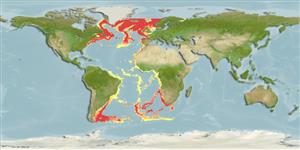
Northwest Atlantic: South Baffin Island and Greenland to Virginia, USA and possibly the Gulf of Mexico. Eastern Atlantic: Iceland along Atlantic slope to Senegal; Guinea to Sierra Leone; Namibia to Quoin Point, South Africa (Ref. 5578). Southwest Atlantic: Uruguay to Argentina (Ref. 58839).
Μήκος κατά την πρώτη ωρίμανση / Μέγεθος / Βάρος / Ηλικία
Γεννητική Ωρίμανση: Lm 64.0, range 58 - 70 cm
Max length : 107 cm TL αρσενικό/απροσδιόριστο; (Ref. ); common length : 84.0 cm TL αρσενικό/απροσδιόριστο; (Ref. 247); common length :70 cm TL (female)
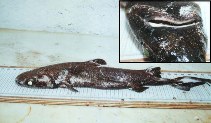
Adults uniformly blackish; fins of juveniles with white margins (Ref. 6577).
Body shape (shape guide): elongated.
Found on the outermost continental shelves and upper slopes, mostly below 275 m (Ref. 247). Epibenthic-pelagic (Ref. 58426). At high latitudes, may move up to the surface especially during the winter (Ref. 247). Bottom water temp. Are from 3.5 to 4.5°C, but sometimes down to 1°C. Segregation by sex and size as well as by movement into shallower water and by increase in school size is sometimes seen. Feeds on crustaceans, cephalopods, jellyfish and small fishes. Ovoviviparous (Ref. 205), with at least 14 pups in a litter (Ref. 247). Has luminescent organs in skin. May reach 107 cm.
Distinct pairing with embrace (Ref. 205).
Compagno, L.J.V., 1984. FAO Species Catalogue. Vol. 4. Sharks of the world. An annotated and illustrated catalogue of shark species known to date. Part 1 - Hexanchiformes to Lamniformes. FAO Fish. Synop. 125(4/1):1-249. Rome, FAO. (Ref. 247)
Κατάσταση Κόκκινου Καταλόγου IUCN (Ref. 130435: Version 2025-2)
Απειλή για τον άνθρωπο
Harmless
Ανθρώπινες χρήσεις
αλιεία: παραδοσιακή αλιεία
Εργαλεία
Ειδικές εκθέσεις
Λήψη XML
Διαδικτυακές πηγές
Εκτιμήσεις βάσει μοντέλων
Προτιμώμενη θερμοκρασία (Αναφ.
123201): 1.6 - 9.9, mean 4.2 °C (based on 219 cells).
Δείκτης φυλογενετικής ποικιλότητας (Αναφ.
82804): PD
50 = 0.5078 [Uniqueness, from 0.5 = low to 2.0 = high].
Bayesian length-weight: a=0.00282 (0.00155 - 0.00514), b=3.08 (2.91 - 3.25), in cm total length, based on LWR estimates for this species & (Sub)family-body (Ref.
93245).
Τροφικό Επίπεδο (Αναφ.
69278): 3.8 ±0.3 se; based on diet studies.
Ελαστικότητα (Αναφ.
120179): Χαμηλό, ελάχιστος χρόνος για διπλασιασμό πληθυσμού 4,5 - 14 έτη (Fec=14).
Ευπάθεια στην αλιεία (Ref.
59153): High vulnerability (64 of 100).
🛈
Ευπάθεια στο κλίμα (Ref.
125649): Moderate vulnerability (38 of 100).
🛈
Θρεπτικά συστατικά (Ref.
124155): Calcium = 6.51 [1.15, 36.11] mg/100g; Iron = 0.304 [0.072, 1.034] mg/100g; Protein = 17.9 [15.9, 20.6] %; Omega3 = 0.262 [0.092, 0.828] g/100g; Selenium = 17.1 [4.9, 53.5] μg/100g; VitaminA = 13.3 [2.5, 68.9] μg/100g; Zinc = 0.352 [0.164, 0.692] mg/100g (wet weight); based on
nutrient studies.