Pagellus bogaraveo, Blackspot seabream : fisheries, gamefish

You can sponsor this page

Pagellus bogaraveo (Brünnich, 1768)

Blackspot seabream
Ajouter votre observation dans Fish Watcher
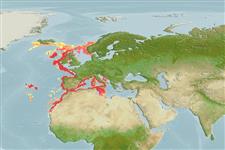
Native range | All suitable habitat | Point map | Year 2050
This map was computer-generated and has not yet been reviewed.
Pagellus bogaraveo   AquaMaps   Data sources: GBIF OBIS
Envoyez vos Photos et vidéos
Images | Timbres, pièces de monnaie, divers | Images Google
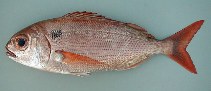
Image of Pagellus bogaraveo (Blackspot seabream)
Pagellus bogaraveo
Male Photo de Cambraia Duarte, P.M.N. (c)ImagDOP


Cyprus territory information

Common names: αμματάς, Μπαλάς
Occurrence: native
Salinity: marine
Abundance: | Ref:
Importance: | Ref:
Aquaculture: | Ref:
Regulations: | Ref:
Uses: no uses
Comments:
National Checklist:
Territory Information: https://www.cia.gov/library/publications/resources/the-world-factbook/geos/cy.html
National Fisheries Authority:
Occurrences: Occurrences Point map
Main Ref: Ioannou, G. and N. Michaelides, 2011
National Database:

Common names from other countries

Classification / Noms Noms communs | Synonymes | Catalog of Fishes(Genre, Espèce) | ITIS | CoL | WoRMS | Cloffa

> Eupercaria/misc (Various families in series Eupercaria) > Sparidae (Porgies)
Etymology: Pagellus: Diminutive of Latin, pager, derived from Greek, pagros = a fish, Dentex sp. (Ref. 45335).

Environnement : milieu / zone climatique / profondeur / gamme de distribution Écologie

marin benthopélagique; profondeur 150 - 700 m (Ref. 56504), usually 150 - 300 m (Ref. 35388). Temperate; 65°N - 20°N, 32°W - 37°E

Distribution Territoires | Zones FAO | Écosystèmes | Occurrences | Carte par point | Introductions | Faunafri

Eastern Atlantic: Norway, Strait of Gibraltar to Cape Blanc in Mauritania, Madeira, Canary Islands, and western Mediterranean (rare beyond the Sicilian Strait).

Longueur à la première maturité / Taille / Poids / Âge

Maturité: Lm 31.4  range ? - ? cm
Max length : 70.0 cm SL mâle / non sexé; (Ref. 4781); common length : 30.0 cm SL mâle / non sexé; (Ref. 4781); poids max. publié: 4.0 kg (Ref. 9987); âge max. reporté: 15 années (Ref. 4645)

Description synthétique Clés d'identification | Morphologie | Morphométrie

Épines dorsales (Total) : 12 - 13; Rayons mous dorsaux (Total) : 11 - 13; Épines anales: 3; Rayons mous anaux: 11 - 12. Black spot above the pectoral fin base. Snout shorter than the eye diameter (Ref. 35388).
Body shape (shape guide): fusiform / normal.

Biologie     Glossaire (ex. epibenthic)

Inshore waters above various types of bottom (rocks, sand, mud) to 400 m (Mediterranean) and 700 m (Atlantic); young near the coast, adults on the continental slope specially over muddy bottoms. Omnivorous, but feed mainly on crustaceans, mollusks, worms and small fish. Protandric hermaphrodites, become females at 20-30 cm length. Adults move towards the coast up to the edge of the continental shelf to spawn from January to June (Ref. 3688). Important foodfish. Marketed fresh and frozen; consumed pan-fried, broiled and baked (Ref. 9987).

Cycle de vie et comportement reproducteur Maturité | Reproduction | Frai | Œufs | Fécondité | Larves

Protandric hermaphrodite species (male during its first sexual maturity). Becomes female between 2 and 7 years of age. Spawns from January to June, depending on latitude. Egg size 1.19 mm, larval length at hatching 3.7 mm. Simultaneous hermaphroditism is also suggested for this species (Ref. 103751).

Référence principale Téléchargez vos références | Références | Coordinateur | Collaborateurs

Bauchot, M.-L. and J.-C. Hureau, 1990. Sparidae. p. 790-812. In J.C. Quero, J.C. Hureau, C. Karrer, A. Post and L. Saldanha (eds.) Check-list of the fishes of the eastern tropical Atlantic (CLOFETA). JNICT, Lisbon; SEI, Paris; and UNESCO, Paris. Vol. 2. (Ref. 3688)

Statut dans la liste rouge de l'IUCN (Ref. 130435: Version 2025-2 (Global))

  Quasi-menacé (NT) ; Date assessed: 17 August 2009

CITES

Not Evaluated

CMS (Ref. 116361)

Not Evaluated

Menace pour l'homme

  Harmless


Utilisations par l'homme

Pêcheries: commercial; pêche sportive: oui
FAO - Systèmes d'aquaculture: production; pêcheries: débarquements; Publication: search | FIRMS - Stock assessments | FishSource | Sea Around Us

Plus d'informations

Écologie trophique
Aliments (proies)
Composition du régime alimentaire
Consommation alimentaire
Rations alimentaires
Prédateurs
Écologie
Écologie
Home ranges
Dynamique des populations
Paramètres de croissance
Âges / tailles maximales
Longueur-poids rel.
Rel. longueur-longueur.
Fréquences de longueurs
Conversion de masse
Recrutement
Abondance
Cycle de vie
Reproduction
Maturité
Maturité/épines rel.
Fécondité
Frai
Agrégats de frai
Œufs
Développement de l'œuf
Larves
Dynamique des populations larvaires
Distribution
Territoires
Zones FAO
Écosystèmes
Occurrences
Introductions
BRUVS - Vidéos
Anatomie
Surface branchiale
Cerveau
Otolithe
Physiologie
Composition corporelle
Nutriments
Consommation d'oxygène
Type de natation
Vitesse de nage
Pigments visuels
Son de poisson
Maladies et parasites
Toxicité (CL50)
Génétique
génôme
Génétique
Hétérozygotie
Héritabilité
Liées à l'homme
Systèmes d'aquaculture
Profils d'aquaculture
Souches
Cas de ciguatera
Timbres, pièces de monnaie, divers
Sensibilisation
Collaborateurs
Références
Références

Outils

Articles particuliers

Télécharger en XML

Sources Internet

AFORO (otoliths) | Aquatic Commons | BHL | Cloffa | Websites from users | FishWatcher | CISTI | Catalog of Fishes: Genre, Espèce | DiscoverLife | ECOTOX | FAO - Systèmes d'aquaculture: production; pêcheries: débarquements; Publication: search | Faunafri | Fishipedia | Fishtrace | GloBI | Google Books | Google Scholar | Google | IGFA World Record | Bases de données nationales | OneZoom | Open Tree of Life | Otolith Atlas of Taiwan Fishes | Aquariums publics | PubMed | Reef Life Survey | Socotra Atlas | TreeBase | Arbre de Vie | Wikipedia: aller à, chercher | World Records Freshwater Fishing | Zoological Record

Estimations basées sur des modèles

Température préférée (Réf. 123201): 6.9 - 14.9, mean 11.2 °C (based on 160 cells).
Indice de diversité phylogénétique (Réf. 82804):  PD50 = 0.5156   [Uniqueness, from 0.5 = low to 2.0 = high].
Bayesian length-weight: a=0.01122 (0.00996 - 0.01263), b=3.03 (3.00 - 3.06), in cm total length, based on LWR estimates for this species (Ref. 93245).
Niveau trophique (Réf. 69278):  4.2   ±0.6 se; based on diet studies.
Generation time: 8.5 (6.5 - 9.3) years. Estimated as median ln(3)/K based on 15 growth studies.
Résilience (Réf. 120179):  Milieu, temps minimum de doublement de population : 1,4 à 4,4 années (K=0.09-0.1; tmax=15; tm=4-5; Fec=70,000).
Prior r = 0.51, 95% CL = 0.34 - 0.77, Based on 4 full stock assessments.
Vulnérabilité de la pêche (Ref. 59153):  High vulnerability (64 of 100). 🛈
Vulnérabilité climatique (Ref. 125649):  Moderate to high vulnerability (45 of 100). 🛈
Catégorie de prix (Ref. 80766):   Medium.
Nutriments (Ref. 124155):  Calcium = 41.2 [17.9, 69.5] mg/100g; Iron = 0.167 [0.103, 0.268] mg/100g; Protein = 19.5 [18.2, 20.8] %; Omega3 = 0.742 [0.486, 1.122] g/100g; Selenium = 47.9 [24.1, 97.4] μg/100g; VitaminA = 10.4 [2.1, 53.0] μg/100g; Zinc = 0.275 [0.208, 0.378] mg/100g (wet weight); based on nutrient studies.