This website uses cookies to enhance your browsing experience and ensure the functionality of our site. For more detailed information about the types of cookies we use and how we protect your privacy, please visit our Privacy Information page.
×
Cookie Settings
This website uses different types of cookies to enhance your experience. Please select your preferences below:
Oreochromis niloticus, Nile tilapia : fisheries, aquaculture
Africa: naturally occurring in coastal rivers of Israel (Ref. 5166), Nile basin (including lake Albert, Edward and Tana), Jebel Marra, Lake Kivu, Lake Tanganyika, Awash River, various Ethiopian lakes, Omo River system, Lake Turkana, Suguta River and Lake Baringo (Ref. 2). In West Africa natural distribution covers the basins of the Senegal, Gambia, Volta, Niger, Benue and Chad, with introduced specimens reported from various coastal basins (Ref. 53405). Widely introduced for aquaculture, with many existing strains. Several countries report adverse ecological impact after introduction. The following subspecies were previously recognized: Oreochromis niloticus baringoensis, Oreochromis niloticus cancellatus, Oreochromis niloticus eduardianus, Oreochromis niloticus filoa, Oreochromis niloticus niloticus, Oreochromis niloticus sugutae, Oreochromis niloticus tana and Oreochromis niloticus vulcani. 非洲: 以色列的沿海的河川; 尼羅河從下方艾伯特湖尼羅河到三角州; Jebel Marra; 查德湖流域與河尼日,貝努埃河,佛塔河,甘比亞與塞內加爾。 對於水產業廣泛地引入, 有許多現有的緊張。 引入後的一些國家報告不利的生態衝擊。
首次成熟时的长度 / 大小 / 重量 / 年龄
成熟度: Lm18.6, range 6 - 28 cm Max length : 60.0 cm SL 雄鱼/尚未辨别雌雄; (Ref. 4967); 最大体重: 4.3 kg (Ref. 40637); 最大年龄: 9 年 (Ref. 164)
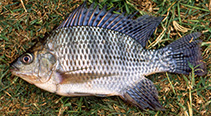
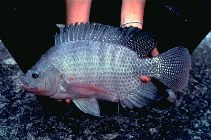
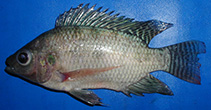
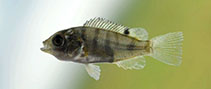
背棘 (总数) : 15 - 18; 背的软条 (总数) : 11 - 13; 臀棘: 3; 臀鳍软条: 9 - 11; 脊椎骨: 30 - 32. Diagnosis: A large deep-bodied tilapia, with a relatively small head (Ref. 118638). Jaws of mature male not greatly enlarged, length of lower jaw 29-37% of head length; genital papilla of breeding male not tassellated (Ref. 2). Body depth 36-50% of SL (Ref. 28714). Most distinguishing characteristic is the presence, at all life stages, of regular vertical stripes throughout depth of caudal fin (Ref. 4967, 53405, 118638). In smaller fishes, these are relatively wide and form an arc, and start at the base of the caudal fin (Ref. 118638). Males are bluish pink, sometimes with a dark throat, belly, anal and pelvic fins; females are usually brownish, silvery/white beneath with around 10 thin vertical bars (Ref. 118638).
Body shape (shape guide): fusiform / normal; Cross section: compressed. 繁殖期的雄鱼的生殖乳突没有方格斑纹。 成熟雄鱼的颚不明显增大 (下颌 29-37% 的头长长度) 。 此鱼种的最显着特性是那在尾鳍的深度各处有规则的垂直斑纹.(参考文献 4967) 背鳍的边缘灰色或黑色的。 在尾鳍 7-12 中的纵带.
Occurs in a wide variety of freshwater habitats like rivers, lakes, sewage canals and irrigation channels (Ref. 28714). Does not do well in pure salt water, but is able to survive in brackish water (Ref. 52307). Mainly diurnal. Feeds mainly on phytoplankton or benthic algae. Additionally, insect larvae are of some importance, as are aufwuchs and detritus; juveniles tend to be more omnivorous than adults (Ref. 52307). Oviparous (Ref. 205), ovophilic (Ref. 52307). A maternal mouthbrooder (Ref. 2, 28714, 52307, 118638), males dig simple pits in shallow water (Ref. 118638). May mature early (about 11 cm TL females, 14 cm TL males) (Ref. 28714). Globally, the most important tilapia species in fish farming and supports major capture fisheries where established; generally highly invasive and known to hybridise with many other Oreochromis species and for this reason further stocking has been banned in a number of countries, e.g. South Africa, Malawi and Zambia (Ref. 118638). Extended temperature range 8-42 °C, natural temperature range 13.5 - 33 °C (Ref. 3). Maximum depth from Ref. 34290. Marketed fresh and frozen (Ref. 9987).
Sexual maturity is reached at 3-6 months depending on temperature, reaching about 30 g. Reproduction occurs only when temperatures are over 20°C. Several yearly spawnings every 30 days. Females incubate eggs inside their mouths (approximately for a week) where larvae hatch and remain until the vitellus is reabsorved. Egg size 1.5 mm, larval length at hatching 4 mm.
Spawns in firm sand in water from 0.6 to 2 m deep of lakes (Ref. 2) and inshore waters (Ref. 55624). Males set up and defend territory which are visited by the females. Courtship lasts several hours. A single male probably fertilises the eggs of more than one female (Ref. 55624). Eggs are shed in batches in shallow nest and fertilized by male. Each batch of eggs is picked up into oral cavity by female. Females solely involved in broodcare. Female carries up to 200 eggs in her mouth where the larvae hatch and remain until after the yolk-sac is absorbed.非洲: 以色列的沿海的河川; 尼羅河從下方艾伯特湖尼羅河到三角州; Jebel Marra; 查德湖流域與河尼日,貝努埃河,佛塔河,甘比亞與塞內加爾。 對於水產業廣泛地引入, 有許多現有的緊張。 引入後的一些國家報告不利的生態衝擊。