Micropogonias furnieri, Whitemouth croaker : fisheries

You can sponsor this page

Micropogonias furnieri (Desmarest, 1823)

Whitemouth croaker
Beobachtung melden im Fish Watcher
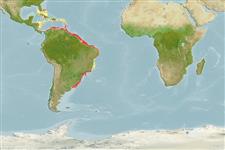
Native range | All suitable habitat | Point map | Year 2050
This map was computer-generated and has not yet been reviewed.
Micropogonias furnieri   AquaMaps   Data sources: GBIF OBIS
Hochladen Photos und videos
Bilder | Google Bild
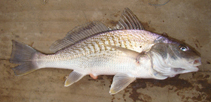
Image of Micropogonias furnieri (Whitemouth croaker)
Micropogonias furnieri
Photo von Timm, C.D.


Brazil territory information

Common names: Cascote, Cascuda, Cascudo
Occurrence: native
Salinity: marine
Abundance: | Ref:
Importance: commercial | Ref: FAO, 1994
Aquaculture: | Ref:
Regulations: | Ref:
Uses: no uses
Comments: Located at the southernmost tip of the Bombinhas peninsula, southern Brazil (Ref. 55758). Caught by shrimp trawl in Pirambu, Sergipe (Ref. 118626). Also in Ref. 122009.
National Checklist:
Territory Information: https://www.cia.gov/library/publications/resources/the-world-factbook/geos/br.html
National Fisheries Authority:
Occurrences: Occurrences Point map
Main Ref: Hureau, J.-C., 1991
National Database:

Common names from other countries

Klassifizierung / Names Namen | Synonyme | Catalog of Fishes(Gattung, Arten) | ITIS | CoL | WoRMS | Cloffa

> Eupercaria/misc (Various families in series Eupercaria) > Sciaenidae (Drums or croakers)
Etymology: Micropogonias: Greek, mikros = small + greek, pogon = beard (Ref. 45335).
Eponymy: Marcellin Fournier supplied specimens from Cuba. For some reason, Desmarest chose to omit the o from Fournier’s name in the scientific binomial furnieri. We have been unable to unearth any further information. (Ref. 128868), visit book page.

Issue
The species Micropogonias opercularis (Quoy & Gaimard, 1825) is considered as valid in Eschmeyer (CofF ver. Jul. 2010: Ref. 84883) according to López et al. (2002: Ref. 80900).

Umwelt: Milieu / Klimazone / Tiefenbereich / Verbreitungsgebiet Ökologie

seewasser; brackwasser demersal; ozeanodrom (Ref. 51243); tiefenbereich ? - 60 m (Ref. 9626), usually 20 - 40 m (Ref. 9626). Subtropical; 27°N - 36°S, 84°W - 34°W (Ref. 54591)

Verbreitung Territorien | FAO Gebiete | Ökosysteme | Vorkommen | Punkt Karte | Einführungen | Faunafri

Western to Southwest Atlantic: Greater Antilles and from Costa Rica to Argentina (Ref. 9626). Also reported in Nicaragua (Ref. 13613). Also reported in Brazil (Ref. 118626).

Länge bei der ersten Reifung / Größe / Gewicht / Alter

Geschlechtsreife: Lm 30.6  range ? - ? cm
Max length : 60.0 cm SL Männchen/unbestimmt; (Ref. 27363); common length : 45.0 cm SL Männchen/unbestimmt; (Ref. 27363); max. veröff. Gewicht: 55.30 g (Ref. 118626); max. veröff. Alter: 7 Jahre (Ref. 27)

Kurzbeschreibung Bestimmungsschlüssel | Morphologie | Morphometrie

Rückenflossenstacheln (insgesamt) : 11; Rückenflossenweichstrahlen (insgesamt) : 26 - 30; Afterflossenstacheln: 2; Afterflossenweichstrahlen: 7 - 9. Body silvery with a golden cast, back greyish, with distinct oblique dark streaks along scale rows extending to much below lateral line; spinous dorsal without small dark dots (Ref. 27363).
Body shape (shape guide): short and / or deep.

Biologie     Fachlexikon (Englisch) (z.B. epibenthic)

Found over muddy and sandy bottoms in coastal waters and in estuaries where the nursery and feeding grounds are located. Adults form schools. Feeding habits vary with ontogenic development and season; juveniles feed on benthic migratory crustaceans and sessile boring mollusks while adults are benthos-feeders and occasionally capture fish (Ref. 27). Undergoes seasonal migration. An important food fish which is usually marketed fresh and salted.

Lebenszyklus und Paarungsverhalten Geschlechtsreife | Fortpflanzung | Ablaichen | Eier | Fruchtbarkeit | Larven

Hauptreferenz Laden Sie Ihre Referenzen hoch | Referenzen | Koordinator | Partner

Isaac, V.J., 1988. Synopsis of biological data on the whitemouth croaker, Micropogonias furnieri (Desmarest, 1823). FAO Fish. Synop. (150). (Ref. 27)

IUCN Rote Liste Status (Ref. 130435: Version 2025-2)

  nicht bedroht (LC) ; Date assessed: 30 July 2019

CITES

Not Evaluated

CMS (Ref. 116361)

Not Evaluated

Bedrohung für Menschen

  Harmless


Nutzung durch Menschen

Fischereien: hoch kommerziell
FAO - Fischereien: landungen, Artbeschreibung; Publication: search | FIRMS - Stock assessments | FishSource | Das Meer um uns herum

Mehr Information

Trophische Ökologie
Lebensmittel (Beutetiere)
Nahrungszusammensetzung
Nahrungsaufnahme
Lebensmittelrationen
Räuber
Ökologie
Ökologie
Home ranges
Lebenszyklus
Fortpflanzung
Geschlechtsreife
Reifung/Kiemen rel.
Fruchtbarkeit
Ablaichen
Laichaggregationen
Eier
Eientwicklung
Larven
Larven Pop.Dyn.
Verbreitung
Territorien
FAO Gebiete
Ökosysteme
Vorkommen
Einführungen
BRUVS - Videos
Anatomie
Kiemenoberfläche
Gehirn
Otolith
Physiologie
Körperliche Zusammensetzung
Nährstoffe
Sauerstoffverbrauch
Schwimmart
Schwimmgeschwindigkeit
Visuelle Pigmente
Fischgeräusche
Krankheiten und Parasiten
Toxizität (LC50s)
Genetik
Genom
Genetik
Heterozygotie
Vererbbarkeit
Menschenbezogen
Aquakultur-Systeme
Aquakultur Profile
Zuchtlinien
Ciguatera-Fälle
Briefmarken, Münzen, Verschiedenes.
Aufsuchen
Partner
Referenzen
Referenzen

Tools

Zusatzinformationen

Download XML

Internet Quellen

AFORO (otoliths) | Aquatic Commons | BHL | Cloffa | Websites from users | FishWatcher Einträge suchen | CISTI | Catalog of Fishes: Gattung, Arten | DiscoverLife | ECOTOX | FAO - Fischereien: landungen, Artbeschreibung; Publication: search | Faunafri | Fishipedia | Fishtrace | GloBI | Google Books | Google Scholar | Google | IGFA World Record | Nationale Datenbanken | OneZoom | Open Tree of Life | Otolith Atlas of Taiwan Fishes | PubMed | Reef Life Survey | Socotra Atlas | TreeBase | Tree of Life | Wikipedia: Gehe zu, Suchen | World Records Freshwater Fishing | Zoologischer Rekord

Schätzungen auf der Grundlage von Modellen

Bevorzugte Temperatur (Ref. 123201): 16.5 - 28, mean 26.6 °C (based on 196 cells).
Phylogenetischer Diversitätsindex (Ref. 82804):  PD50 = 0.5156   [Uniqueness, from 0.5 = low to 2.0 = high].
Bayesian length-weight: a=0.00933 (0.00773 - 0.01127), b=3.02 (2.96 - 3.08), in cm total length, based on LWR estimates for this species (Ref. 93245).
Trophische Ebene (Ref. 69278):  3.1   ±0.1 se; based on diet studies.
Generation time: 6.1 (4.3 - 8.5) years. Estimated as median ln(3)/K based on 12 growth studies.
Widerstandsfähigkeit (Ref. 120179):  mittel, Verdopplung der Population dauert 1,4 - 4,4 Jahre. (K=0.12-0.18; tmax=7).
Prior r = 0.71, 95% CL = 0.47 - 1.06, Based on 4 data-limited stock assessments.
Anfälligkeit der Fischerei (Ref. 59153):  Moderate to high vulnerability (48 of 100). 🛈
Klimaanfälligkeit (Ref. 125649):  Moderate vulnerability (43 of 100). 🛈
Preiskategorie (Ref. 80766):   Medium.
Nährstoffe (Ref. 124155):  Calcium = 82.4 [47.1, 158.8] mg/100g; Iron = 1.07 [0.58, 1.86] mg/100g; Protein = 20 [18, 22] %; Omega3 = 0.265 [0.134, 0.513] g/100g; Selenium = 28.3 [15.5, 53.0] μg/100g; VitaminA = 7.34 [2.76, 23.48] μg/100g; Zinc = 0.86 [0.63, 1.26] mg/100g (wet weight); based on nutrient studies.