This website uses cookies to enhance your browsing experience and ensure the functionality of our site. For more detailed information about the types of cookies we use and how we protect your privacy, please visit our Privacy Information page.
×
Cookie Settings
This website uses different types of cookies to enhance your experience. Please select your preferences below:
Common names:
Smooth dory, Smooth oreo, Smooth oreo dory
Occurrence:
native
Salinity:
marine
Abundance:
abundant (always seen in some numbers)
|
Ref: Kailola, P.J., M.J. Williams, P.C. Stewart, R.E. Reichelt, A. McNee and C. Grieve, 1993
Importance:
commercial
|
Ref: Kailola, P.J., M.J. Williams, P.C. Stewart, R.E. Reichelt, A. McNee and C. Grieve, 1993
Aquaculture:
never/rarely
|
Ref: Kailola, P.J., M.J. Williams, P.C. Stewart, R.E. Reichelt, A. McNee and C. Grieve, 1993
Regulations:
restricted
|
Ref: Kailola, P.J., M.J. Williams, P.C. Stewart, R.E. Reichelt, A. McNee and C. Grieve, 1993
Uses:
no uses
Comments:
Known to inhabit the continental slope from Broken Bay in New South Wales (Ref. 7300) to southern Western Australia (Ref. 27124); and are also present on the Cascade Plateau and South Tasman Rise.
There is no information concerning stock structure of smooth oreos in Australian waters.
Commercial fishery: The main fishing area for oreos including smooth oreos is within the South East Fishery, on the continental slope of Tasmania. There have also been significant catches taken from the Cascade Plateau by foreign vessels under developmental fishing arrangements (Ref. 27029). Oreos in general are caught exclusively by vessels using demersal otter trawl gear. Oreo aggregations tend to be located over rough ground and require the use of 'target trawling' techniques similar to those used for orange roughy. They have been caught as a bycatch of orange roughy fishing for a number of years and, in the early stages of the orange roughy fishery, were normally discarded. Development of markets for oreos has led fishers to retain the oreo bycatch. Some fishers have targeted aggregations of oreos off southern Tasmania (Ref. 27090), especially during the closed season for orange roughy. Experienced skippers can often distinguish between orange roughy and oreos by their different acoustic target strengths on the echo sounder.
Smooth oreos are the most common species in oreo landings in Tasmania. Smooth oreos are generally larger fish than the other species and give a more valuable return. Most of the smooth oreo catch has been taken in late spring and summer in the 1990s, a seasonal trend probably more related to fishing patterns in the orange roughy fishery than to changes in abundance or catchability of oreos.
Landings of oreos in the South East Fishery were about 60 t per annum between 1985-86 and 1987-88. The catch retained increased considerably in 1989-90 to just over 900 t. Some oreos are caught by vessels fishing orange roughy aggregations in the Great Australian Bight Trawl Fishery. Approximately 200 t of oreos were landed from this fishery in 1988-89 but the 1989-90 catch was less than 30 t. However, most of the oreo catch in the Bight is reported to be spiky oreos which are normally discarded in favour of orange roughy. Further west, exploitation of deepwater trawl grounds off Albany during 1991 has resulted in some significant catches of smooth oreos. However, the amount of oreo catch retained generally appears to be determined by catch levels of orange roughy.
Smooth oreos are usually processed into fillets and frozen for both domestic and export markets. As of 1993, approximately 50% of the oreo catch was exported, mainly to Europe and the United States of America. The oreo 'frames' are processed into fertilizer or fishmeal and there is some interest in fish oil production from oreo waste.
Resource status: As of 1993, Australian oreo stocks including smooth oreos were probably not fully fished. However, the low reproductive rate of oreos, their likely slow growth rate and their tendency to form dense aggregations may mean that there is a limited scope for expansion of this fishery.
National Checklist:
Territory Information:
https://www.cia.gov/library/publications/resources/the-world-factbook/geos/as.html
National Fisheries Authority:
http://www.csiro.au/
Occurrences:
OccurrencesPoint map
Main Ref:
Kailola, P.J., M.J. Williams, P.C. Stewart, R.E. Reichelt, A. McNee and C. Grieve, 1993
National Database:
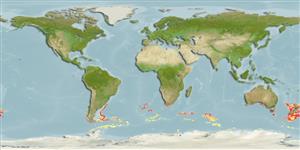
Southwest Atlantic: off Uruguay to Argentina and the Falklands. Southeast Atlantic: Namibia to South Africa, including the northern part of Walvis Ridge (Ref. 6545). South Pacific: off southern Chile, Bellingshausen and Australian-Antarctic Basin to New Zealand, New South Wales and Tasmania, Australia and the Kerguelen Islands.
Length at first maturity / Size / Weight / Age
Maturity: Lm40.0 range ? - 41 cm Max length : 68.0 cm TL male/unsexed; (Ref. 58312); common length : 40.0 cm TL male/unsexed; (Ref. 9258); max. published weight: 5.0 kg (Ref. 6390); max. reported age: 100 years (Ref. 27140)
Dorsalspines (total): 5 - 7; Dorsalsoft rays (total): 33 - 36; Analspines: 2 - 3; Analsoft rays: 31 - 34; Vertebrae: 40 - 43. First dorsal spine longer than second dorsal spine. Opercles fully scaled (Ref. 27159).
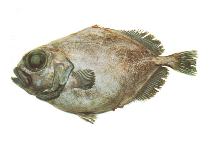
Female adult chocolate brown in color with darker fins; prejuveniles silvery with numerous dark spots of various sizes which become larger with age (Ref. 6548). Body shape (shape guide): short and / or deep.
Inhabit continental slopes of all southern continents (Ref. 6545). Adults found near the bottom; juveniles near the surface, usually in association with krill (Ref. 5194). Feed mainly on salps (Ref. 27150). Eggs float near the sea surface and larvae also inhabit surface waters (Ref. 6390). There is no vertical migration during the day or night (Ref. 27150).
Heemstra, P.C., 1990. Oreosomatidae. p. 226-228. In O. Gon and P.C. Heemstra (eds.) Fishes of the Southern Ocean. J.L.B. Smith Institute of Ichthyology, Grahamstown, South Africa. (Ref. 5194)
IUCN Red List Status (Ref. 130435: Version 2025-2)