Common names from other countries
أشلاق (القروش و الشفانين) (sharks and rays) >
Rajiformes (Skates and rays) >
Arhynchobatidae (Softnose skates)
Etymology: Bathyraja: Greek, bathys = deep + Latin, raja, -ae = a ray (Raja sp) (Ref. 45335).
Eponymy: Henryk Arctowski (né Artzt) (1871–1958) was a Polish scientist, meteorologist and explorer who took part in the Belgian Antarctic Expedition that took place over the course of three years (1897, 1898 & 1899) with the voyages of the ‘Belgica’ under [...] (Ref. 128868), visit book page.
البيئة: الوسط / المنطقة المناخية / نطاق العمق / نطاق التوزيع
البيئة
بحري القاع; نطاق العمق 0 - 1685 m (Ref. 123566), usually 126 - 810 m (Ref. 123566). Deep-water
Southern Ocean: widespread, circumantarctic: Atlantic sector (off the South Shetland, Brabant, and Biscoe Islands to the South-East Weddell Sea); Pacific (Ross Sea); Indian (from Prydz Bay).
الحجم / وزن / العمر
النضج: Lm ? range ? - ? cm
Max length : 61.0 cm TL ذكر/ مختلط الجنس; (Ref. 123566); 53.5 cm TL (female)
وصف مختصر
مفاتيح التعريف | الوصف الخارجي | قياسات المظهر الخارجي
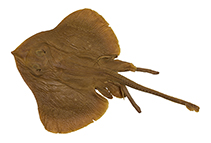
This species is characterized by the following: usually completely medium to dark grayish pigmented mouth cavity, often dark underside of the nasal curtain from very small juvenile stages onwards; differs from most congeners in Antarctic and Subantarctic waters in the absence of thorns on the dorsal disc. It is further distinguished by the following characters: disc
evenly inverse heart-shaped (the disc margins distinctly undulated in adult males, but not or slightly undulated in others), with broadly rounded outer corners and with body length to mid-cloaca shorter than or equal to tail length from mid-cloaca; preorbital snout length 8.1-16.2% TL (depending on ontogenetic stage) and distance between first gill slits 14.2-15.9% TL; orbits are moderately large, horizontal diameter 1.3-1.8 times interorbital width; upper side of the disc and tail entirely rough, prickly with dermal denticles while the underside is smooth; except for alar thorns of mature males, no thorns on disc but only a median row of 19-30 small thorns along tail to first dorsal fin, the thorns become smaller and more widely spaced posteriorly in subadults and adults and are generally wider spaced in large juveniles to adults as compared with small juveniles; bases of low, more or less equal-sized dorsal fins confluent or with short interspace; postdorsal tail section very short, 1.7-5.2% TL, with low epichordal caudal lobe which is confluent with second dorsal fin; opened clasper tip shows all components typical for Bathyraja species, of which most apparent a long and deep pseudosiphon (ps) along outer edge of dorsal lobe, as well as a massive projection (pj) over entire length of the inner ventral lobe; clasper terminal skeleton with distal processes of dorsal marginal cartilage (forming external pseudorhipidion) and ventral marginal cartilage (forming external projection), 3 dorsal terminal cartilages (with dt1 very large and encapsulating terminal skeleton), ventral terminal, and one accessory terminal cartilage; apparent sexual dimorphism in scapulocoracoid, with post-mesocondyle length longer in females than in males. Colouration: dorsal ground color plain dark to medium grayish-brown, often with mostly indistinct scattered pale and dusky spots on disc, the posterior pelvic lobes and on sides of tail, occasionally with transverse white pseudoocellus stripe on inner posterior pectorals; ventral or underside mostly plain white or pale, often with gray marked cloaca and gray spots on belly to gill region, occasionally gray spotted posterior pectoral margins, origin and sides of tail, or tail partly dark; mouth cavity and underside of nasal curtain at least partly, usually completely pigmented medium to dark grayish from very small juvenile stages onwards (Ref. 123566).
Cross section: flattened.
Individuals collected deeper than 810 m indicate that the species possibly occurs in greater depths in the Pacific sector, but may also be the result of differing fishery efforts in the respective depths. Most specimens caught deeper than 810 m were adults but were also recorded from shallower depths elsewhere and juveniles in turn were also recorded deeper than 810 m and even below 1000 m (Ref. 123566).
دورة الحياة وسلوك التزاوج
النضج | التكاثر | وضع البيض | بيض | الخصوبة | اليرقات
Stehmann, M.F., S. Weigmann and G.J. Naylor, 2021. First complete description of the dark-mouth skate Raja arctowskii Dollo, 1904 from Antarctic waters, assigned to the genus Bathyraja (Elasmobranchii, Rajiformes, Arhynchobatidae). Mar. Biodiv. 51(1):1-27. (Ref. 123566)
حالة القائمة الحمراء للاتحاد الدولي لحفظ الطبيعة والموارد الطبيعية (Ref. 130435: Version 2025-2)
استخدامات بشرية
أدوات
تقارير خاصة
تنزيل XML
مصادر علي الأنترنت
تقديرات تستند إلى النماذج
مؤشر التنوع الشُعبي الوراثي (مرجع
82804): PD
50 = 0.5000 [Uniqueness, from 0.5 = low to 2.0 = high].
Bayesian length-weight: a=0.00550 (0.00291 - 0.01038), b=3.13 (2.97 - 3.29), in cm total length, based on LWR estimates for this Genus-body shape (Ref.
93245).
مستوى غذائي (مرجع
69278): 3.9 ±0.7 se; based on size and trophs of closest relatives
المرونه (مرجع
120179): منخفض, الحد الزمني الأدني لتضاعف عدد أفراد المجتمع 4.5-14 سنة (Preliminary K or Fecundity.).
ضعف الصيد (Ref.
59153): Moderate vulnerability (44 of 100).
🛈