Common names from other countries
Élasmobranches (requins et raies) (sharks and rays) >
Hexanchiformes (Frill and cow sharks) >
Hexanchidae (Cow sharks)
Etymology: Hexanchus: hex (Gr.), six; anchus, etymology unclear, perhaps anchos (Gr.), choke or throttle, referring to how six gill openings of H. griseus extend down onto the throat (See ETYFish); griseus: Medieval Latin for gray, reflecting the French vernacular “Le Griset,” referring to its dark-gray coloration (See ETYFish).
More on author: Bonnaterre.
Environnement : milieu / zone climatique / profondeur / gamme de distribution
Écologie
marin bathydémersal; océanodrome (Ref. 87829); profondeur 0 - 2500 m (Ref. 132203), usually 180 - 1100 m (Ref. 45445). Subtropical; 6°C - 10°C (Ref. 125614); 65°N - 48°S, 180°W - 180°E
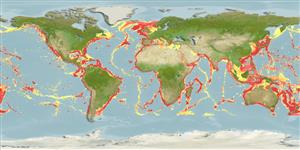
Circumglobal with patchy distribution and possibly absent from Arctic and Antarctic. Highly migratory species.
Longueur à la première maturité / Taille / Poids / Âge
Maturité: Lm 441.0, range 400 - 482 cm
Max length : 600 cm TL mâle / non sexé; (Ref. 124786); common length : 300 cm TL mâle / non sexé; (Ref. 5217); poids max. publié: 590.0 kg (Ref. 27436)
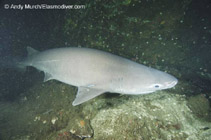
Épines dorsales (Total) : 0; Épines anales: 0. A heavily-bodied, broad-headed sixgill shark, mouth ventral with 6 rows of lower, bladelike, comb-shaped teeth on each side (Ref. 247). Snout broadly rounded, body fusiform (Ref. 6871). Anal fin smaller than dorsal fin (Ref. 6871). Brown or grey above, paler below, with a light stripe along side (Ref. 26346). Fins with white edges (Ref. 6574). Live specimens with fluorescent green eyes (Ref. 6871). Six gill slits are very long (Ref. 35388).
Body shape (shape guide): elongated.
Depth range reported at 0m-2500m (Ref. 125614). A deepwater species of the outer continental and insular shelves and upper slopes (Ref. 6871, 75154), islands, seamounts and mid-ocean ridges (Ref. 125614). Near bottom, occasionally pelagic, adults usually below 91 m (Ref. 58302). Juveniles may be found close inshore (Ref. 6871), while nursery areas are in very shallow waters (Ref. 125614). Found on the bottom by day, moving to the surface at night to feed, and where it may take longlines set for other species (Ref. 45445). Depth distribution related to growth and temperature, with juveniles having most shallow records and from colder, poleward regions (Ref. 58302). Generally occurs at a bottom temperature of 6 to 10°C (Ref. 125614). Feeds on a wide range of marine organisms, including other sharks, rays, chimaeras, bony fish, squids, crabs, shrimps, carrion, and even seals (Ref. 26969). Large sharks (at least 2m) take cetaceans and seals. Viviparous, very large litters of 47-108 pups (Ref. 125614). Give birth to almost 100 young (Ref. 35388). Young and adults may be segregated, with the young using inshore nursery grounds. Possibly long-lived (Ref. 125614). Is a eurytrophic predator that is capable of exploiting a wide range of prey species and habitats (Ref. 26969). A vertical migrant, it may sit on the bottom by day, and rise to the surface at night to feed (Ref. 247). It occurs alone or in groups. Adults are more sensitive to light than the juveniles and less seen in clear shallow waters, but more prevalent at night or areas with dense plankton blooms (Ref. 125614). It is locally common in bycatch and target fisheries for food, fishmeal and oil, and in sports fisheries, but vulnerable to overfishing and requires careful management (Ref. 125614). Marketed fresh, frozen, or dried salted (Ref. 247). Not known to have attacked people without provocation (Ref. 247).
Cycle de vie et comportement reproducteur
Maturité | Reproduction | Frai | Œufs | Fécondité | Larves
Viviparous, very large litters of 47-108 pups (Ref. 125614). Size at birth 60-75 cm (Ref. 26346). Distinct pairing with embrace (Ref. 205).
Ebert, D.A., S. Fowler and M. Dando, 2021. Sharks of the World: A complete guide. Princeton University Press, 607 p. (Ref. 125614)
Statut dans la liste rouge de l'IUCN (Ref. 130435: Version 2025-2)
Utilisations par l'homme
Pêcheries: commercial; pêche sportive: oui
Outils
Articles particuliers
Télécharger en XML
Sources Internet
Estimations basées sur des modèles
Température préférée (Réf.
123201): 3.6 - 15.7, mean 8.1 °C (based on 3800 cells).
Indice de diversité phylogénétique (Réf.
82804): PD
50 = 0.6641 [Uniqueness, from 0.5 = low to 2.0 = high].
Bayesian length-weight: a=0.00117 (0.00067 - 0.00207), b=3.17 (3.01 - 3.33), in cm total length, based on LWR estimates for this species & (Sub)family-body (Ref.
93245).
Niveau trophique (Réf.
69278): 4.5 ±0.2 se; based on diet studies.
Résilience (Réf.
120179): Faible, temps minimum de doublement de population : 4,5 à 14 années (Fec= 22-108).
Vulnérabilité de la pêche (Ref.
59153): Very high vulnerability (90 of 100).
🛈
Vulnérabilité climatique (Ref.
125649): Moderate vulnerability (38 of 100).
🛈
Nutriments (Ref.
124155): Calcium = 8.75 [2.27, 47.99] mg/100g; Iron = 0.664 [0.163, 2.072] mg/100g; Protein = 19.5 [17.5, 21.5] %; Omega3 = 0.24 [0.10, 0.59] g/100g; Selenium = 79.6 [24.5, 261.1] μg/100g; VitaminA = 3.68 [0.99, 13.90] μg/100g; Zinc = 0.324 [0.155, 0.615] mg/100g (wet weight);