Common names from other countries
分類 / 名稱
俗名 | 同種異名 | Catalog of Fishes(屬, 種) | ITIS | CoL | WoRMS | Cloffa
Elasmobranchii
板鰓亞綱 (鯊魚與魟魚) (sharks and rays) >
Hexanchiformes (Frill and cow sharks)
六鰓鯊目 (Frill and cow sharks) >
Hexanchidae (Cow sharks)
六鰓鮫科 (Cow sharks)
Etymology: Hexanchus: hex (Gr.), six; anchus, etymology unclear, perhaps anchos (Gr.), choke or throttle, referring to how six gill openings of H. griseus extend down onto the throat (See ETYFish); griseus: Medieval Latin for gray, reflecting the French vernacular “Le Griset,” referring to its dark-gray coloration (See ETYFish).
More on author: Bonnaterre.
環境: 環境 / 氣候帶 / 深度上下限 / 配送範圍
生態學
海洋 深海底的; 海洋洄游的 (Ref. 87829); 深度上下限 0 - 2500 m (Ref. 132203), usually 180 - 1100 m (Ref. 45445). 亞熱帶的; 6°C - 10°C (Ref. 125614); 65°N - 48°S, 180°W - 180°E
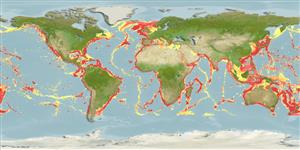
Circumglobal with patchy distribution and possibly absent from Arctic and Antarctic. Highly migratory species.
Circumglobal: 在熱帶與溫帶水域中; (參考文獻 13573). 西大西洋: 北卡羅萊那州到佛羅里達 (美國) 與墨西哥灣北部到阿根廷北部。 東大西洋: 冰島與挪威到那米比亞, 包括地中海。 印度洋: 馬達加斯加,莫三比克與南非。 西太平洋: 日本東部到紐西蘭與夏威夷。 東太平洋: 阿留申群島, 阿拉斯加到墨西哥的下加利福尼亞; 也智利。 高度遷移的種, 1982年海事法會議的附件一.(參考文獻 26139, 參考文獻 41819)
初熟時的長度 / 大小 / 重量 / 年齡
成熟度: Lm 441.0, range 400 - 482 cm
Max length : 600 cm TL 雄魚/尚未辨別雌雄; (Ref. 124786); common length : 300 cm TL 雄魚/尚未辨別雌雄; (Ref. 5217); 最大體重: 590.0 kg (Ref. 27436)
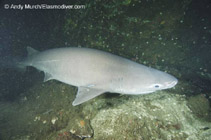
背棘 (總數) : 0; 臀棘: 0. A heavily-bodied, broad-headed sixgill shark, mouth ventral with 6 rows of lower, bladelike, comb-shaped teeth on each side (Ref. 247). Snout broadly rounded, body fusiform (Ref. 6871). Anal fin smaller than dorsal fin (Ref. 6871). Brown or grey above, paler below, with a light stripe along side (Ref. 26346). Fins with white edges (Ref. 6574). Live specimens with fluorescent green eyes (Ref. 6871). Six gill slits are very long (Ref. 35388).
Body shape (shape guide): elongated.
一隻身體很重的, 寬頭的六條鰓裂的鯊魚, 腹下的嘴具有 6 列的低﹐刀葉狀的﹐和梳狀的牙齒在兩邊.(參考文獻 247) 吻寬廣地圓的, 身體紡錘型.(參考文獻 6871) 比背鰭小的臀鰭.(參考文獻 6871) 背面褐色或灰色的﹐腹面灰白的, 沿著側邊具有一個淡色條紋.(參考文獻 26346) 鰭有白色的邊緣。 (參考文獻 6574) 活體有螢光的綠色眼。 (參考文獻 6871) 六個鰓縫非常長。 (參考文獻 35388)
Depth range reported at 0m-2500m (Ref. 125614). A deepwater species of the outer continental and insular shelves and upper slopes (Ref. 6871, 75154), islands, seamounts and mid-ocean ridges (Ref. 125614). Near bottom, occasionally pelagic, adults usually below 91 m (Ref. 58302). Juveniles may be found close inshore (Ref. 6871), while nursery areas are in very shallow waters (Ref. 125614). Found on the bottom by day, moving to the surface at night to feed, and where it may take longlines set for other species (Ref. 45445). Depth distribution related to growth and temperature, with juveniles having most shallow records and from colder, poleward regions (Ref. 58302). Generally occurs at a bottom temperature of 6 to 10°C (Ref. 125614). Feeds on a wide range of marine organisms, including other sharks, rays, chimaeras, bony fish, squids, crabs, shrimps, carrion, and even seals (Ref. 26969). Large sharks (at least 2m) take cetaceans and seals. Viviparous, very large litters of 47-108 pups (Ref. 125614). Give birth to almost 100 young (Ref. 35388). Young and adults may be segregated, with the young using inshore nursery grounds. Possibly long-lived (Ref. 125614). Is a eurytrophic predator that is capable of exploiting a wide range of prey species and habitats (Ref. 26969). A vertical migrant, it may sit on the bottom by day, and rise to the surface at night to feed (Ref. 247). It occurs alone or in groups. Adults are more sensitive to light than the juveniles and less seen in clear shallow waters, but more prevalent at night or areas with dense plankton blooms (Ref. 125614). It is locally common in bycatch and target fisheries for food, fishmeal and oil, and in sports fisheries, but vulnerable to overfishing and requires careful management (Ref. 125614). Marketed fresh, frozen, or dried salted (Ref. 247). Not known to have attacked people without provocation (Ref. 247).
深度範圍在 0 公尺-2000 公尺報告。 大陸棚和島嶼棚外緣與上層斜坡的一種深水種.(參考文獻 6871) 接近底部﹐偶然大洋性, 在 91 公尺之下成魚通常.(參考文獻 58302) 稚魚可能被發現於近岸。 (參考文獻 6871) 白天棲息於底部., 移動到表面在晚上覓食, 與在那裡它可能認為延繩釣組是其他的種.(參考文獻 45445) 深度分布與成長與溫度有關., 藉由有大多數的水淺記錄的稚魚與從比較寒冷的, poleward 區域.(參考文獻 58302) 吃寬範圍的海洋生物, 包括其他的鯊魚,魟,銀鮫,硬骨魚,烏賊,螃蟹,蝦,腐肉, 甚至海豹。 卵胎生的 (參考文獻 205), 藉由 22 到 108個幼胎一胎.(參考文獻 247) 在市場上銷售生鮮地., 冷凍 , 或乾燥鹽醃; 也利用作為一個油與魚粉的來源。 不知道沒有激怒曾經攻擊過人.(參考文獻 247) 對幾乎 100個幼魚生產。 (參考文獻 35388)
生命週期和交配行為
成熟度 | 繁殖 | 產卵場 | 卵 | 孕卵數 | 仔魚
Viviparous, very large litters of 47-108 pups (Ref. 125614). Size at birth 60-75 cm (Ref. 26346). Distinct pairing with embrace (Ref. 205).Circumglobal: 在熱帶與溫帶水域中; (參考文獻 13573). 西大西洋: 北卡羅萊那州到佛羅里達 (美國) 與墨西哥灣北部到阿根廷北部。 東大西洋: 冰島與挪威到那米比亞, 包括地中海。 印度洋: 馬達加斯加,莫三比克與南非。 西太平洋: 日本東部到紐西蘭與夏威夷。 東太平洋: 阿留申群島, 阿拉斯加到墨西哥的下加利福尼亞; 也智利。 高度遷移的種, 1982年海事法會議的附件一.(參考文獻 26139, 參考文獻 41819)
Ebert, D.A., S. Fowler and M. Dando, 2021. Sharks of the World: A complete guide. Princeton University Press, 607 p. (Ref. 125614)
IUCN 瀕危狀態 (Ref. 130435: Version 2025-2)
近危 (NT) (A2bd); Date assessed: 21 November 2019
人類使用
漁業: 商業性; 游釣魚種: 是的
工具
特別的報告
下載 XML
網路資源
基於模型的估計
首選溫度 (參考文獻
123201): 3.6 - 15.7, mean 8.1 °C (based on 3800 cells).
系統發育多樣性指數 (參考文獻
82804): PD
50 = 0.6641 [Uniqueness, from 0.5 = low to 2.0 = high].
Bayesian length-weight: a=0.00117 (0.00067 - 0.00207), b=3.17 (3.01 - 3.33), in cm total length, based on LWR estimates for this species & (Sub)family-body (Ref.
93245).
營養階層 (參考文獻
69278): 4.5 ±0.2 se; based on diet studies.
回復力 (參考文獻
120179): 低的, 最小族群倍增時間4.5 - 14 年 (Fec= 22-108).
釣魚的脆弱性 (Ref.
59153): Very high vulnerability (90 of 100).
🛈
氣候脆弱性 (Ref.
125649): Moderate vulnerability (38 of 100).
🛈
營養素 (Ref.
124155): Calcium = 8.75 [2.27, 47.99] mg/100g; Iron = 0.664 [0.163, 2.072] mg/100g; Protein = 19.5 [17.5, 21.5] %; Omega3 = 0.24 [0.10, 0.59] g/100g; Selenium = 79.6 [24.5, 261.1] μg/100g; VitaminA = 3.68 [0.99, 13.90] μg/100g; Zinc = 0.324 [0.155, 0.615] mg/100g (wet weight);