-

- About this page
- Languages
- User feedbacks
- Citation
- Uploads
- Related species
-



Add your observation in Fish Watcher
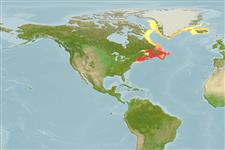
| Native range | All suitable habitat | Point map | Year 2050 |
|
| This map was computer-generated and has not yet been reviewed. |
| Sebastes fasciatus AquaMaps Data sources: GBIF OBIS |
Upload your photos and videos
Pictures | Google image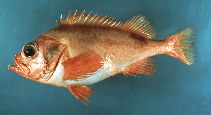 Sebastes fasciatus
Picture by Flescher, D.
Pictures | Google image
Picture by Flescher, D.
Classification / Names Common names | Synonyms | Catalog of Fishes(genus, species) | ITIS | CoL | WoRMS | Cloffa
Teleostei (teleosts) > Perciformes/Scorpaenoidei (Scorpionfishes) > Sebastidae (Rockfishes, rockcods and thornyheads) > Sebastinae
Etymology: Sebastes: Greek, sebastes = august, venerable (Ref. 45335).
Etymology: Sebastes: Greek, sebastes = august, venerable (Ref. 45335).
Environment: milieu / climate zone / depth range / distribution range Ecology
Marine; demersal; depth range 70 - 592 m (Ref. 5951), usually 128 - 366 m (Ref. 5951). Temperate; 74°N - 35°N, 75°W - 13°W
Distribution Territories | FAO areas | Ecosystems | Occurrences | Point map | Introductions | Faunafri
Northwest Atlantic: Gulf of St. Lawrence to shelf waters of Nova Scotia in Canada. Northeast Atlantic: off Iceland and western Greenland (Ref. 4570).
Length at first maturity / Size / Weight / Age
Inhabits shallow water; rocky or clay-silt bottom (Ref. 5951). Bears live young. Gregarious during all life. Feeds on euphausiids, decapods, mysids, small mollusks and fishes. Ovoviviparous (Ref. 4570). A long-lived species with estimated life span of 30-50 years, slow growing and has low fecundity. Late juveniles (11-20 cm total length) were primarily associated with boulder reefs that have deep interstices amongst the boulders; as well as in exposed boulders that do not have crevices along their lower margins, but are surrounded by dense patches of cerianthid anemones, Cerianthus borealis. The use of both boulder and cerianthid habitats are either on an encounter basis, regardless of habitat saturation or predation pressure, or because boulder reefs serve as recruitment habitats, and cerianthid habitats serve as a conduit for redfish moving away from saturated boulder reef sites (Ref. 58487).
Life cycle and mating behavior Maturity | Reproduction | Spawning | Eggs | Fecundity | Larvae
Ovoviviparous (Ref. 4570).
Main reference
Upload your references | References | Coordinator | Collaborators
Robins, C.R. and G.C. Ray, 1986. A field guide to Atlantic coast fishes of North America. Houghton Mifflin Company, Boston, U.S.A. 354 p. (Ref. 7251)
IUCN Red List Status (Ref. 130435: Version 2025-2)
Endangered (EN) (A1bd); Date assessed: 01 August 1996
CITES
Not Evaluated
Threat to humans
Harmless
Human uses
FAO - Fisheries: species profile; Publication: search | FishSource | Sea Around Us
More information
Population dynamics
Growth parameters
Max. ages / sizes
Length-weight rel.
Length-length rel.
Length-frequencies
Mass conversion
Recruitment
Abundance
Growth parameters
Max. ages / sizes
Length-weight rel.
Length-length rel.
Length-frequencies
Mass conversion
Recruitment
Abundance
Life cycle
Reproduction
Maturity
Maturity/Gills rel.
Fecundity
Spawning
Spawning aggregations
Eggs
Egg development
Larvae
Larval dynamics
Reproduction
Maturity
Maturity/Gills rel.
Fecundity
Spawning
Spawning aggregations
Eggs
Egg development
Larvae
Larval dynamics
Anatomy
Gill area
Brain
Otolith
Gill area
Brain
Otolith
Physiology
Body composition
Nutrients
Oxygen consumption
Swimming type
Swimming speed
Visual pigments
Fish sound
Diseases & Parasites
Toxicity (LC50s)
Body composition
Nutrients
Oxygen consumption
Swimming type
Swimming speed
Visual pigments
Fish sound
Diseases & Parasites
Toxicity (LC50s)
Genetics
Genome
Genetics
Heterozygosity
Heritability
Genetic Diversity
Genome
Genetics
Heterozygosity
Heritability
Genetic Diversity
Human related
Aquaculture systems
Aquaculture profiles
Strains
Ciguatera cases
Stamps, coins, misc.
Aquaculture systems
Aquaculture profiles
Strains
Ciguatera cases
Stamps, coins, misc.
Tools
Special reports
Download XML
Internet sources
AFORO (otoliths) | Aquatic Commons | BHL | Cloffa | Websites from users | Check FishWatcher | CISTI | Catalog of Fishes: genus, species | DiscoverLife | DORIS | ECOTOX | FAO - Fisheries: species profile; Publication: search | Faunafri | Fishipedia | Fishtrace | GloBI | Google Books | Google Scholar | Google | IGFA World Record | OceanAdapt | OneZoom | Open Tree of Life | Otolith Atlas of Taiwan Fishes | Public aquariums | PubMed | Reef Life Survey | Socotra Atlas | TreeBase | Tree of Life | Wikipedia: Go, Search | World Records Freshwater Fishing | Zoobank | Zoological Record
Estimates based on models
Preferred temperature (Ref. 123201): 0.8 - 7.8, mean 5.2 °C (based on 147 cells).
Phylogenetic diversity index (Ref. 82804): PD50 = 0.5000 [Uniqueness, from 0.5 = low to 2.0 = high].
Bayesian length-weight: a=0.01023 (0.00682 - 0.01535), b=3.13 (3.01 - 3.25), in cm total length, based on LWR estimates for this species & Genus-body shape (Ref. 93245).
Trophic level (Ref. 69278): 3.2 ±0.2 se; based on diet studies.
Resilience (Ref. 120179): Low, minimum population doubling time 4.5 - 14 years (tm=5.5).
Prior r = 0.07, 95% CL = 0.05 - 0.11, Based on 1 full stock assessment.
Nutrients (Ref. 124155): Calcium = 31.1 [11.9, 105.5] mg/100g; Iron = 0.275 [0.114, 0.699] mg/100g; Protein = 17.6 [16.4, 18.8] %; Omega3 = 1.34 [0.56, 3.30] g/100g; Selenium = 39.4 [14.5, 112.6] μg/100g; VitaminA = 28.4 [8.6, 92.1] μg/100g; Zinc = 0.469 [0.244, 0.840] mg/100g (wet weight);