-

- About this page
- Languages
- User feedbacks
- Citation
- Uploads
- Related species
-



Upload your photos and videos
Google image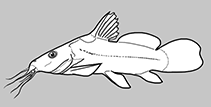 No image available for this species;
drawing shows typical species in Auchenoglanididae.
Google image
drawing shows typical species in Auchenoglanididae.
Classification / Names Common names | Synonyms | Catalog of Fishes(genus, species) | ITIS | CoL | WoRMS | Cloffa
Teleostei (teleosts) > Siluriformes (Catfishes) > Auchenoglanididae (Flatnose catfishes)
Etymology: Notoglanidium: Greek, noton = back + Greek, glanis = a fish that can eat the bait without touching the hook; a cat fish; diminutive (Ref. 45335); maculatum: The species name maculatus, Latin for spotted, refers to the colouration of the species (Ref. 94168).
More on author: Boulenger.
Etymology: Notoglanidium: Greek, noton = back + Greek, glanis = a fish that can eat the bait without touching the hook; a cat fish; diminutive (Ref. 45335); maculatum: The species name maculatus, Latin for spotted, refers to the colouration of the species (Ref. 94168).
More on author: Boulenger.
Environment: milieu / climate zone / depth range / distribution range Ecology
Freshwater; demersal; pH range: 6.0 - 7.2; dH range: 2 - 14. Tropical; 22°C - 25°C (Ref. 2059)
Distribution Territories | FAO areas | Ecosystems | Occurrences | Point map | Introductions | Faunafri
Size / Weight / Age
Short description Identification keys | Morphology | Morphometrics
Dorsal soft rays (total): 16 - 22; Anal spines: 0; Anal soft rays: 10 - 12; Vertebrae: 35. Diagnosis: Notoglanidium maculatum differs from other species in the genus in having: very small eyes, eye diameter 3.3-5.3% of head length vs. 6.0-13.3% in all other species except N. pallidum; a rather large interorbital distance, 35.3-36.8% of head length vs. larger in N. thomasi and less than 34% in all other species except N. macrostoma; a small combined premaxillary tooth plate width, 10.5-13.6% of head length vs. more han 13.6% in all other species except N. pallidum and N. thomasi; and a greater number of soft dorsal-fin rays, 16-22 vs. less than 16 in other species except N. thomasi (Ref. 94168).
Body shape (shape guide): elongated.
Body shape (shape guide): elongated.
Life cycle and mating behavior Maturity | Reproduction | Spawning | Eggs | Fecundity | Larvae
Main reference
Upload your references | References | Coordinator | Collaborators
Geerinckx, T., E. Vreven, M. Dierick, L.V. Hoorebeke and D. Adriaens, 2013. Revision of Notoglanidium and related genera (Siluriformes: Claroteidae) based on morphology and osteology. Zootaxa 3691(1):165-191. (Ref. 94168)
IUCN Red List Status (Ref. 130435: Version 2025-2)
Vulnerable (VU) (B1ab(iii)); Date assessed: 16 April 2020
CITES
Not Evaluated
Threat to humans
Harmless
Human uses
FAO - Publication: search | FishSource |
More information
Trophic ecology
Food items (preys)
Diet composition
Food consumption
Food rations
Predators
Food items (preys)
Diet composition
Food consumption
Food rations
Predators
Ecology
Ecology
Ecology
Population dynamics
Growth parameters
Max. ages / sizes
Length-weight rel.
Length-length rel.
Length-frequencies
Mass conversion
Recruitment
Abundance
Growth parameters
Max. ages / sizes
Length-weight rel.
Length-length rel.
Length-frequencies
Mass conversion
Recruitment
Abundance
Life cycle
Reproduction
Maturity
Maturity/Gills rel.
Fecundity
Spawning
Spawning aggregations
Eggs
Egg development
Larvae
Larval dynamics
Reproduction
Maturity
Maturity/Gills rel.
Fecundity
Spawning
Spawning aggregations
Eggs
Egg development
Larvae
Larval dynamics
Anatomy
Gill area
Brain
Otolith
Gill area
Brain
Otolith
Physiology
Body composition
Nutrients
Oxygen consumption
Swimming type
Swimming speed
Visual pigments
Fish sound
Diseases & Parasites
Toxicity (LC50s)
Body composition
Nutrients
Oxygen consumption
Swimming type
Swimming speed
Visual pigments
Fish sound
Diseases & Parasites
Toxicity (LC50s)
Genetics
Genome
Genetics
Heterozygosity
Heritability
Genetic Diversity
Genome
Genetics
Heterozygosity
Heritability
Genetic Diversity
Human related
Aquaculture systems
Aquaculture profiles
Strains
Ciguatera cases
Stamps, coins, misc.
Aquaculture systems
Aquaculture profiles
Strains
Ciguatera cases
Stamps, coins, misc.
Tools
E-book | Field guide | Identification keys | Length-frequency wizard | Life-history tool | Point map |
Catch-MSY |
Special reports
Download XML
Internet sources
AFORO (otoliths) | Aquatic Commons | BHL | Cloffa | Websites from users | Check FishWatcher | CISTI | Catalog of Fishes: genus, species | DiscoverLife | ECOTOX | FAO - Publication: search | Faunafri | Fishipedia | Fishtrace | GloBI | Google Books | Google Scholar | Google | IGFA World Record | OneZoom | Open Tree of Life | Otolith Atlas of Taiwan Fishes | PubMed | Reef Life Survey | Socotra Atlas | TreeBase | Tree of Life | Wikipedia: Go, Search |