
|
Tyrannophryne pugnax Regan & Trewavas, 1932 |
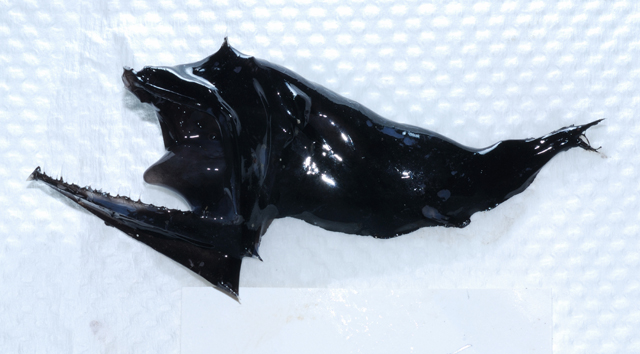
|
|
photo by
Ho, H.-C. |
| Family: | Oneirodidae (Dreamers) | |||
| Max. size: | 4.7 cm SL (female) | |||
| Environment: | bathypelagic; marine; depth range 400 - 2100 m | |||
| Distribution: | Pacific Ocean: Eastern Central Pacific (Ref. 40966); western and central Pacific, including South Pacific (Ref. 86949). | |||
| Diagnosis: | Dorsal soft rays (total): 5-5; Anal soft rays: 5-5. Metamorphosed females distinguished by having an extremely large oblique mouth; elements of upper and lower jaws extending posteriorly far beyond the base of the pectoral fin and opercular opening; vomerine teeth present or absent; well developed sphenotic spines; well-developed symphisial spine on lower jaw; elongate and tapering angular, forming long narrow spine; hypomandibula with two heads; small quadrate spine, however, longer than articular spine; deeply notched posterior margin of opercle; short and broad subopercle, dorsal end rounded, ventral end nearly circular; toothless pharyngobranchial II; caudal fin lacking internal pigmentation; extremely short illicium, almost totally enveloped by tissue of esca in smaller specimens; well developed first ray of dorsal fin; dorsal fin rays 5; anal fin rays 5; short and broad pectoral fin lobe, shorter than longest rays of pectoral fin; pectoral fin rays 18-20; skin naked, lacking dermal spinules; darkly pigmented skin of caudal peduncle extends well past base of caudal fin (Ref. 86949). | |||
| Biology: | ||||
| IUCN Red List Status: | Least Concern (LC); Date assessed: 11 October 2018 Ref. (130435) | |||
| Threat to humans: | harmless | |||