
|
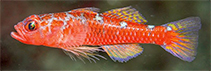
Trimma caesiura Jordan & Seale, 1906 Caesiura pygmygoby |
|
|
photo by
Erdmann, M.V. |
| Family: | Gobiidae (Gobies), subfamily: Gobiinae | |||
| Max. size: | 3.5 cm SL (male/unsexed) | |||
| Environment: | reef-associated; marine; depth range - 70 m | |||
| Distribution: | Western Pacific: Chesterfield Banks and New Caledonia to Samoa. Reported from the Ryukyu Islands (Ref. 559). Resembles Trimma naudei and Trimma okinawae (Ref. 1602). | |||
| Diagnosis: | Dorsal spines (total): 7-7; Dorsal soft rays (total): 7-8; Anal spines: 1-1; Anal soft rays: 8-9. Diagnosis: frontal ridge behind the orbits slopes steeply into a wide interorbital trench anteromedially, and into postorbital trenches laterally; posterior nasal opening separate from anterior margin of eye; elongate first dorsal spines absent; fifth pelvic fin ray branched once dichotomously; body red-orange with four white dorsolateral spots between caudal region and origin of second dorsal; no white ventrolateral spots; facial pattern with two thin, diffuse white diagonal lines under orbit and one over preopercle (Ref. 57688). | |||
| Biology: | Inhabits clear lagoon and seaward reefs; within crevices and caves of mostly dead coral rock and sandy rubble bottom (Ref. 9710, 57688). Solitary (Ref. 90102). | |||
| IUCN Red List Status: | Least Concern (LC); Date assessed: 07 September 2021 Ref. (130435) | |||
| Threat to humans: | harmless | |||